
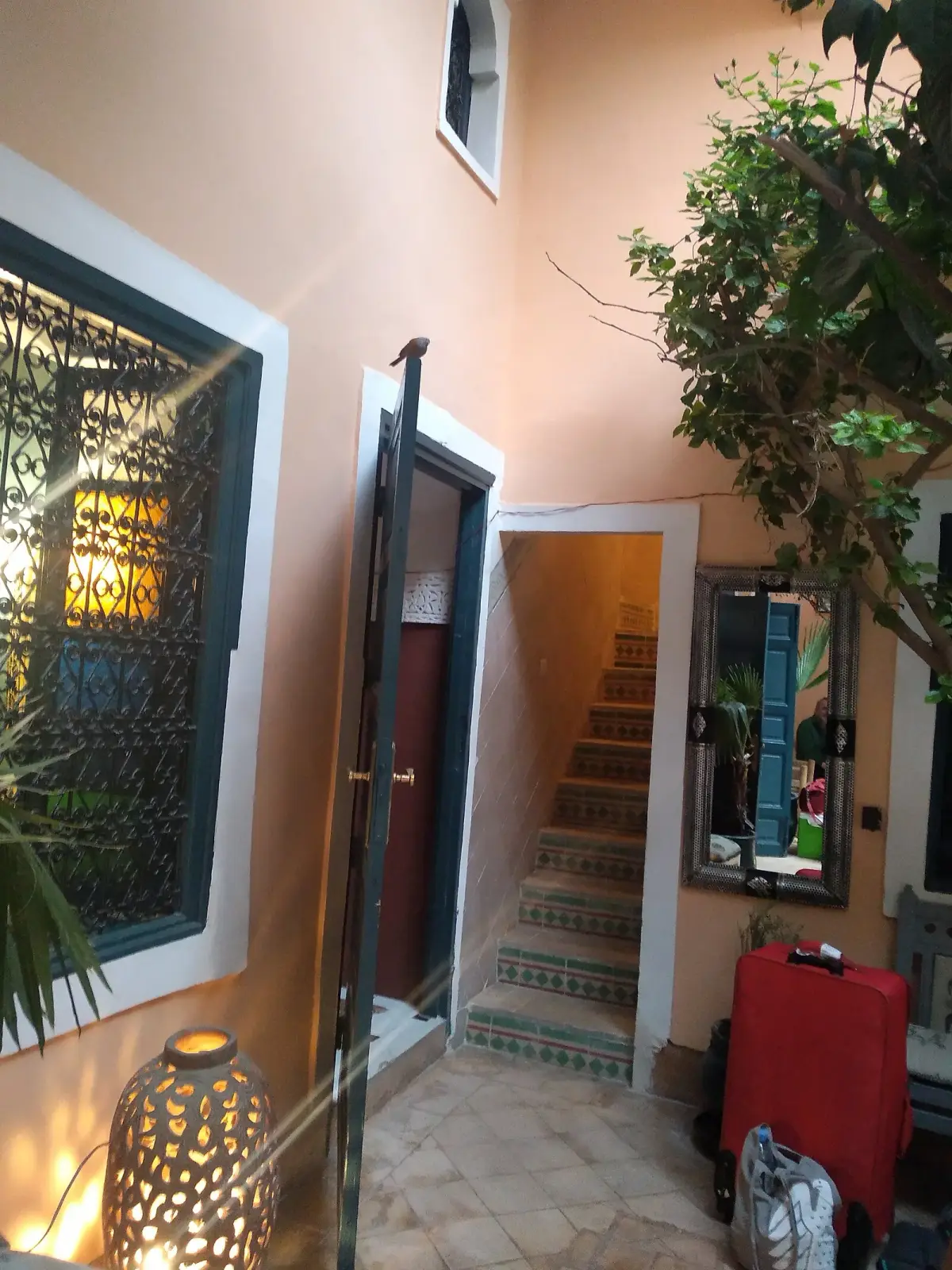
1. Two logics of value for the same property
It is one of the most misunderstood questions among riad owners: "how much is my riad worth?" does not have one answer, but two — depending on what is being valued. As long as the riad is lived in (by the owner, a family, or sold to be lived in), it is a residential asset: its value is read by comparison with similar riads in the medina. As soon as it operates as a guesthouse, it becomes an asset whose value depends on what it produces: occupancy, rates, operating margin.
The RICS Red Book standards formalise this duality. For a residential riad, the comparative method (VPS 3) is central. For an operated riad, VPGA 4 — Valuation of trading property and businesses applies: the establishment is valued as a going concern, taking into account its operating performance.
2. The residential riad: comparison per sqm of medina
When the riad is not operated commercially, the expert reasons as for any property of character, with the specifics of the medina. The comparative method relies on transactions of similar riads, adjusted line by line.
- Comparison criteria: area, patio configuration, number of levels, presence of a terrace, state of conservation, quality of original features (zellige, gebs, carved wood), accessibility from the gates and tourist routes.
- Heritage value: a well-preserved riad of character carries an architectural value that adds to the intrinsic value — documented, with photographs and descriptions in support.
- Cross-check by income: the expert can inject a market economic rent (ERV) and a yield observed on the segment, to check the consistency of the result — without thereby tipping into an operating logic.
At this stage, no goodwill is valued, no clientele, no brand. The riad is worth what a fine medina riad is worth — no more, no less.
3. The guesthouse: profit-earning capacity and VPGA 4
When the riad is operated as a guesthouse, the bricks are no longer more than one of the supports of value. What matters is the capacity of the whole to generate a result — what VPGA 4 calls valuing the property as an operational entity. The approach is then based on cash flows:
- Accommodation revenue = rooms × occupancy rate × ADR (Average Daily Rate), hence the RevPAR (Revenue Per Available Room = occupancy × ADR).
- Ancillary revenue: catering (F&B), spa / hammam, services.
- Operating expenses: staff, energy, laundry, marketing, OTA commissions — hence the GOP (Gross Operating Profit).
- FF&E reserve (Furniture, Fixtures & Equipment): reserve for renewing furniture and equipment.
The going-concern value then incorporates three inseparable components: the bricks, the goodwill (clientele, reputation, contracts, classification) and the equipment needed for the operation. It is not the sum of separately valued parts, but the value of a functional whole.
4. The tipping criteria: when do we stop comparing to value cash flows?
The line is not declarative. It is not because an owner plans to operate their riad that it must be valued as a trading property: valuing an activity that does not exist would mean inventing cash flows. The expert looks for three bundles of concrete indicators.
- The operating licence and classification: the opening to the public of a tourist establishment in Morocco is governed by Law 61-00 of 3 October 2002 on the status of tourist establishments, and the classification of guesthouses falls under Order no. 1751-17 of 14 August 2017. Without a licence or classification, one cannot presume a sustainable operation.
- The revenue history: occupancy rate, ADR, RevPAR and GOP documented over several financial years. An operation with no accounts is a hypothesis, not a basis of value.
- The real operating structure: staff in place, OTA contracts (Booking, Airbnb), online reputation and rating, established goodwill. This is what distinguishes a guesthouse from a riad let occasionally.
As long as these elements are lacking, the riad remains a residential asset — possibly with an operating potential mentioned qualitatively, but not quantified as if it were acquired. When they are met, it is the performance that speaks, and the residential comparison becomes secondary.
5. Why the expert sometimes presents a dual valuation
For an operated riad, it is not uncommon to present two values in parallel: the residential value (the bricks, by comparison, as if selling to a buyer who wishes to live there) and the going-concern value (profit-earning capacity). This dual reading is not a luxury: it answers a RICS obligation to explicitly define the basis of value adopted, and it informs the decision.
- When the dual valuation is useful: an owner hesitating between reselling the riad as a prestige residence or transferring it as a going business; a buyer who wants to know whether they are paying for bricks or for goodwill; an estate or joint-ownership exit file requiring a neutral value.
- The operating value is not mechanically the higher: a profitable, well-classified operation can yield a going concern above the value of the bricks; a loss-making or single-operator-dependent operation can, conversely, be worth less than the riad sold empty. The comparison reveals whether the activity creates or destroys value relative to the residential use.
The basis ultimately adopted depends strictly on the purpose of the engagement — property sale alone, business transfer, global transfer, financing, estate. It is this purpose, and not the property in isolation, that commands the method.
6. The purpose commands the basis — decision table
- Sale of the riad for housing → residential basis, comparative method (VPS 3).
- Global transfer of an operating riad-guesthouse → going concern, VPGA 4, with breakdown bricks / goodwill / FF&E.
- Bank financing → the bank generally requires the value of the bricks (mortgage base), sometimes supplemented by the operating value.
- Estate or joint-ownership exit on a non-operated riad → residential basis, possibly supplemented by an FF&E inventory.
- Transfer of the business alone (without the bricks) → valuation of the activity, never used alone in a transaction where the property ownership changes hands.
This purpose-led reasoning is exactly the one an expert applies to set the market value of an atypical asset: the method follows from the use, never the other way round.
7. What an independent appraisal brings
On a riad, an error of basis of value is costly: overvaluing a riad simply lived in by lending it cash flows it does not generate, or undervaluing a high-performing guesthouse by comparing it to empty bricks. An independent appraisal report compliant with RICS (Red Book) standardsdecides by documenting the file — legal (land title or Melkia, licence, classification), operating (accounts, occupancy, ADR, contracts, FF&E) and physical (areas, condition, heritage) — then by making explicit the basis adopted and, if relevant, the dual valuation.
Our RICS-certified experts produce these reports across Morocco, in 5 to 8 days (48-72h express), from 3,500 MAD excl. VAT, with a firm quote within 24h. Recall that a private appraisal serves the negotiation and decision between the parties (sale, estate, joint ownership, financing): in a judicial context, it is the judge who appoints the expert.
8. FAQ
Is a riad always valued at its hotel capacity?
No. A riad lived in, or sold to be lived in, is valued as a residential property — by comparison with similar riads in the medina (VPS 3). The profit-earning-capacity logic (going concern, VPGA 4) only applies when the riad actually operates as a guesthouse: licence, revenue history, staff, clientele. Below that threshold, valuing a trading property would mean quantifying an activity that does not exist.
What tips it toward a trading-property valuation?
Three bundles of indicators: an operating licence and a classification (guesthouse within the meaning of Law 61-00 and Order 1751-17); a documented revenue history (occupancy, ADR, RevPAR, GOP over several financial years); and a real operating structure (staff, OTA contracts, goodwill). Met together, these elements mean the operating performance determines the value, and VPGA 4 takes over from the residential comparison.
Why present two values for the same riad?
Because the basis of value depends on the purpose, not on the property alone. For an operated riad, the expert can establish the residential value (bricks, by comparison) and the going-concern value. Depending on the purpose — property sale, business transfer, global transfer, estate — one or the other is the most relevant. The dual valuation makes the choice explicit, in line with the RICS obligation to define the basis adopted.
Is the operating value always higher?
Not necessarily. A high-performing, well-classified operation can yield a going concern above the value of the bricks; a loss-making or single-operator-dependent operation can be worth less than the riad sold as a prestige residence. Comparing the two bases reveals whether the operation creates or destroys value relative to the residential use.
What documents does the expert ask for to decide?
On the legal side: land title or Melkia documentation, any operating licence and classification certificate. On the operating side: accounts and revenue statements over several financial years, occupancy and ADR statistics, OTA contracts, employment contracts, FF&E inventory. On the physical side: areas, condition of the building, heritage features. The analysis of this file determines the basis of value — residential, trading property, or both in parallel.
Residential riad or guesthouse? Have the right basis of value decided.
RICS-certified experts — comparative valuation (bricks) and/or going concern (VPGA 4), dual valuation where relevant, in 5 to 8 days (48-72h express). Reports compliant with RICS (Red Book) standards, across Morocco, from 3,500 MAD excl. VAT.
Note: Methodological article. The classification and operation of guesthouses fall under Law 61-00 and Order no. 1751-17; the bases and methods of valuation cited (VPS 3, VPGA 4) come from the RICS Red Book. The basis of value adopted depends on the purpose of your engagement — confirm your legal situation with your notary. To have your riad valued, see our property appraisal page or the property blog.