
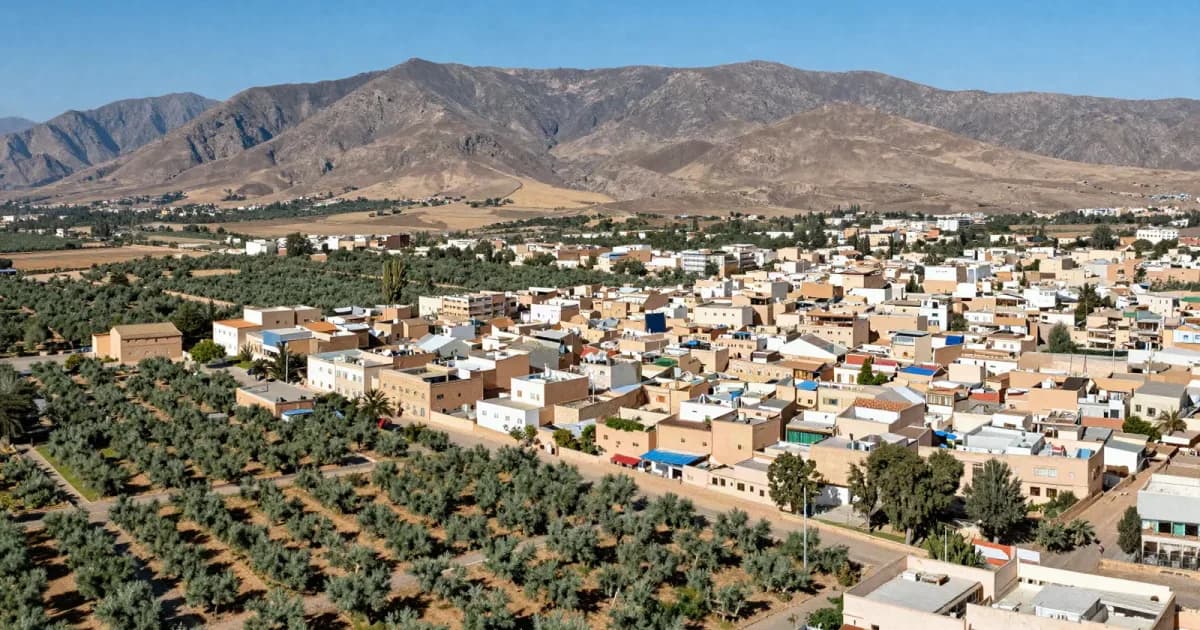
1. The economic profile: irrigated farming, agri-industry and emigration savings
The economy of Beni Mellal and its hinterland rests first on the irrigated farming of the Tadla scheme: citrus, sugar beet, olive, fodder crops and dairy farming. Around that agricultural base an agri-industry has grown — processing units, dairy and olive cooperatives, packing — along with a regional trading function that makes the town the convergence point of a vast rural catchment. To which is added a construction sector driven less by local employment than by the savings of emigration.
The area of influence extends well beyond the regional capital: Fkih Ben Salah, Kasba Tadla, Souk Sebt Oulad Nemma and Afourer form with Beni Mellal a set of satellite towns where the same logics repeat — irrigated land, family construction, movement back and forth between Morocco and abroad.
That is the most structuring feature of this market: the region is one of the main historic heartlands of emigration to northern Italy and to Spain. Many families there count two, sometimes three generations settled abroad. The direct property consequence: a significant share of the residential stock and of the land was acquired or built thanks to remittances, in a family and estate logic rather than a yield logic. The property has often never been put on the market — and therefore never confronted with a real price.
2. Property types and the valuations commonly asked for
- The self-built family house: the « emigrant's house », built in stages as remittances arrived, often oversized against local demand, sometimes unfinished at one or two levels. Valued for partition, buying out shares or putting it on the market.
- Apartments and income blocks in town: market value, security for lending, contribution to a company, the choice between letting and reselling.
- Agricultural land in the irrigated scheme: valued on the actual agricultural use.
- Urban land and plots on the edges of Beni Mellal, Fkih Ben Salah or Kasba Tadla: care needed on tenure, plot boundaries and effective buildability.
- Retail premises and small agri-industrial units: stores, packing units, cooperative premises — the valuation must separate the walls from the activity carried on inside them.
- Douar property that is unregistered, often in long-standing undivided ownership, where the appraisal begins with observation and description.
3. Local tenure specifics: melk, collective regimes, self-building and blurred boundaries
Valuing at Beni Mellal and in the Tadla runs into a superposition of tenure situations that must be identified before anything else. Melk property coexists here with land under collective regimes and, in the douars, with unregistered property whose proof of ownership rests on traditional deeds and family memory. Those three regimes do not offer the same liquidity, nor the same capacity to be sold or given in security — and that shows up in the value.
A second specific: agricultural land inside the irrigated scheme, whose agricultural use governs the value. Effective access to water, the crops grown, fragmentation and access weigh far more than speculative considerations. Moving land from agricultural to building use is an administrative decision, not a valuer's assumption: without a document establishing it, the valuer does not value a potential that does not legally exist. That is stated plainly in the report, together with what would remain to be checked with the competent administrations.
A third specific, the most visible on the ground: construction carried out in stages, at the rhythm of remittances, without complete permission or a certificate of compliance. A ground floor finished and occupied, a first floor in shell, a second at structure stage — with none of the administrative documents keeping up. To which are added real areas that often differ from the documents and imprecise plot boundaries, which call for a boundary marking with the parties present where neighbours or co-heirs do not agree. A valuer who merely read a title would miss the property entirely.
4. The central case: succession between the Tadla, Italy and Spain
The scenario recurs endlessly. A parent dies at Beni Mellal or in a Tadla village. The heirs are spread between the home town, northern Italy, Spain, sometimes France. The estate includes a family house built in stages, possibly agricultural land and a retail unit. Some want to sell, others want to keep, a co-heir offers to buy out the others. And nobody agrees on what the whole is worth.
That is exactly the role of an independent valuation: producing a neutral, reasoned and documented value that serves as a common basis for the partition. It holds up in arm's-length negotiation and in contradictory debate, and it stops the division being settled on figures passed by word of mouth — failing which the price a cousin says he heard for a house in the neighbourhood remains the only reference available. On property that has never been marketed, the gap between rumour and documented value is often considerable, and it is that gap which blocks families for years. The procedure for the deed of inheritance before adoul establishes who inherits; the appraisal establishes what of.
The other reasons for an assignment in the region are more classic, but just as frequent:
- Security for lending: the value adopted for a financing, a local investment or taking over a business.
- Selling from a distance: an owner settled in Italy or Spain wants a defensible asking price without depending on the sole opinion of a local intermediary.
- Keep or sell: the family house costs money in upkeep and produces nothing; the decision deserves to be taken on a value, not on attachment.
- Insurance value on a reinstatement-cost basis: for self-built construction, that cost is often poorly captured by existing policies.
- Contribution to a company: bringing land or premises into a structure, notably when setting up an agri-industrial or trading business.
5. How an assignment run from Italy or Spain works
Beni Mellal is outside our six main cities (Casablanca, Rabat, Marrakech, Tangier, Fez, Agadir): we work there on request, with travel time, and a quote within 24 hours. The sequence is designed for a client who cannot get away: the instruction comes from abroad, from a co-heir or the family's representative.
The valuer travels to the site — Beni Mellal, Fkih Ben Salah, Kasba Tadla, Souk Sebt Oulad Nemma, Afourer and their surroundings. They observe the condition of the fabric and its level of completion, measure the real areas, examine the immediate surroundings — access, neighbours, services, position relative to the irrigated scheme for land — and document with photographs and video so that those who have not seen the property for a long time see it as it is. The report is delivered remotely and explained by video call if needed, which allows heirs from three countries to gather around the same document. From 3,500 MAD excluding tax, travel costs quoted separately.
6. What you get
Founded in 2019, ReaConsult has carried out more than 5,000 appraisals, with client reviews published on our Google profile, and works from six cities in Morocco. Our RICS-certified experts document the condition, the level of completion, the measured areas, the tenure position as it stands, the comparables adopted and the value that follows — with the method and the limits set out. A report usable with a lender, between co-heirs spread across three countries, or in a remote sale negotiation. It is documented and verifiable line by line and imposes itself on nobody; where a matter reaches court, the court appoints its own expert.
7. FAQ
How is a family house at Beni Mellal built with emigration savings valued?
The valuer starts neither from invoices nor from the amount invested over the years. They observe the real condition on site, measure the areas actually built — often different from those on the documents — check the level of completion and compliance of the successive floors, examine the title or its absence, then set all of it against the evidence for the sector. What the family spent is not what the market pays: it is precisely that gap the report documents.
Is irrigated agricultural land in the Tadla worth the same as building land?
No. The value of irrigated land is read first in its agricultural use: effective access to water, the crops grown — citrus, sugar beet, olive, fodder — access and fragmentation. Moving to a building use is an administrative decision, not a valuer's assumption. Without a document establishing it, the valuer does not value a potential that does not legally exist; they describe the situation and flag what remains to be checked with the competent administrations.
We are heirs between Beni Mellal, Italy and Spain: how do we have the property valued remotely?
One co-heir, or the family's representative, commissions the appraisal from abroad. The valuer travels to Beni Mellal, Fkih Ben Salah, Kasba Tadla or Souk Sebt Oulad Nemma, observes the condition, the areas and the surroundings, documents with photographs and video, then delivers the report remotely and explains it by video call if needed. The value obtained is neutral and documented: it holds up in arm's-length negotiation and in contradictory debate, and stops the partition being settled on hearsay figures. Intervention on request with travel time, a quote within 24 hours, from 3,500 MAD excluding tax plus travel costs quoted separately.
A property at Beni Mellal or in the Tadla? The assignment can be run entirely from Italy, Spain or France.
Request an assessment →Related articles
Note: this article describes market situations and an appraisal method; it is neither legal advice nor an estimate. Tenure status, the devolution of an estate, building permissions and the buildability of a plot are matters for the notary, the adoul and the competent administrations. A private appraisal informs the decision and the arm's-length negotiation. No price per square metre is quoted here — the value of a property in the Tadla is established property by property, on site. To instruct us, see our contact page or the property blog.