
1. The context (anonymised)
Our client, an institutional investor, was contemplating the acquisition of an existing cold storage platform, with a view to letting it to a specialised logistics operator associated with the project. The site, close to the roads serving the port and the market-gardening production areas, handles export flows: reception, pull-down to temperature, buffer storage and order preparation, with a seasonality set by the agricultural campaigns.
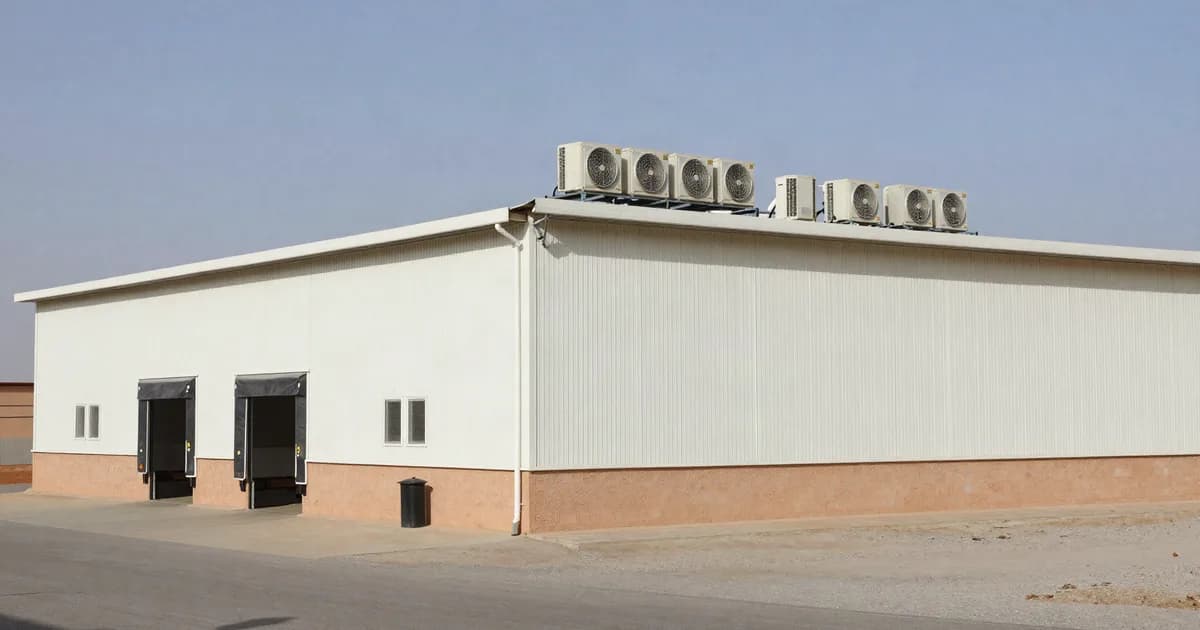
- The asset: a building with several cold rooms at distinct temperature regimes, a reception and dispatch area under docks, plant rooms housing the refrigeration production, plus offices and staff facilities.
- The market: a region where demand for refrigerated capacity is structurally tied to the export campaigns, with a limited number of players and therefore limited market depth for this type of asset.
- The purpose of the assignment: to inform an acquisition decision — buy, renegotiate or walk away — and to provide a documented base that holds up in arm's-length negotiation and in contradictory debate with the seller.
2. The brief and its constraints
- Two articulated deliverables, not two parallel reports — the client did not want a technical audit on one side and a valuation on the other: it asked that every technical finding be traced through to its effect on value, or explicitly set aside as having none.
- A constrained exclusivity timetable — the negotiation window called for a tight investigation campaign, with a single complete technical visit, prepared in advance by a list of documents sent to the seller.
- A clear basis of value — market value on the assumption of continued operation, the asset being intended to remain a cold store. Any alternative assumption — conversion to ambient warehousing, for instance — had to be treated as a sensitivity test and not as the principal basis, in line with the VPS.
- An explicit boundary to the assignment — property due diligence replaces neither the legal audit of title and contracts, nor the financial audit of the operation, nor the health checks carried out by the competent bodies. That perimeter was written into the terms of engagement (VPS 1) with the exact extent of investigations (VPS 2).
3. The challenges specific to the asset
- Cold is a chain, not a piece of equipment — refrigeration production, distribution, insulation of the envelope, air locks and air curtains, control, supervision: the failure of one link degrades all the rest. The analysis covered the whole chain, not the plant room alone.
- The insulated envelope ages without warning — sandwich panels, joints, thermal bridges, fixings: their condition governs energy consumption and the ability to hold the temperature regimes, and therefore directly the commercial usability of the site.
- Refrigerants are a regulatory subject on a known horizon — the nature of the refrigerants in service determines obligations on leak-tightness, on checking and, in time, on replacing the installations concerned. That point was identified as a future commitment to be provided for, not as compliance already secured.
- The slab and the docks drive productivity — flatness, permissible loads, condition of the joints, dock levelling, the number and equipment of the bays, refrigerated air locks: all determine throughput and safety, and putting them right is heavy and disruptive on an occupied site.
- Energy and its back-up — available capacity, condition of the incoming substation, back-up arrangements in the event of an outage: on an asset where a prolonged interruption compromises the goods, redundancy is not a comfort, it is a condition of operation.
- Export approvals do not automatically follow the walls — the site's fitness to receive the health approvals required for export depends on both the fabric and the operator. Distinguishing what belongs to the building from what belongs to the future operator's organisation was essential.
- Shallow market depth — few comparable transactions on Moroccan cold stores: direct comparison could serve only as a sanity check, which gave more weight to depreciated replacement cost and to the income approach.
4. The method, step by step
The assignment ran in seven stages, the technical audit feeding the valuation and not the reverse:
- Step 1 — scoping and extent of investigations (VPS 1, VPS 2): terms of engagement setting out the basis of value, the valuation date, the property perimeter, the explicit limits of the intervention and the points referred to the client's other advisers.
- Step 2 — document review and data room: title and plans, building and operating permissions, maintenance contracts for the refrigeration installations, history of interventions, energy consumption records, storage contracts in force and documents relating to approvals. A missing document is itself information: every gap was listed.
- Step 3 — site inspection (VPGA 8): a complete, documented visit — envelope and roof, cold rooms and air locks, plant room, docks, slab, services, plant rooms and staff facilities — with photographic record and time-stamped findings. Inspecting during a period of activity allowed the site to be observed in real conditions.
- Step 4 — qualifying the property perimeter (VPGA 5): a methodical sorting between what belongs to the building — structure, insulated envelope, slab, docks, fixed services — and what belongs to the specialised refrigeration production equipment and installations. That split determines what enters the property value, what is valued separately, and what is excluded.
- Step 5 — list of blocking items and deferred capex: findings ranked at three levels — what must be dealt with before operations resume, what must be dealt with in the short term, and what is routine maintenance — with, for each, the nature of the works, their urgency and their effect on operations. That list became the backbone of the negotiation file.
- Step 6 — valuation by two converging approaches: on one side depreciated replacement cost, suited to a specialised asset with shallow market depth — reconstructing the cost of renewing the building and the installations qualified as property, then depreciating for physical deterioration, functional obsolescence and economic obsolescence; on the other an income approach based on the marketable storage capacity and the seasonality of the campaigns, tested in discounted cash flow. The deferred capex identified at step 5 is deducted explicitly, and not drowned in a yield.
- Step 7 — cross-checks and sensitivities (VPS 3): comparison against the few market references available on logistics assets in the region, testing the value on a conversion-to-ambient assumption — a useful floor — and presenting the effect on value of an early replacement of the refrigeration installations, of a poor export campaign and of a change of operator.
5. The outcome (qualitative)
Significant technical points emerged during the visit and the document review — some were not mentioned in the sale pack. Once those findings were translated into works to be undertaken and into future regulatory commitments, the conclusion showed a significant gap against the asking price, not because the asset had been overvalued in absolute terms, but because the price implicitly assumed a site ready to use. The report delivered a defensible value on a going-concern basis, together with the ranked list of blocking items and the assumptions adopted. The investor pursued the negotiation with a documented case, asking both for a price adjustment and for contractual guarantees on the most uncertain items. No amount is disclosed here: reinstatement costs, capacities and yields depend on each site, each campaign and the market cycle.
6. What it teaches
- On a technical asset, the audit comes before the value — valuing a cold store without having opened the plant room is estimating an assumption, not a building.
- Deferred capex is deducted, not diluted — bringing it in explicitly makes the conclusion legible and negotiable; burying it in a yield makes it indisputable, and therefore useless.
- The property-versus-plant split must be written down — VPGA 5 provides the framework: what is property, what is plant, what is outside the perimeter.
- Future regulatory obligations are present commitments — a replacement of installations known in advance weighs on today's value, even if it is not yet due.
- Property due diligence does not replace the other audits — legal and financial remain indispensable; the valuer's usefulness is to bridge the physical condition of the site and its value.
- A list of blocking items is worth more than a figure alone — it is what structures the renegotiation and the guarantees asked from the seller.
ReaConsult, founded in 2019, carries out more than 1,000 appraisals a year — over 5,000 assignments in total — in 6 Moroccan cities, with client reviews published on our Google profile. Our RICS-certified experts work on specialised industrial and logistics assets, with reports consistent with the RICS Red Book. Our assignments start at 3,500 MAD excluding tax for simple assets; an acquisition due diligence is quoted individually. Firm quote within 24 hours.
Secure your acquisition before you sign. Property due diligence and valuation: technical audit, blocking items, documented value.
Request an assessment →Related articles
Note: this case study is anonymised and strictly methodological — a model case drawn from real assignments, no detail of which identifies a client, a site, an operator or a transaction. The figures of the assignment are not disclosed: costs, capacities, storage tariffs and yields depend on each installation and on the market cycle. Health approvals, operating permissions and the compliance of installations fall to the competent authorities and specialists. Property due diligence replaces neither the legal audit nor the financial audit. The value of a real asset always results from a case-by-case analysis conducted on documents and on site. To instruct us, see our contact page or the property blog.