
What the property company owns is a right to receive a licence fee — not a power plant. Everything in the valuation follows from that sentence.
1. The context (anonymised case)
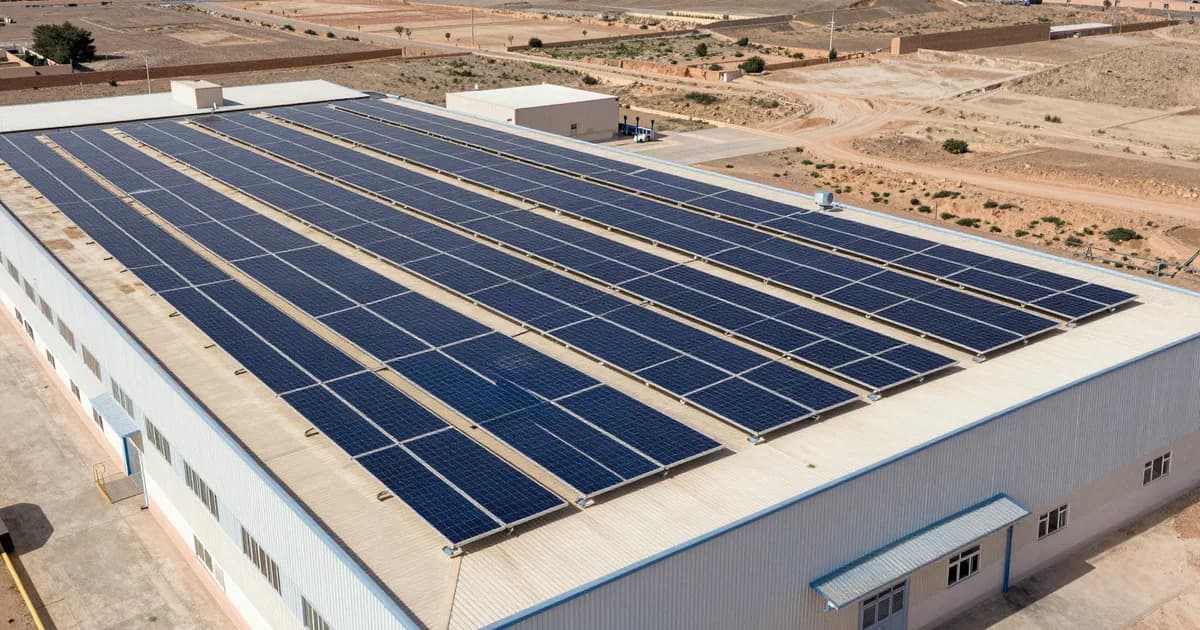
Our client, a logistics property company, owns a set of recently built warehouse units in the industrial belt of Casablanca, occupied by a single user under a commercial lease. A few years after completion, the owner granted an energy operator an agreement to occupy the roofs for the installation and operation of a photovoltaic plant. The operator financed, installed and runs the equipment; the property company receives a licence fee; the logistics occupier consumes part of the electricity generated.
- Occupation — a single tenant at ground level for the logistics activity, a third-party occupier on the roof for electricity generation: two independent contracts, two counterparties, two horizons.
- Environment — an active Casablanca logistics market in which demand for quality warehousing remains firm, set against a broader Moroccan expansion of renewable generation that is making this kind of arrangement steadily more common.
- Purpose of the instruction — a valuation of the asset for the property company's periodic reporting and for the preparation of a refinancing: in other words a documented value, one whose every step can be checked line by line and argued out at arm's length.
2. The brief and its constraints
- Define the property scope — the client's first question was in fact the right one: what exactly is being valued? The buildings and the land, yes. The panels, mounting structures, inverters and cabling, owned by the energy operator, no: they are not components of the building and they sit outside the scope of a property valuation. That framing was written into the terms of engagement in black and white, in line with the VPS.
- Do not conflate two kinds of income — the client wanted a single value, but that value had to be built by separating the logistics rent from the roof licence fee, whose risk profile, residual duration and counterparty differ radically.
- Assess the effect of the plant on the building itself — the question put to us was whether the presence of the installations improved, degraded or left unchanged the value of the bare structure: waterproofing, load on the frame, insurance and, above all, future re-lettability.
- A single valuation date and a report compliant with the RICS Red Book (VPS 3), readable by a third party with no prior knowledge of the file.
3. The challenges specific to the asset
- A roof is a finite asset, and it has been given away — by granting a long occupation, the owner has tied up a surface it can no longer deploy freely: future extension, new roof lights, major re-roofing, change of use of the building. That loss of freedom has a financial counterpart, but it also carries a flexibility cost that must be named.
- Waterproofing, the number one subject — who answers for a defect arising beneath the installations? Who removes and reinstates the panels on the day the covering has to be renewed, and at whose expense? A close reading of the contractual allocation of responsibility feeds directly into the long-run maintenance budget adopted in the analysis.
- The fate of the equipment at expiry — dismantling at the operator's cost, transfer to the owner for value or for nothing, or renewal: the three scenarios carry neither the same value nor the same risk, and the agreement has to be read to its final clause.
- The re-lettability of the building — will a future logistics occupier accept a building whose roof is held by a third party with a permanent right of access for maintenance? The answer depends on the quality of the drafting and on the perceived value of the electricity consumed on site.
- Insurance and fire safety — electrical installations on a roof change the way the risk reads: intervention routes, emergency isolation, compartmentation. These points were recorded as factors of uncertainty, without standing in for the opinion of the relevant specialists.
- A thin pool of comparables — Moroccan warehouses fitted out on the roof and sold in that configuration remain rare: the comparable approach could only serve as a sense-check on the bare structure, never as the primary method for the whole.
4. The methodology, step by step
The instruction followed a six-stage sequence built around one simple principle: separate before recomposing.
- Stage 1 — scope and bases of value (VPS 1, VPS 4): a written definition of what is being valued — land, buildings, fixed installations belonging to the owner — and of what is expressly excluded, namely the generating equipment held by the energy operator. The assumptions adopted were stated, in particular the normal continuation of both contracts.
- Stage 2 — inspection and technical characterisation (VPGA 5): site visit, examination of the covering, of the fixing points and of the technical routes, assessment of the additional load imposed on the frame and of the general condition of the waterproofing. VPGA 5 supplies the thread here: distinguishing what is integral to the building and passes with it from what belongs to a third party and has no business being valued as property.
- Stage 3 — legal reading of both contracts: the logistics lease — residual unexpired term, indexation, recoverable outgoings, reinstatement obligations — and the roof occupation agreement — duration, licence fee and the mechanism by which it evolves, access rights, waterproofing and maintenance responsibilities, insurance, the fate of the installations at expiry.
- Stage 4 — separate treatment of the two streams: the logistics rent was assessed by the income approach, with the passing rent tested against market rental value and the residual unexpired term taken into account. The roof licence fee was treated for what it is — a contractual income of long but finite duration, attached to a counterparty and to an installation — and discounted over its own horizon, without an automatic terminal value.
- Stage 5 — recomposition and consistency test: a reasoned addition of the two components, after verifying that nothing had been counted twice, then a comparison of the total with the value of the same building assumed free of any roof occupation. The gap between the two readings is precisely the measure of what the agreement brings — and of what it costs in flexibility.
- Stage 6 — cross-checks and sensitivities: comparison of the bare structure with observable Casablanca logistics evidence, a depreciated replacement cost test on the property element, then a presentation of the effect on value of a non-renewal of the agreement at expiry, of the owner having to bear a re-roofing programme, and of a vacancy of the logistics tenant.
5. The outcome (qualitative)
The report set out a defensible value, built stream by stream and then recomposed — appreciably different from what the two incomes added together and capitalised at the logistics market yield would have produced. The analysis showed that the contribution of the roof agreement was real but bounded, and that it had to be read net of the commitments it imposes on the owner: permanent third-party access, maintenance constraints, rigidity in the event of a restructuring of the building. Above all, it dispelled a common confusion by making clear that the plant, owned by the operator, was not a property asset of the client: what the property company holds is a right to receive a licence fee, not a power plant. That point was set out explicitly, which spared everyone a sterile discussion. No amounts are given here: fees, rents and yields depend on each contract and each market.
6. The lessons
- Scope is defined before value — panels, inverters and structures belonging to a third party are not property; writing it into the terms of engagement saves months of misunderstanding.
- Two streams, two rates — a logistics rent and an infrastructure licence fee share neither counterparty, nor horizon, nor risk: capitalising them together manufactures a false value.
- A licence fee comes to an end — it is discounted over its contractual term; assuming perpetuity is a strong assumption, to be justified or discarded.
- Waterproofing and access are value questions — they are contractual clauses before they are technical ones, and they translate directly into long-run outgoings.
- Lost flexibility has a price — a roof occupied for many years narrows the owner's future options: the valuation must account for it, in one direction or the other.
7. What the report is for
The conclusions are built to be argued with: named assumptions, cited sources, a stated methodology — documented and verifiable line by linerather than defensible in a block. This is a private valuation: it informs a decision and an arm's-length negotiation. Our reports are prepared by RICS-certified experts and comply with Red Book standards.
ReaConsult has been advising owners, occupiers and investors since 2019, with more than 5,000 valuations completed, offices in 6 cities and client reviews published on our Google profile. Our valuations start at 3,500 MAD excl. tax for standard assets; a fitted logistics estate is a specialist instruction quoted case by case. Firm quote within 24 hours, delivery in 5 to 8 days, 48-72 hours on the express service.
Warehouse, platform or factory fitted out on the roof? Have the building and the roof agreement valued separately, with the flexibility cost priced in.
Request a valuation →Related articles
Note: this case study is anonymised and strictly methodological — a typical case drawn from real instructions, in which no detail allows a client, a site, an operator or a transaction to be identified. The figures of the instruction are not disclosed: rents, licence fees, durations and yields depend on each contract, each counterparty and prevailing conditions. Questions of grid connection, generation authorisations and installation safety fall to the competent authorities and specialists. The value of a real asset always follows from a case-by-case analysis conducted on documents and on site. To instruct us, see our contact page or the property blog.