
1. The context (anonymised)
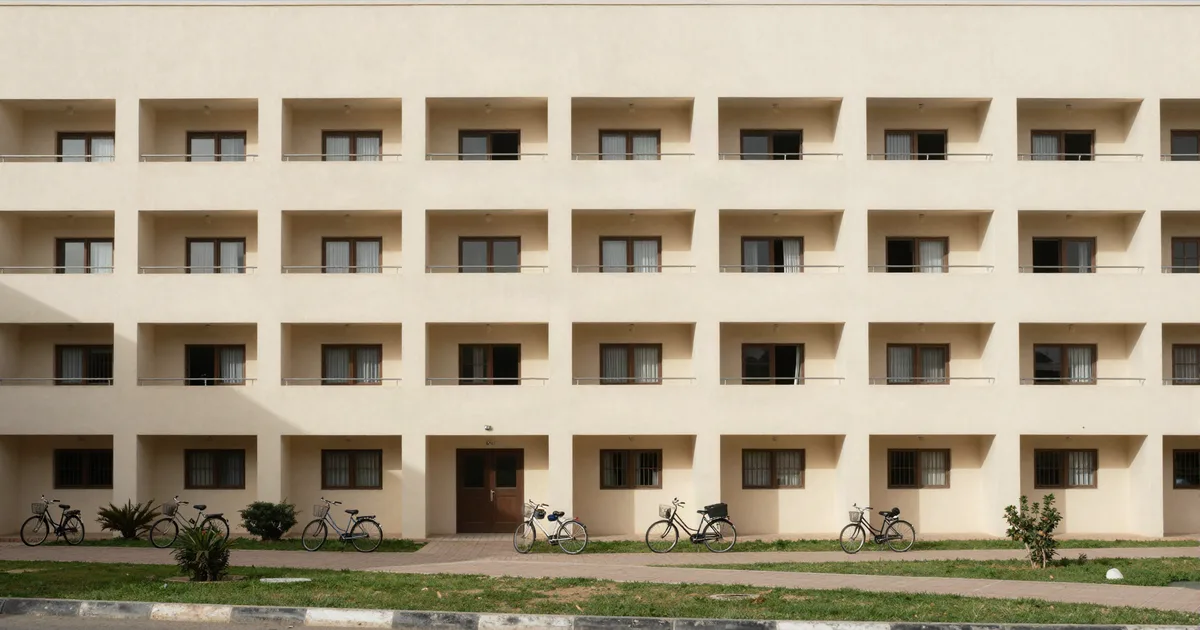
Our client, a private Moroccan investor, owns a student residence built or restructured for that use: single rooms, twin rooms and studios, common areas, a study room, a laundry, reception and security. The location is the heart of the file — a dense university sector of Agdal, within walking distance of major schools and faculties, on a demand catchment fed each year by students from other cities of the Kingdom.
- Occupation: operation is entrusted to a specialist manager, who handles marketing, reception, routine maintenance and the relationship with families.
- Environment: structural student letting demand, but competed with by diffuse house-sharing in ordinary apartments in the quarter and by institutional provision.
- Purpose of the assignment: to establish a market value of the asset in operation, with a view to estate arbitrage and a discussion with a financial partner.
2. The brief and its constraints
- A report consistent with the VPS — the terms of engagement set the perimeter, the basis of value, the valuation date, the assumptions and the limits on use, in line with the Red Book VPS applicable to any valuation report.
- Settling the nature of the asset — residential property generating rents, or a trading asset whose value depends on a service delivered? That classification is not cosmetic: it commands the method, the unit of account and the vocabulary of the report.
- Income to be adjusted — the advertised monthly price is an all-inclusive price covering charges, internet, cleaning and security. The client wanted to understand what, inside that price, remunerates the property and what remunerates a service.
- Documenting the relationship with the operator — nature of the contract, term, remuneration, maintenance obligations and exit conditions: the financial partner wanted to know which income it could count on, and on what conditions.
3. The challenges specific to the asset
- Income forms per bed — a well-designed twin room produces more than a studio of equivalent floor area; conversely a studio re-lets more easily outside the start of term. Reasoning in dirhams per square metre erases that reality and leads mechanically to a wrong value. The valuer therefore reconstructs income by bed category, distinguishing single rooms, twin rooms and studios.
- An all-inclusive price is not a rent — it aggregates a property component and a services component (utilities, connectivity, cleaning, security, activities). Capitalising that gross figure means valuing a service at the yield of a building: the classic error, and the costliest.
- The academic calendar sets the rhythm — occupancy tracks the university year, with a structural summer void, a start of term that sometimes shifts by course, marketing campaigns concentrated into a few weeks and a near-total turnover of the stock every year. A calendar accounting period says nothing about that seasonality: occupancy has to be read month by month, over several successive academic years.
- Arrears, guarantees and collection — solvency often rests on a parental guarantee; the guarantee arrangement, the deposit policy and collection discipline are part of the analysis of income actually collected, not merely invoiced.
- The operator, two very different configurations — under a management contract the owner receives the operating result and carries its risk: the asset is then analysed as a trading asset, in the spirit of VPGA 4, the operator working on the owner's behalf. Under a firm lease granted to the operator, the owner collects a contractual rent and the operating risk shifts to the operator: a letting logic applies, and the quality of the tenant's covenant becomes a central parameter.
- Replaceability of the operator — a residence whose operation depends on non-substitutable know-how is worth less than one another manager could take over without disruption. The level of service promised to families must also be economically sustainable over time.
- Furniture ages fast — beds, desks, storage and shared kitchens face intense turnover and rapid wear; without a renewal reserve provided for each year, the reported income is artificially flattered and the value overstated.
- Compliance and safety — collective accommodation of young adults: the requirements applicable to premises open to the public, fire safety, circulation, emergency lighting and access control are examined in the condition survey and flagged as assumptions, without substituting for the competent authorities or an approved inspector.
4. The method, step by step
The assignment was conducted as the valuation of an income-producing asset, framed by VPS 3 for the content and form of the report, and worked in the spirit of VPGA 4 where the operator acts on the owner's behalf — the asset then behaving as a trading unit:
- Step 1 — qualifying the asset and the contract: reading the contract between owner and operator, to settle between a « management contract » and a « firm lease » configuration. That qualification determines what follows: risk profile, the nature of the flow to be capitalised, and the principal method.
- Step 2 — inspection and inventory by bed category: a complete visit (single rooms, twin rooms, studios, sanitary facilities, common areas, reception, plant rooms), measurement of areas, condition of the fabric, condition and age of the furniture, review of safety arrangements and access.
- Step 3 — reconstructing income per bed: analysis of the tariff by category, breaking the all-inclusive price between property and services, the gap between income invoiced and income collected, the weight of arrears and the effect of marketing discounts.
- Step 4 — modelling the academic calendar: occupancy reconstructed month by month over several academic years, explicit treatment of the summer void and the shifted start of term, the cost of marketing campaigns and the effect of annual turnover on the fill rate on re-letting.
- Step 5 — adjusting operating costs: reception and security staff, utilities, routine maintenance, insurance, management fees, and above all an annual provision for a reserve to renew furniture and equipment. This yields a sustainable operating result — the one a reasonably efficient operator would maintain over time.
- Step 6 — capitalisation and discounted cash flow: converting the sustainable result into value at a yield reflecting the risk profile specific to the asset — dependence on a university catchment, seasonality, management intensity, the quality and replaceability of the operator — cross-checked by a discounted cash flow analysis incorporating the furniture renewal cycle and a change-of-operator scenario.
- Step 7 — floor test through alternative use: the residence was also examined on the assumption of a return to ordinary use — a conventional income block subdivided into apartments let to the residential market of the quarter. That alternative value, net of conversion works and the time needed, serves as a lower guard rail: an operation that created no value beyond ordinary use would signal a problem with the model, not with the building.
- Step 8 — market comparison as a guard rail: references on residential property in the sector and observable benchmarks on managed residences, used to check the order of magnitude, never as the principal method.
- Step 9 — sensitivities: the report presents the effect on value of a variation in occupancy and in price per bed — the two levers every buyer or lender tests first — and the effect of a more demanding renewal provision.
5. The outcome (qualitative)
The report adopted a value based on the sustainable operating result, markedly distinct from what a naive capitalisation of the reported receipts would have produced — those receipts incorporating remuneration for services and ignoring both the summer void and furniture renewal. The alternative-use test as a conventional income block confirmed that the operation did create value beyond ordinary use, which reassured the financial partner. Above all, the file clarified the question of the operator: what the contract actually delivers to the owner, where the operating risk sits, and what a change of operator would imply. The report, documented and reasoned, holds up in arm's-length negotiation and in contradictory debate. No amount is disclosed here: rents per bed, occupancy, margins and yields vary with the residence, the quarter and the academic year.
6. What it teaches
- The unit of account is the bed — not the square metre, not the apartment. A student residence is modelled by bed category, otherwise the value is built on a measure that produces no income at all.
- An all-inclusive price gets broken down — the services share is not capitalised like property; confusing it with rent mechanically inflates the value.
- The academic calendar is part of the asset — summer void, shifted start of term, annual turnover, marketing campaigns: this is analysed by academic year, not by calendar accounting period.
- The operating contract decides the method — management contract or firm lease: two risk profiles, two flows to capitalise, two ways of writing the report.
- The renewal reserve is not optional — furniture in a student residence wears out fast; ignoring it means valuing an income the asset will not sustain.
- Alternative use provides the floor — knowing what the building is worth returned to ordinary residential use bounds the analysis from below and secures the discussion with a lender.
ReaConsult, founded in 2019, carries out more than 1,000 appraisals a year — over 5,000 assignments in total — in 6 Moroccan cities, with client reviews published on our Google profile. Our reports are produced by RICS-certified experts and are consistent with the Red Book. Our assignments start at 3,500 MAD excluding tax for simple assets; a managed residence is a specialised mandate quoted individually. Firm quote within 24 hours.
Have your managed residence valued. Student residence, serviced residence, operated building: a report consistent with the RICS Red Book.
Request an assessment →Related articles
Note: this case study is anonymised and strictly methodological — a model case drawn from real assignments, no detail of which identifies a client, an operator, an educational establishment or a transaction. The figures of the assignment are not disclosed: price per bed, occupancy, costs and yields depend on the market cycle, the quarter and the characteristics of each residence. Questions of compliance, safety and permissions fall to the competent authorities and approved inspectors. The value of a real residence always results from a case-by-case analysis conducted on documents and on site. To instruct us, see our contact page or the property blog.