
1. The photograph has become the first viewing
A buyer no longer discovers a property by pushing open an agency door: they discover it on a screen, often a phone, often in a few seconds, in the middle of a list of competing listings. At that precise moment it is neither the price nor the description that makes the difference — it is the first image. It decides whether the listing is opened or scrolled past. In other words, photography no longer illustrates the property, it presents it: it has become the first viewing.
That shift created a job. For a long time, in Morocco as elsewhere, listing photographs were taken on the fly by the negotiator during the mandate: a dark room, leaning verticals, direct flash into a mirror, a frame that cuts half the living room. Those images cost nothing to produce, but they cost a great deal in viewings that never happen. Structured agencies, developers launching an off-plan scheme and short-let managers have understood that a set of professional images is not a comfort expense: it is a marketing tool.
The consequence is real demand for a provider able to deliver, quickly and regularly, a clean set of images, a usable virtual tour and a short video for social media. That provider does not need to be an art photographer: they need to be a reliable technician and a professional counterpart. And that is exactly what can be learned.
2. The technical fundamentals that make the difference
Property photography is a narrow discipline, with few rules but strict ones. Respecting them delivers most of the result; ignoring them produces images anyone recognises immediately as amateur.
Light above all
An interior is photographed first with natural light. That means choosing the hour of the shoot according to the orientation of the rooms: a south-facing façade at midday is flattened, a west-facing living room photographs well at the end of the day. Shutters open, curtains are pulled clear, side lamps are switched on to warm the dark corners — but direct flash is banned: it flattens volumes and casts hard shadows that give the amateur away.
Straight verticals, wide focal length without distortion
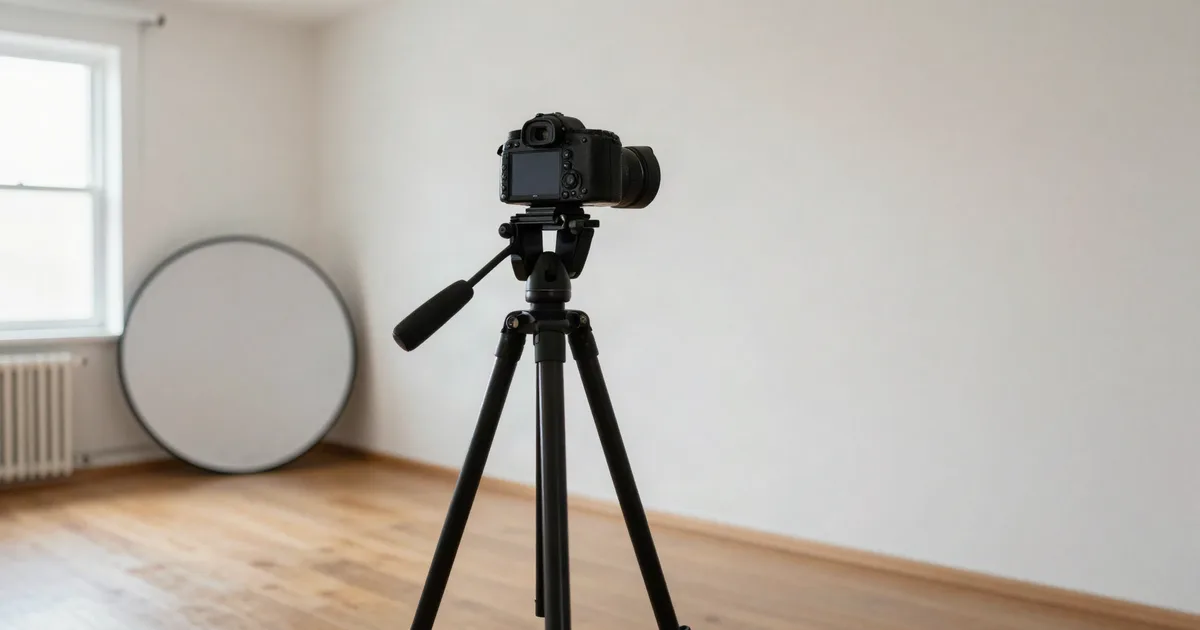
Nothing disqualifies an interior photograph faster than leaning walls. The rule is simple: sensor parallel to the floor, verticals strictly straight. That calls for a tripod with a level and a stable shooting height — often mid-height of the room rather than eye level. On the lens, a wide angle is needed to render a volume, but ultra wide angle distorts perspective and artificially inflates rooms. You want a focal length wide enough to show, never extreme enough to mislead.
Exposure, HDR and measured retouching
The recurring problem of interior photography is the brightness gap between the room and the window: expose the interior correctly and the outside burns out; make the window legible and the room goes black. The technical answer is exposure bracketing then HDR merging, provided it stays natural — heavy HDR, with its halos and unreal colours, is a fault, not a style. Retouching then corrects white balance, straightens what needs straightening, and cleans up noise and stray reflections. It stops there.
Preparing the property
A large part of the result is decided before the first shutter release: clearing worktops, removing personal objects and cleaning products, aligning chairs, closing cupboard doors, straightening rugs, switching off screens. That tidying takes twenty minutes and is often worth more than a high-end camera body.
Realistic kit to start with
- An entry- or mid-range mirrorless body, or failing that a recent smartphone used methodically — rigour counts for more than the sensor;
- A decent wide-angle lens, without excessive distortion at the edges;
- A stable tripod with a level: the most cost-effective accessory in the job, indispensable for bracketing and verticals;
- A light fill source, to lift a corridor or a windowless shower room;
- Development and retouching software, and above all a repeatable workflow so you can deliver fast.
3. 360° and 3D virtual tours: what they really change
The virtual tour is the second skill that structures the job. Technically it rests on a 360° camera set on a tripod at several points across the floor area, whose captures are assembled into a navigable path: the viewer moves from room to room, looks in every direction, retraces their steps. Current tools add an interactive floor plan — sometimes with indicative dimensions — which makes the layout intelligible at a glance, something a series of photographs never shows.
The real contribution is not spectacular, it is logistical. A virtual tour filters physical viewings: the merely curious disqualify themselves, and interested buyers arrive already informed about layout and circulation. The agency loses less time, the seller sees fewer strangers cross the living room, and the buyer loses fewer Saturdays. On empty or off-plan properties, the virtual tour makes tangible a space that the sales plan does not convey.
That benefit becomes decisive for one audience in particular: remote buyers and Moroccans living abroad. Someone who comes home two weeks a year cannot view fifteen properties: they have to arrive with a short list, already sorted from abroad. The virtual tour gives them that sorting. It is also a very concrete argument for winning a mandate against a competitor who does not offer it.
Two practical points separate a useful virtual tour from a gimmick: hosting — the tour must stay reachable through a stable link, open quickly on mobile and remain online for the duration of the marketing — and integration into the listing, meaning a visible button on the portal or the agency site, not a link lost in an email. A provider who handles both sells a service, not a file.
4. Drone, video, social media: the add-ons
Aerial work: a framework to respect
An aerial view shows what no ground-level photograph can: how a villa sits on its plot, the immediate surroundings of a development, the real proximity of a beach or a road. It is particularly asked for by developers and on prime property. But it cannot be improvised: drone use in Morocco is strictly regulated and requires prior authorisation from the competent authorities, both for the aircraft and for the intended flight. A professional provider handles that point up front, tells the client what delays it implies, and only includes aerial work in their offer once their administrative position is in order. It is a point to check with the competent authorities before any commercial commitment, never a detail to settle on the day of the shoot.
Short video for social media
Short vertical formats have become the natural distribution channel for listings on social media. The grammar differs from photography: fluid movement rather than static shots, a path that follows the logic of a viewing — entrance, living room, kitchen, bedrooms, outside — a tight duration, a hook in the first seconds, and subtitles legible without sound. A simple stabiliser and a recent smartphone are often enough to produce that format, provided the run-through has been worked out before filming.
A coherent set of deliverables
The classic mistake is to deliver sixty undifferentiated photographs. A professional deliverable is selected and ordered: an opening image that creates desire, an ordered series that follows the path through the property, formats suited to portals and to social media, and the virtual tour reachable by link. It is that coherence, more than the number of files, that the agency is buying.
5. Making it a business: clients, offers, contract and ethics
Who to sell to
- Estate agencies: recurring need, regular volume, high sensitivity to delivery time;
- Off-plan developers: scheme launches, show apartments, overall views of a development, marketing material;
- Short-let management companies: constant rotation of properties to put online, high demands on visual quality;
- Prime private owners marketing a valuable property directly and refusing a mediocre listing;
- Hotels and guest houses: seasonal refresh of visuals, rooms, common areas, outdoor spaces.
Pricing models
Three models coexist, and an established professional combines them. Per-property invoicing suits a private owner or a one-off mandate. A fixed package, calibrated by property type and floor area, makes the offer legible and avoids renegotiating on every job. A monthly retainer with an agency — a volume of properties covered each month — is the most interesting model: it stabilises income, retains the client and turns a service into a partnership. In every case the price is built on real time: travel, shoot, post-production, delivery.
Organising a shooting day
Profitability comes from organisation, not from speed of execution. An efficient day is prepared the evening before: the order of properties optimised geographically, slots chosen according to each home's orientation, confirmation that the property will be accessible and tidy, kit loaded and checked. On site, an identical run-through every time — recce, tidying, shots in a fixed order, a check before leaving — avoids the omission that forces a return trip. Post-production is then handled in batches, with consistent settings.
Contract and licensing of image rights
This is the point beginners neglect and the one that creates disputes. A written contract, however short, must set out: the deliverables and their number, the delivery time, the price and payment terms, the conditions for cancellation or postponement if the property is not accessible, and above all the extent of the licence granted over the images — for which media, for how long, with or without exclusivity, with or without credit to the author. An agency buying photographs wants to be able to distribute them with confidence; a photographer wants to know what they are granting. Thought must also be given to the owner's authorisation to distribute images of their property, and to privacy where the home is occupied.
Standing out through reliability
In a market where many people can hold a camera, differentiation is not played out on aesthetics but on consistency: arriving on time, delivering within the announced deadline, producing a homogeneous result from one property to the next, being reachable. An agency does not call back the most creative provider: it calls back the one who has never made it miss a listing going live.
The ethics of retouching: show well without lying
This is the red line of the job. A photograph must show a property well, never disguise it. Correcting white balance or straightening a vertical is part of the craft; removing a crack or a structural defect, artificially widening a volume, erasing a nuisance visible from the property or replacing a view is deception. A buyer who finds at the viewing a glaring gap between image and reality does not merely walk away: they lose trust in the agency, and the disappointment can turn into a challenge that exposes intermediary and seller alike. The right benchmark is simple: retouching is acceptable if the property, seen in the flesh, confirms the image.
And that is where the business of the image meets the business of value. A fine photograph attracts; a fair price closes. The best visuals on the market do not get an overpriced property signed: they only bring forward the moment when the market notices. A well-advised seller therefore combines the two — careful marketing and a value established by an independent appraisal, carried out by RICS-certified experts, which sets the price on market evidence rather than on hope.
6. Training: content, audience and the ReaConsult setting
A course useful to this trade does not stop at photographic technique: it covers the whole chain, from the shot to the invoice. Typical content combines:
- The fundamentals of interior shooting: reading the light, choosing hours, framing, verticals, handling backlight;
- The post-production workflow: development, exposure merging, consistency across a series, export in the right formats;
- The 360° virtual tour: capture points, assembly, interactive plan, hosting and integration into a listing;
- Short vertical video: run-through, movement, simple editing, subtitling;
- The drone framework: what may be offered, and the requirement of prior authorisation to be checked with the competent authorities;
- The commercial and contractual side: building the offer, pricing models, a template contract, licensing image rights, prospecting agencies and short-let managers;
- Ethics: what may be retouched, what may not, and why.
Who it is for: negotiators and agents who want to bring the production of their visuals in-house and win mandates; managers of short-let and accommodation businesses who publish constantly; photographers or videographers looking for a specialisation with recurring B2B demand; and career changers wanting to start a service business with moderate investment.
On format, ReaConsult Academy offers its practical modules as an in-person day at 1,500 MAD including tax and as video sessions at 150 EUR for remote participants, notably Moroccans living abroad. For organisations wanting to train several colleagues, an in-house format may be fundable through the OFPPT Special Training Contracts (CSF), subject to review of the file. Longer certification pathways run between 15,000 and 17,500 MAD. Photographing, distributing, valuing: three distinct skills which, brought together, make a complete property professional — and that is the setting ReaConsult has been building since 2019, with more than 5,000 appraisals carried out in 6 cities of the Kingdom.
Frequently asked questions
Do you need expensive equipment to start in property photography?
No. An entry-level mirrorless body with a wide-angle lens, a stable tripod and a small fill light cover most of the need. A recent smartphone, used on a tripod and with rigour on light and verticals, already produces results better than many listing photographs. What sets a professional apart is not the price of the body but command of light, framing and measured retouching, then consistency in delivery.
Does a 360° virtual tour replace a physical viewing?
It does not replace it, it filters it. A virtual tour lets a buyer understand the layout, the circulation and the volumes before travelling. It is particularly useful for remote buyers and for Moroccans living abroad, who cannot view ten properties in a week. It reduces wasted viewings and saves both sides time, but the decision to buy is almost always taken after a physical visit.
Can a drone be used freely to photograph a property in Morocco?
No. Drone use in Morocco is strictly regulated and requires prior authorisation from the competent authorities, both for the aircraft and for the intended flight. A serious provider checks their administrative position before any aerial work and tells the client what delays that implies. Flying a drone without authorisation exposes the provider and the client alike, and the resulting image becomes unusable if checked.
How far can a property photograph be retouched without misleading the buyer?
Retouching may correct what the sensor renders badly: white balance, verticals, contrast, noise, stray reflections. It must never remove a structural defect, artificially widen a volume, erase a nuisance visible from the property or invent a view. A photograph must show the property well without lying: the gap between the image and the reality found at the viewing destroys trust and can ground a challenge against the agency and the seller alike.
Make property imagery a real business. In-person day at 1,500 MAD including tax or video session at 150 EUR: technique, virtual tours and the commercial side.
Talk to us →Related articles
Note: drone use in Morocco is strictly regulated and requires prior authorisation from the competent authorities: check your position with them before any commercial commitment. The extent of image rights granted, the owner's authorisation to distribute and the privacy of occupants are contractual matters to settle in writing before the shoot. No price scale is quoted here for photographic services — it is built on the real time each assignment takes. To reach us, see our contact page or the property blog.