
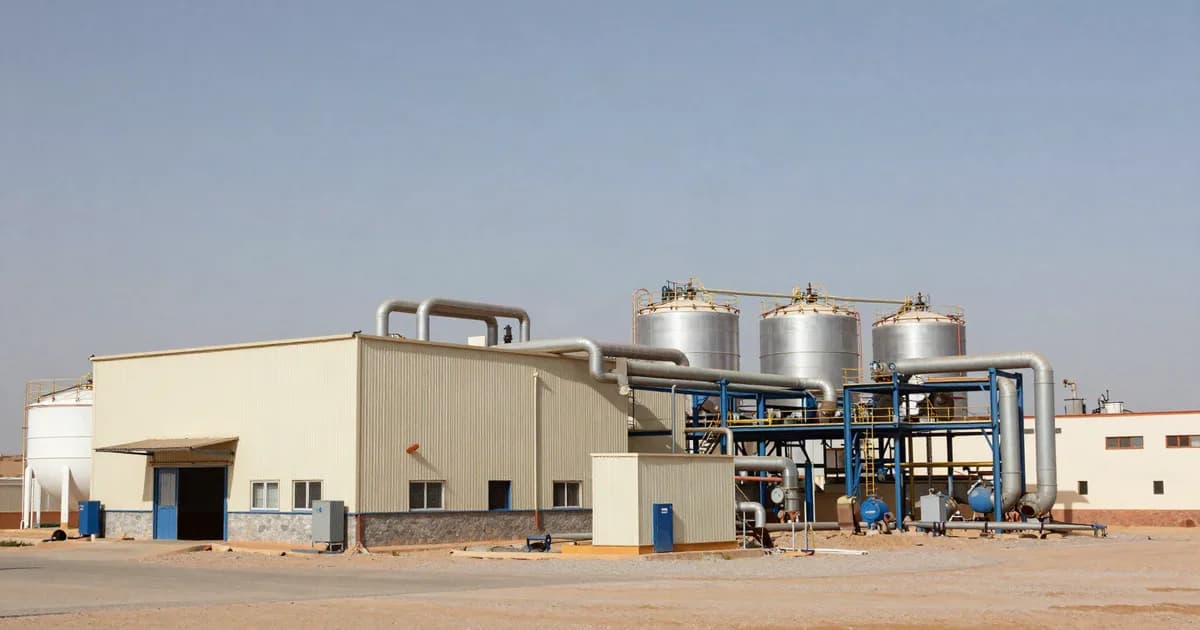
On a factory, the quality of an insurance programme is decided less by the accuracy of the figures than by where the line between fabric and process was drawn — and by whether anyone wrote it down.
1. Two assets on one site
The general principle holds here as everywhere: the sum to insure is not the market value but the cost of rebuilding the fabric as new, land excluded, adjusted to the basis of the policy and increased by fees, clearance and compliance. That much is set out in our complete guide to reinstatement cost assessment. What a factory adds is a difficulty of its own — a boundary that no other asset class has to draw with the same precision.
- The industrial building — load-bearing frame, cladding, roof, industrial floor slab, general services (main electrical distribution, plumbing, smoke extraction) and the utilities attached to the fabric. This belongs to property appraisal, and to the building heading of the policy.
- The process equipment — production lines, machines, tooling, automation. This is quantified separately, by other skills, and belongs to a heading of its own.
- The policy has to reach both — with no gap (an item nobody declared) and no duplication (an item declared twice, in the building sum and in the plant sum, inflating the premium without increasing the indemnity, which stays capped at the actual loss).
It is that articulation, more than the arithmetic, that makes an industrial programme good or bad. A building sum declared without an appraisal almost always mixes the two worlds together, and the sorting is then done after the fire, in front of the insurer's adjuster. The broader anatomy of the perimeters — fabric, plant, stock, interruption — is set out in our note on insuring an industrial or logistics building.
2. The straddling installations, qualified item by item
This is the heart of the exercise on a factory, and it cannot be done generically, because the answer is written in the wording of a particular contract rather than in any general rule. The recurring cases:
- Overhead cranes and their runway beams. The crane is handling equipment; the runway beams and the columns that carry them are frequently part of the frame, and were designed with it. Reinstating one without the other is not possible, and the two may well sit under different headings.
- Process-dedicated networks. Compressed air, steam, special fluids: pipework that serves no purpose but the process, routed through and fixed to a building that would never have carried it otherwise.
- Clean rooms. A room within a room — envelope, air handling, controlled pressure — that is simultaneously construction and equipment.
- Cold rooms and other specific chambers built into the fabric. Insulated envelopes, refrigeration plant, doors and floors engineered for the use. Sometimes an integral part of the building, sometimes a piece of equipment installed in it.
The appraisal qualifies each of these item by item, against the definitions the policy actually uses, and records the reasoning. That record is the deliverable's most useful page: it is what allows an insurer, a broker and an operations director to see the same site the same way, and it is what prevents the same item from being argued over twice.
3. What the industrial fabric costs to reinstate
Once the boundary is drawn, the fabric is costed in parts, in the vocabulary of the contract:
- Frame and weathertight envelope — foundations on the terms of the contract, load-bearing structure in steel or concrete, cladding and roof. Industrial structural work follows its own cost logic, quite unlike ordinary tertiary construction.
- The floor slab and the works at ground level — an industrial slab designed for operating loads, together with pits, drainage channels and equipment plinths. These are expensive works, and they are the single most frequently under-costed item in declared sums: they are invisible in a photograph and unforgettable in a rebuild.
- General services and the utilities attached to the building — main electrical distribution, lighting, ventilation, fire protection of the fabric, fluid networks up to the point at which they are handed over to the process.
- Professional fees — architect, structural and services engineers, technical inspection, safety coordination. Rebuilding an industrial building requires a full design team, and its cost sits on top of the works.
- Demolition and clearance — on an industrial site, removing damaged structures and debris is a project in itself, and one that declared sums routinely ignore.
4. Compliance: you rebuild to today's standards, not yesterday's
A rebuilt industrial building is rebuilt to the rules in force on the day it is rebuilt — fire safety, environmental requirements, occupational safety, planning. For an older industrial fabric, the distance between the standards it was built to and the standards it would have to meet again is often one of the heaviest items of the whole reinstatement, and it is almost never present in a sum insured that was carried forward from an original construction cost.
The point deserves emphasis because it works in one direction only. Compliance requirements accumulate; they do not lapse. A declared sum that has not been revisited in years is therefore not merely stale — it is stale in a way that systematically understates.
5. A sum insured building by building
On a multi-building site, the exposure multiplies in a way that catches out even careful operators. Depending on the terms of the policy, the average clause may be assessed building by building. A total sum that is correct in aggregate but badly distributed across the buildings can therefore leave one workshop underinsured in the middle of a site that looks, on paper, comfortably covered — and it will be that workshop that burns.
The appraisal establishes a reinstatement cost for each building, checks the coherence of the whole, and documents the distribution. Beyond the claim, that breakdown is also what makes a premium discussion an informed one rather than a matter of assertion.
6. How underinsurance settles in on an industrial site
The mechanism itself is standard, and we treat it at length in our note on underinsurance and the proportional rule: where the declared sum falls below the real value at the date of the loss, the indemnity is reduced in the same proportion, including on a partial loss. What is worth setting out here is how ordinary the routes into it are on a factory.
- A sum carried over from a depreciated book value, falling every year while construction costs rise.
- Extensions and additional workshops built over the years without the contract ever being revisited.
- Compliance works carried out and paid for, but never declared.
- A fabric-versus-process boundary that was never clarified, leaving whole structures outside every heading.
Overinsurance is the mirror: items counted twice, once in the building sum and once in the plant sum, paid for in premium year after year and never indemnified twice. Both drifts are corrected by the same exercise.
7. The method: the cost approach, and its kinship with DRC
The RICS Red Book treats insurance value as a basis distinct from market value; the corresponding technique is the cost approach (VPS 3). On industrial assets it has a direct relative: depreciated replacement cost (DRC, VPGA 5), used to value exactly the kind of specialised building that has no market comparables. The technical base is shared — establish the cost of reinstating the fabric, then reason the depreciation — which is why the two assignments sit naturally with the same practitioner. The DRC method itself is set out in our note on valuing an industrial asset under RICS methodology. In practice the assignment comprises:
- Inspection and measurement of the site — gross areas building by building, construction methods, heights, slabs, and ancillary structures (canopies, docks, gatehouses, fencing, roadways, according to the policy).
- Classifying the fabric — each generation and each type of industrial construction has its own cost structure. A recent steel-framed workshop, a concrete building from earlier decades and a high-bay store do not reinstate on the same basis.
- Qualifying the straddling installations item by item — cranes, process networks, clean rooms, specific chambers: allocated to the building heading or the plant heading, against the contractual definitions.
- Costing by component — frame, envelope, slab, general services, fees, clearance, compliance, by reference to costs observed on comparable industrial works. The cost references used are the same ones that support a turnkey industrial building valuation.
- Component depreciation — the frame does not age like the cladding, nor like the services. Where the policy indemnifies less depreciation, the deduction is reasoned component by component.
- Reconciliation with the policy — headings and definitions read, a sum insured per building, and articulation with the process figures produced elsewhere. The object is a programme with no gap and no duplication.
The report is documented and verifiable line by line, and it imposes itself on nobody: each insurer applies its own criteria. It serves to inform a decision — fixing the sums at inception or renewal, or supporting a discussion after a loss — and where a matter reaches court, the court appoints its own expert.
8. When to have the figure refreshed
- At inception or on renewal of the programme — the natural moment to replace a declared figure with a documented one, building by building.
- After any extension or new construction — an added workshop, a store, an additional storey, a large canopy. Every undeclared structure widens the shortfall across the whole site.
- After compliance works or a heavy refurbishment — reinforced fire protection, slab reconstruction, re-roofing. These investments change the cost of reinstatement.
- When construction costs have moved appreciably — materials, labour and standards make a rebuild dearer quite independently of any accounting figure. A periodic review is the only answer, at an interval suited to the site.
- Around a transaction — acquisition or disposal of the site, financing, or the restructuring of a multi-site insurance programme.
9. Instructing an assessment on an industrial site
Bring the site plan and the building drawings, the current policy schedule with its headings, and the record of works carried out since the site was built. Everything else — measurement, the inventory of the straddling installations, the condition of each component — we establish on site. Assignments are handled by RICS-certified experts in Casablanca, Rabat, Marrakech, Tangier, Fès and Agadir, and elsewhere in the country from our network — which is the usual case for industrial sites, since they rarely sit inside a city centre. Reports comply with Red Book standards and are delivered in 5 to 8 days, 48-72 hours on the express service, with a firm quote within 24 hours, from 3,500 MAD excl. tax. What we cover on industrial assets is set out on our industrial property page. ReaConsult has been advising owners, operators and institutional clients since 2019, with more than 5,000 valuations completed, offices in 6 cities and client reviews published on our Google profile.
Is the fabric-versus-process boundary on your site written down anywhere? Have the reinstatement cost established building by building, and each straddling installation qualified.
Request an assessment →Related articles
Note:this article describes an appraisal method consistent with RICS standards (Red Book, cost approach — VPS 3; kinship with DRC — VPGA 5). The average clause is a standard insurance mechanism whose application depends on the wording of each policy: refer to your own contract and advisers. The allocation of straddling installations between the building heading and the plant heading follows the contractual definitions, which prevail on every point they regulate. No percentage, rate or cost scale is quoted here — the reinstatement cost of an industrial building is established site by site. A private appraisal informs an underwriting decision and an arm's-length negotiation; it is documented and verifiable line by line and imposes itself on nobody, and where a matter reaches court the court appoints its own expert. To instruct us, see our contact page or the property blog.