
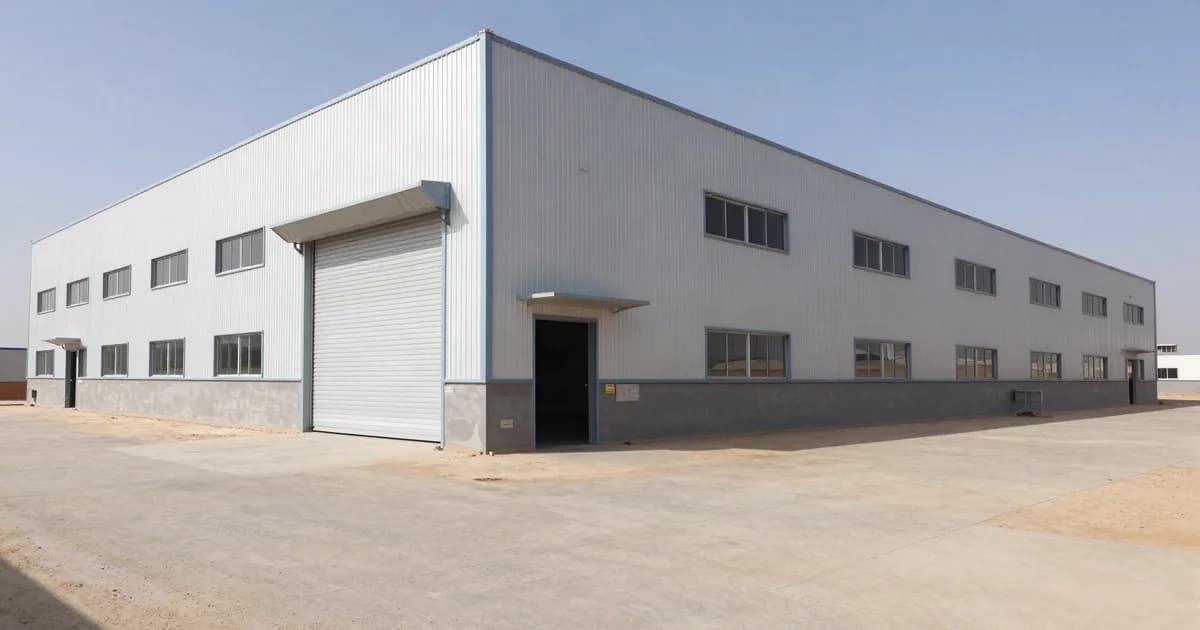
A turnkey building is a property and a contract at the same time
The standard structure brings together three parties. An occupier defines what it needs — floor areas, clear internal height, floor loading, dock levellers, electrical capacity, room to extend later. A contractor or industrial developer designs and builds it. In many cases an investor then acquires the completed asset and grants the occupier a lease. The documents that shape value are therefore the technical brief, the building contract, the lease — usually with a term certain — and the transfer deed or the agreement to purchase.
For a valuer this has a very practical consequence: the answer does not fall out of a measurement exercise. Value depends on what the building allows (whether it can be made generic again, whether it can be extended, whether a third party could take it over), on what the lease produces, and on what the contracts protect or expose. Our note on the structure and valuation of built-to-suit transactions in Morocco looks at how those agreements are typically assembled.
The construction contract and handover
What the valuer actually reads
- The technical brief — floor areas, structural grid, clear height, slab loading capacity, docks and levellers, electrical supply, fire protection, and any land held in reserve for a future extension.
- The building contract — the scope of works, the price and how it may be adjusted, the programme, liquidated damages for delay, and the conditions governing handover.
- Interim payment applications and certified progress, where the valuation is being carried out while the site is still live.
- The handover record — whether acceptance was given with or without reservations, and how far those reservations have since been cleared.
- The as-built documentation file — drawings as executed, operating and maintenance information, third-party technical inspections, certificates.
None of this is bureaucratic detail. A building whose file is complete can be sold, insured and lent against without a discovery exercise; a building handed over with an incomplete file transfers that exercise, and its cost, to whoever comes next.
Warranties
A new building benefits from the statutory and contractual warranties that Moroccan construction law and the contracts themselves provide, together with whatever insurance the parties to the works have taken out. A property valuer does not give a legal opinion on them. What the valuer does is record that they exist, note the period they run for, and note any known reservations, then draw the consequences in value terms. An asset with live warranties and a complete technical file is more liquid than one delivered without documentation. The legal analysis itself belongs to the parties' own advisers.
Value while the site is still running
Two bases, never merged. The value in its current state at the valuation date reflects what physically exists on the ground and the risk attached to finishing it. The value on completion is reported as a special assumption — that the building is delivered in conformity and on programme. Lenders use both, for different purposes: the first supports the security position today, the second supports the funding plan. Presenting one as if it were the other is the single most consequential error in a development-stage instruction.
Building, financing or acquiring a turnkey industrial facility in Morocco?
💬 Chat with a RICS-certified valuer on WhatsAppRental value: where the argument is won or lost
Contract rent is not market rental value
A turnkey building is frequently let at a rent engineered to remunerate the owner's outlay — land, construction cost, margin, spread over the term certain. That rent may sit above, at, or below what a different occupier would pay for the same shed in the local market. The valuer therefore reconstructs a market rental value from evidence of comparable industrial and warehouse units in the same catchment, and then analyses the gap. Skipping that step means valuing a covenant rather than a building.
What the gap tells you
- Rent above market. Part of the value rests on the tenant's covenant and on the unexpired term certain, not on the property. The re-letting risk at expiry has to be addressed explicitly, not assumed away.
- Rent below market. There is reversionary potential at expiry — but only to the extent the lease actually permits it to be captured. The mechanics of over-rented and under-rented positions are set out in our guide to term and reversion valuation in Morocco.
- Highly specific building. The more the fit-out has been cut to one occupier's process, the further market rental value drifts from the contract rent, and the less certain re-letting becomes.
The lease terms that move the number
Term certain and total term, indexation, the split of outgoings and structural repair, reinstatement obligations at expiry, renewal or purchase options, and the security given by the tenant: each of these feeds either the cash flow or the risk profile, and therefore the value. A heavy dilapidations or reinstatement obligation at lease end is not a legal footnote — it is a future cost, and it belongs in the analysis.
The RICS methodology in practice
Income approach
For a completed, income-producing asset this is the primary approach: a sustainable net income, capitalised at a yield that is argued from evidence, or a discounted cash flow where the lease structure requires a projection — stepped rents, rent-free periods, reversion at expiry, programmed capital works. The rates adopted are justified by observed market behaviour and by the risk profile of the specific asset. They are never adopted by convention because they are what the sector “usually” uses.
Comparable evidence
Standard industrial buildings — good clear height, dock loading, a regular structural grid — do have a rental market, and sometimes an investment market, in Morocco's principal industrial estates. Comparable evidence can then be applied directly, with the usual adjustments for location, accessibility, age, height, office content and the quality of the estate itself. Our note on the technical characteristics that define an industrial building explains why two apparently similar sheds are often not comparable at all.
Depreciated replacement cost (DRC, VPGA 5)
DRC moves to the centre when the building is heavily specific — an integrated process, bespoke fit-out, fixed plant embedded in the structure — to the point where no relevant rental market exists. The exercise is land value, plus the cost of replacing the asset with a modern equivalent, less physical, functional and economic depreciation. Our methodological guide to valuing industrial assets in Morocco works through the approach in detail. DRC also sits close to, but must never be confused with, the reinstatement cost assessment used for insurance, which answers a different question entirely.
Residual method for the land
Before anything is built, the land intended for a turnkey scheme can be read through the residual method: the value of the completed and let asset, less construction costs, professional fees, finance and the developer's required return. That is the direct bridge between an industrial development appraisal and a property valuation, and it is governed by the same standards — see our detailed treatment of the residual method under IVS 410 and VPGA 10.
The evidence a valuer will ask for
- Land and planning — the land title or occupation right (Moroccan registered titles are held at the ANCFCC, the national land registry agency), the zoning and its rules, the building permit, the status of the host estate, easements and access arrangements.
- Construction — technical brief, works contract, programme, certified interim applications, the handover record, outstanding reservations, and the as-built file.
- The building — areas by use, clear height, floor loading, structural grid, docks and levellers, the proportion of offices and welfare space, and the scope for extension.
- Services — electrical capacity, fire protection, smoke control, lighting, and any specialist utilities such as compressed air, refrigeration or air treatment.
- Occupational position — the lease signed or contemplated, term certain, indexation, outgoings, reinstatement obligations, security, and tenant covenant.
- Market — supply and demand for industrial space in the catchment, observed rental values, and the real depth of the re-letting market.
Recurring pitfalls
- Capitalising the contract rent without testing it against the market. That values a signature, not a building.
- Treating construction cost as value. A turnkey scheme can cost more than the local rental market will support, particularly where it is highly specific.
- Blending value in its current state with value on completion. Two distinct bases, to be reported separately with their assumptions stated.
- Ignoring handover reservations. Uncleared reservations are works still to come, and therefore a reasoned deduction.
- Forgetting end-of-lease reinstatement. A heavy obligation weighs on the cash flow and on the negotiation.
- Overlooking extension potential. Developable land held in reserve within the same site boundary is a real option, and should be valued as one — separately, with its conditions stated.
What the report is used for
Lending — construction facilities, mortgage security, acquisition finance for an investor: the lender wants the value in its current state, the value on completion and the market rental value, each clearly separated. Accounts, whether IFRS or Moroccan GAAP — fair value of investment property, componentisation, impairment testing, purchase price allocation. Acquisition and disposal — the build-versus-buy-versus-lease decision, and the negotiation between occupier, developer and investor. Restructuring — lease renegotiation, portfolio arbitrage, or a sale & leaseback at handover. Insurance — reinstatement cost, which is a separate exercise from market value and should never be read across from it.
ReaConsult reports are prepared by RICS-certified valuers, compliant with the RICS Red Book Global Standards, and suitable for amicable negotiation and adversarial discussion between the parties and their advisers. They are private valuations: where a dispute reaches court, the court appoints its own expert. Founded in 2019, we have completed more than 5,000 valuations across six Moroccan cities, over a thousand a year, and hold client reviews published on Google. Industrial instructions are quoted individually; fees start from MAD 3,500 excluding tax for standard assets, with a quotation within 24 hours. Questions on construction contracts, applicable warranties and the status of the host estate are matters for your own legal advisers.
Have your turnkey industrial building valued
Tell us the estate, the floor areas, the stage of construction, the lease signed or contemplated and the purpose of the valuation. English reply within 24 hours with a firm quote.