
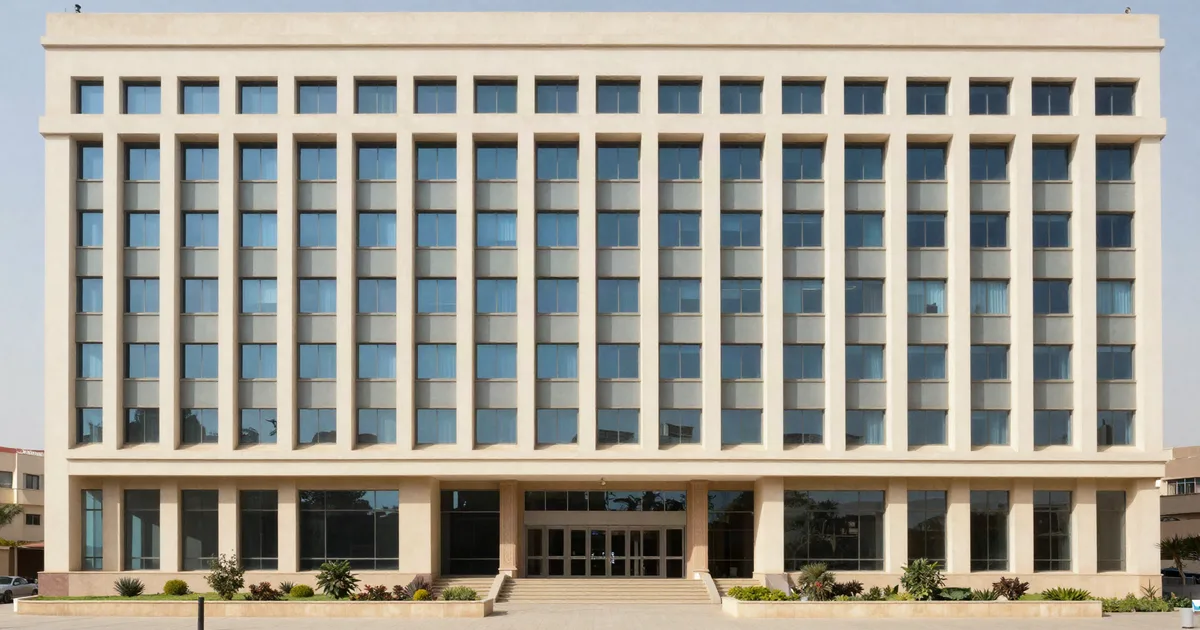
Two figures govern an office building: what it would cost to put the base building back, and what it would cost to put the occupier's fit-out back. They belong to different policies, they are almost never established together, and the gap between them is where cover disappears.
1. What an office building has that a plain building does not
The general principle is the same for every asset, and we set it out in our complete guide to reinstatement cost assessment: the sum to insure is neither the market value — land does not burn — nor an accounting figure. It is the cost of rebuilding the building as new, adjusted to the basis the policy works on. What makes a tertiary building harder to cost than most is not the structure. It is everything bolted to it.
- The weight of the technical plant. Heating, ventilation and air conditioning; lifts; building management; fire safety, from detection through smoke extraction to sprinklers where they are installed; access control; power distribution, low-current systems and standby generation. Collectively this is a large share of the reinstatement cost, and it is the part of the building most often left out of a sum insured that was estimated rather than measured.
- Facades that are an engineered product. A curtain wall is not cladding: it is a fabricated, sealed, glazed system with its own supply chain and its own installation trade. Reinstating one is nothing like rendering a wall.
- The specification level. A high-specification or certified building — full-height glazed facades, a finished entrance hall, high-performance floor plates — reinstates at a materially higher cost than an ordinary office building of the same floor area. The sum insured has to reflect the specification of this building, not an average.
The same reasoning applies floor by floor where offices are held as separate lots in a condominium, with the added complication of who owns the plant serving them — a question taken up in our note on valuing an office floor held in condominium.
2. The base building, item by item
A defensible insurance value is assembled from parts, in the vocabulary the policy itself uses:
- Structure and weathertight envelope — foundations on the terms of the policy, the frame (often long-span, to leave floor plates clear), facades including glazed and curtain-wall systems, waterproofing and roof.
- Base-building finishes — entrance halls, circulation, sanitary accommodation, risers, stairs, and the finishes of common parts and of the floor plates as handed over.
- Technical plant — HVAC, lifts, building management, fire safety, access control, power and low-current systems, standby generation. The heart of what a modern office building costs to reinstate.
- Professional fees — architect, engineering consultants, technical inspection, coordination. A rebuild of this kind requires a full design team, and its cost sits on top of the works.
- Demolition, clearance and compliance — clearing the site, then rebuilding to today's standards for fire safety, accessibility, energy performance and seismic design, not to those in force in the year of construction. On an older building this gap is a substantial item in its own right.
3. The occupier's fit-out: a second sum insured, in someone else's policy
Above the base building sits a layer that belongs, contractually, to whoever occupies: partitioning, specific suspended ceilings and raised floors, data cabling, fitted meeting and conference rooms, integrated furniture, branded reception areas. In principle the owner insures the base building and the occupier insures that layer — but the boundary is drawn by the lease, not by intuition, and fit-out incorporated into the fabric is the classic grey area.
Two consequences follow, and both cost money. Where an item falls between the two policies, nobody declared it and nobody will indemnify it. Where an item is caught by both, it has been paid for twice in premium and will still only be indemnified once, since indemnity is capped at the actual loss. An appraisal that documents the two perimeters separately is what prevents either. The same split, in its retail form — where the fit-out can be the heaviest line of all — is treated in our note on the landlord's shell and the tenant's fit-out.
4. Depreciation reasoned component by component
The policy determines the basis of indemnity — as new, or less depreciation. Where depreciation applies, a single rate across the whole building is the wrong instrument, and on an office building it is wrong by a wide margin: the frame of a tertiary building does not age at the pace of its lifts, its air conditioning or its building management system. Applying one average rate simultaneously overstates the wear on the structure and understates it on the plant.
A serious assessment therefore produces both readings — as-new and depreciated — with the deduction reasoned component by component, from the condition actually observed and the replacement cycle each component belongs to. That is also what allows the resulting figure to be slotted into the right heading of the policy, rather than presented as a single number the insurer then has to interpret.
5. The cost of time: a head office is also a place people work
For an occupying business, physical damage is only the first layer. A serious loss at a head office interrupts the activity, and the building has to be rebuilt while the organisation continues to exist somewhere: temporary premises, moving, reconnecting the systems, reinstating the working environment. All of that belongs to covers that are distinct from the insurance of the fabric.
The point worth making here is the dependency. Those operating covers are calibrated on the property figures — the value of the building and of the fit-out, and the time a reinstatement of that specification would realistically take. If the property figures are wrong, everything built on top of them is wrong too, and in the same direction. The property appraiser documents the real estate side; the company and its advisers then set the operating covers on that footing.
6. Underinsurance and overinsurance of a head office
The most common failure in the tertiary sector is a sum insured that was simply carried over from the balance sheet — a figure that falls every year through depreciation, while construction costs move the other way. The two lines diverge quietly, and the divergence only becomes visible on the day of a claim, when the average clause reduces the indemnity in proportion, including on a partial loss such as a fire confined to two floors. How that mechanism works, and what it does to a claim, is set out in our note on underinsurance and the proportional rule; the specific problem of reusing accounting figures across a corporate portfolio is treated in insuring a company's real estate assets.
Overinsurance is the mirror image and is no cheaper. A head office insured on its market value, with the land and the location effect inside the figure, pays premium every year on a basis the indemnity will never reach, since the indemnity remains capped at the actual loss. In a well-located building — and the office stock of Casablanca, Rabat and Tangier is nothing if not location-driven — that overstatement can be considerable. Either way, the distance between the declared sum and the right figure costs money: every year, or at the worst possible moment.
7. The method: the cost approach applied to a tertiary building
The RICS Red Book treats insurance value as a basis distinct from market value, and the corresponding technique is the cost approach (VPS 3). Applied to an office building, the assignment runs as follows:
- Inspection and measurement — gross areas, number of storeys, floor plates, parking and basements, construction method, facade systems, and an inventory of the technical plant and its specification level.
- Classifying the building — ordinary office building, high-specification building, tower, certified building. Each category has its own cost structure, and using the wrong one contaminates everything downstream.
- Splitting base building from occupier's fit-out — reading the lease and the policies in force, so that each component is attached to the right insurable interest.
- Costing by component — by reference to construction costs observed on comparable tertiary works: structure, facades, finishes, plant, fees, clearance, compliance.
- Component depreciation and reconciliation with the policy — reasoned deductions component by component, then a check against the contractual definitions (building, fit-out, improvements) so the figure produced fits the headings of the contract exactly.
This is private appraisal work. The report is documented and verifiable line by line, and it imposes itself on nobody: each insurer applies its own criteria. Its use is to inform a decision — fixing the sum at inception, or supporting a discussion after a loss — and where a matter reaches court, the court appoints its own expert.
8. When to have the figure refreshed
- At inception, or on changing insurer — the natural moment to replace a declared figure with a documented one.
- After works or a refit — refurbished floor plates, replacement of plant, restructuring, extension. Every investment that is never reflected in the policy widens the shortfall.
- On any significant letting event — new occupier fit-out, reinstatement at end of term, or a change in how the lease allocates the insurance obligations.
- When construction costs have moved appreciably — materials, labour and standards make a rebuild dearer without the declared sum moving at all. A periodic review is the only answer, at an interval suited to the asset.
- Around a transaction — acquisition, financing, or the restructuring of the insurance programme of a tertiary portfolio.
9. Instructing an assessment on offices or a head office
Bring the plans, the lease and the current policy schedule, plus any record of works carried out since the building was handed over. Everything else — measurement, the inventory of plant, the condition of each component — we establish on site. The deliverable sets out the description and measurement of the building, the reinstatement cost split by component, the base-building / occupier's fit-out split, the component depreciation analysis and the figure to declare on the contractual basis of the policy. Assignments are handled by RICS-certified experts in Casablanca, Rabat, Marrakech, Tangier, Fès and Agadir, and elsewhere in the country from our network. Reports comply with Red Book standards and are delivered in 5 to 8 days, 48-72 hours on the express service, with a firm quote within 24 hours, from 3,500 MAD excl. tax. What we cover on tertiary assets is set out on our office valuation page. ReaConsult has been advising owners, occupiers and institutional clients since 2019, with more than 5,000 valuations completed, offices in 6 cities and client reviews published on our Google profile.
Is the sum insured on your offices the right one? Have the reinstatement cost established by component, and the base-building / fit-out boundary documented.
Request an assessment →Related articles
Note:this article describes an appraisal method consistent with RICS standards (Red Book, cost approach — VPS 3). The average clause is a standard insurance mechanism whose application depends on the wording of each policy: refer to your own contract and advisers. No percentage, rate or cost scale is quoted here — the reinstatement cost of an office building is established file by file, from its measured areas, its construction method and the specification of its plant. A private appraisal informs an underwriting decision and an arm's-length negotiation; it is documented and verifiable line by line and imposes itself on nobody, and where a matter reaches court the court appoints its own expert. To instruct us, see our contact page or the property blog.