
Two land regimes, two levels of security
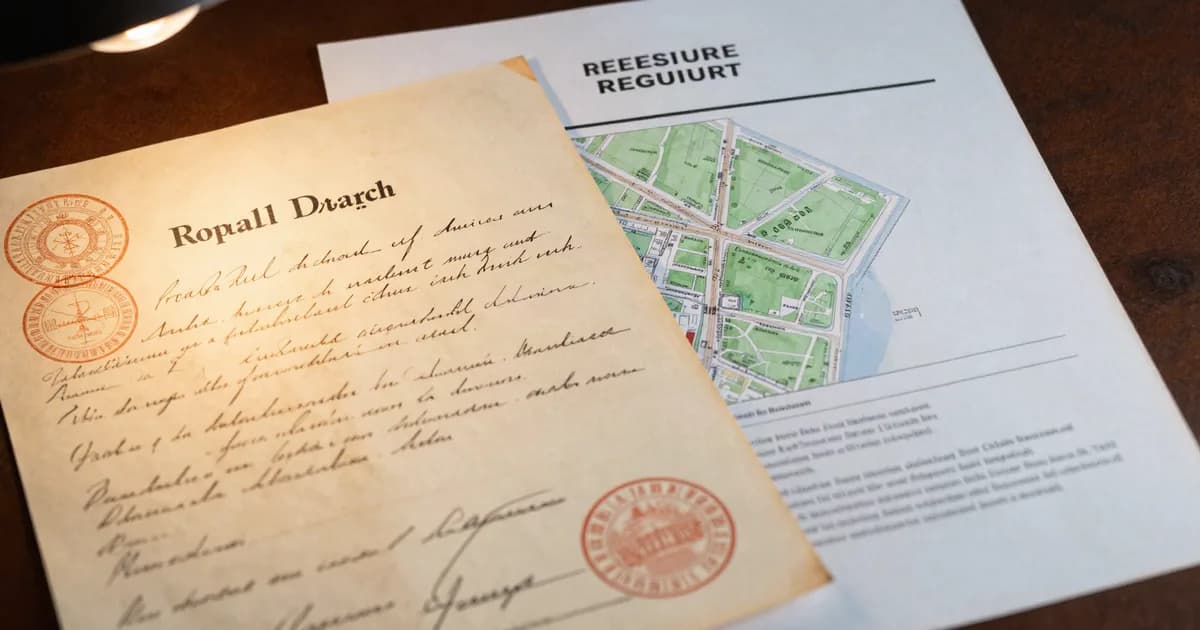
Moroccan land tenure rests on a duality that anyone advising on property in the country has to hold in their head at all times. On one side is the land registration regime, inherited from the 1913 dahir and modernised since. A registered property is entered in the land register kept by the ANCFCC — the national agency for land conservation, cadastre and cartography — identified by a title number, with a cadastral plan, a registered owner and a list of the charges affecting it. Registration extinguishes prior claims. It is, in a phrase, the regime of legal certainty, and it is the closest Moroccan equivalent to what a British or Gulf investor would recognise as a state-guaranteed register of title.
On the other side sits unregistered land, where ownership is evidenced by deeds drawn up by adouls — chief among them the moulkia, which records long, peaceful, public and continuous possession. A moulkia creates a presumption of ownership. What it does not create is a surveyed plan, a published record of charges, or the evidential force of the land register. Our detailed comparison of titled versus moulkia property sets out the practical consequences side by side.
Between the two lies a third, less comfortable category: property currently going through registration. An application has been filed and the procedure is open to third-party objections. That intermediate zone demands particular care, because rights that look settled can still be contested — see our note on oppositions to land registration and how they are lifted.
Layered over all of this are Morocco's special tenure statuses: melk (private ownership), collective land, habous, and the private and public domain of the State. Each has its own rules on transfer, its own restrictions and its own procedures. Treating them as interchangeable exposes your client and your own liability. Our overview of land tenure statuses in Morocco and their effect on value is the map most newcomers wish they had been handed on day one.
Want to learn to read a Moroccan title the way a practitioner does?
💬 Speak to a RICS-certified valuer on WhatsAppWhy land status decides everything else
In the daily practice of an agency, a valuation firm or a bank's property department, land status governs four things at once:
- Financeability. Lenders generally require a registered title in order to enter their mortgage on the register. A property held on moulkia is difficult to finance, which narrows the pool of buyers and, mechanically, the price.
- Value. All other characteristics being equal, a registered and an unregistered property do not carry the same value. The valuer's job is to qualify the land risk explicitly and reflect it in the report rather than quietly ignore it.
- Transaction security. A registered mortgage, a prenotation, a seizure, an easement or a live opposition during registration can block or vitiate a sale.
- Timescales. Regularising a land position — completing a registration, discharging a charge, exiting joint ownership — is measured in months and sometimes years. The professional who anticipates that spares their client promises that cannot be kept.
The central reflex a good course installs is simple to state and demanding to practise: obtain and read a recent certificate of ownership before any commitment, and know exactly what each entry on it means. Our step-by-step guide to verifying a land title in Morocco shows what that looks like for a buyer; a professional simply does it faster and reads more into it.
What a land law course actually covers
The programme
- Foundations. The architecture of the Moroccan land system, the role of the ANCFCC, how the land registry and the cadastre fit together, and what the Real Rights Code changed.
- The registration procedure. Application, boundary survey, publication, oppositions, judicial determination where required, and issue of the title — together with the specific risks of buying while the procedure is still running. Our article on land registration in Morocco covers the mechanics.
- Reading the title. Practical exercises on real, anonymised certificates of ownership: identifying the registered owner, mortgages, easements, prenotations and entries of seizure. This is the part that cannot be learned from a textbook.
- Special statuses. Collective land, habous, State domain — what can be transferred, what cannot, and by which procedures. Two frequently misunderstood cases are worth studying in their own right: guich land and soulaliyate collective land.
- Pre-transaction checks. A full land due diligence checklist to run before taking an instruction, before signing a preliminary agreement, and before starting a valuation.
Who it is for
The natural audiences are estate agents, valuers, notarial staff, bankrelationship managers, in-house lawyers at developers and land promoters, and wealth managers — plus any investor buying land in Morocco who would rather understand the file than delegate their judgement entirely. For readers based abroad, this material is also the antidote to the most common and most expensive assumption in cross-border property: that a Moroccan “deed” and an English or Emirati title are the same instrument. They are not.
A subject that is learned on real files
Land law is not absorbed in the abstract. The reflexes form by handling actual certificates of ownership, cadastral plans, opposition files and joint-ownership situations. That is the deliberate bias of training run by practising valuers: every concept is anchored to a file encountered on the ground — an encumbrance discovered too late, a cadastral area that differs from the area sold, a registration application struck by an objection.
ReaConsult, a property valuation practice founded in 2019 and present in 6 Moroccan cities, handles these situations continuously: every valuation instruction starts with an analysis of the land status of the asset. That practice — more than 5,000 appraisals completed — feeds directly into the training material of ReaConsult Academy, which has run 21 sessions for professionals to date.
For anyone considering the subject as part of a wider career move rather than a one-off top-up, two companion pieces are worth reading: becoming a certified property expert in Morocco and the RICS pathway, and how to choose a property training course in Morocco. To be explicit about what ReaConsult Academy is and is not: it delivers professional training and is not a body that awards RICS membership — RICS qualifications are obtained through RICS itself.
Formats, language and funding
- Practical in-person day in Casablanca — 1,500 MAD including tax for the standard day.
- Online session for participants outside Casablanca or based abroad — EUR 150 per session.
- In-house delivery, with the programme adapted to the organisation's own files: bank, developer, agency, notarial office.
One point of honesty for international readers: ReaConsult Academy sessions are delivered in French. The material is Moroccan land law, taught in the language in which the titles, certificates and case law are written. English-speaking professionals who need the substance without the classroom are usually better served by an advisory engagement or a written report in English.
For Moroccan companies paying the vocational training levy, these courses may be eligible for funding through the OFPPT Special Training Contracts scheme, on application and subject to review of the file — the mechanics are set out in our guide to funding property training through CSF and the OFPPT. If you are comparing providers on cost, our comparison of property training prices in Morocco gives the wider picture. The land law module combines naturally with the valuation and property taxation modules to build a full pathway; the current calendar is on the ReaConsult Academy page.
When you need the answer rather than the course
Training is the right investment when you deal with Moroccan land repeatedly. When you have one asset and one decision in front of you, what you need is an opinion on that asset. A ReaConsult valuation begins with the land status — regime, title number where one exists, entries on the register, boundary consistency — and translates it into value, with reports produced in line with RICS Red Book Global Standards where the instruction calls for it. Such a report is suitable for amicable negotiation and adversarial discussion between parties; if a matter reaches court, the court appoints its own expert.
Fees start from MAD 3,500 (excl. tax). ReaConsult: founded 2019, RICS-certified valuers, more than 5,000 appraisals across 6 Moroccan cities, over 1,000 a year with client reviews published on Google. Questions of conveyancing, registration formalities and litigation strategy should be put to a notary or a lawyer; we advise on value and on land risk as it affects value.
Master the land position, secure the deal
Tell us whether you want the training or the report on a specific asset. English reply within 24 hours.