
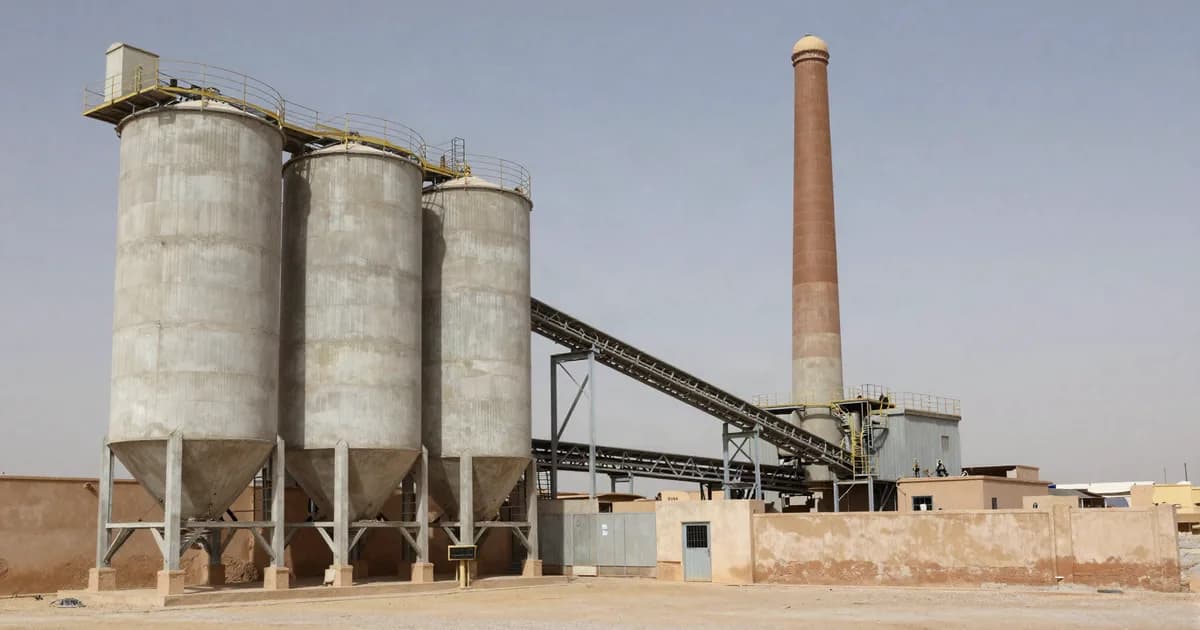
Take the permit away and what remains is a deformed piece of ground and a heap of machinery. The right to extract is the asset; the land is what survives it.
1. A property asset that consumes itself as it produces
The whole of the rest of property rests on an unspoken assumption: the support endures. A building deteriorates but its site remains; a factory becomes dated but its platform stays. A quarry is the exception. Every cubic metre extracted is a cubic metre of value converted into turnover and then permanently removed from the physical balance sheet of the site. The asset exhausts itself by operating. That is the first thing to explain to a client, and the reason a quarry can never be capitalised like an investment property.
The second peculiarity lies in the nature of the product. Dredged or alluvial sand, crushed aggregates for concrete and asphalt, dimension stone for traditional construction, clay for fired products, marble and ornamental rock: these materials share neither the same market, nor the same added value, nor the same sensitivity to transport. Aggregates are a heavy, low-unit-value product: the market is local, bounded by the cost of the lorry, and the position of the site relative to the construction sites it serves weighs as heavily as the deposit itself. Marble and ornamental rock follow the opposite logic — a selective product with a wider market, but an uncertain extraction yield and a sharp dependence on block quality. The same volume of rock is therefore not worth the same thing depending on what can be won from it.
Finally, a quarry is a permitted asset. It exists only because an authorisation allows it, within a defined perimeter, for a defined term, on conditions.
2. The legal and administrative footing: what to establish before any calculation
No income approach means anything until the right to extract has been characterised. This is the compulsory starting point of every instruction, and it is usually where the figures put forward by the parties start to diverge. The valuer must establish, on documentary evidence:
- The existence and exact perimeter of the extraction permit — the authorised outline, the permitted levels and depths, the phasing envisaged. Working beyond the permitted perimeter does not produce value; it produces exposure.
- The residual term — the structuring datum. It bounds the period over which cash flow may be projected, whatever volume remains in the ground.
- The attached conditions and obligations — operating requirements, technical prescriptions, reinstatement undertakings, periodic inspections. They weigh on the cash flow and sometimes heavily on the exit.
- Transferability — does the permit follow the site on a sale, or is it attached to its holder? A right that cannot be transferred transfers badly, by definition, and the purchaser is then buying an expectation of re-authorisation rather than a right.
- The land tenure of the underlying ground — registered title, State land, collective land, undivided ownership: each configuration changes the nature of what is being sold, the mechanics of transfer and the security of the structure.
- The relationship between ownership of the ground and the right to extract — two distinct things, and not always in the same hands. An operator may hold the right to extract without holding the ground; an owner may hold the ground without being able to win any material from it.
The rule is blunt but reliable: a short, conditional or non-transferable permit truncates value, whatever the deposit. A site over an abundant, good-quality material whose right to extract is about to lapse is worth essentially its after-quarry land and its demountable plant. Conversely, a modest deposit covered by a long, clear and assignable permit values comfortably. The right outranks the rock. The same discipline applies to any asset held on a right of finite duration — the reasoning is set out in our note on occupation permits on the maritime public domain and the valuation of a precarious right.
3. Reserves: what a property valuer may say — and must not
The available resource is the second determinant of value. It depends on the workable volume remaining within the permitted perimeter, on the quality of the material and its consistency, on the thickness of overburden to be stripped to reach it, on the geometry of the deposit, on the water table where relevant, and on perimeter constraints — standoff strips, neighbouring uses, structures and easements that leave certain zones theoretically rich but practically unworkable.
On this ground the valuer's methodological position must be explicit and modest: a property valuer is not a geologist. He calculates neither volumes nor tonnages, does not interpret boreholes and does not adjust a deposit model. He relies on the geological studies, drilling campaigns, topographical surveys and phasing plans supplied by the client or prepared by the relevant professionals, and incorporates them as explicit assumptions.
In practice the report names the source of every reserve figure, its date and its author, and states that the conclusion is conditional on their accuracy. It sets out the sensitivity of that conclusion: were the resource to be revised, value would move with it. This transparency is not a stylistic precaution — it is the condition of a sound report. A valuation presenting reserves as a fact established by the valuer himself would be open to challenge on the merits, and rightly so.
4. The method: valuing an asset with a finite life
From all of this the arithmetic follows. A quarry is an asset whose economic life is bounded: by the residual term of the permit on one side, by exhaustion of the deposit on the other — and it is the shorter of the two that governs. The primary approach is therefore an income approach over the residual working life, built as follows:
- Net operating cash flow projected over the residual term — the proceeds of the activity less the costs of extraction, processing, internal haulage, staff, energy, maintenance and plant renewal. These flows are by nature declining as exhaustion approaches: overburden gets heavier, haul distances lengthen, working faces become less convenient. Projecting a flat flow to the end date is a classic error.
- Plus the residual value of the land once operations cease and restoration is complete — the ground still exists at the end, transformed, and it is worth something.
- Less the cost of restoration and of the environmental obligations still to be discharged, whenever they happen to be borne.
As in any serious valuation, that primary approach must be tested against two further readings. The cost approach applies naturally to the plant: crushing and screening installation, technical and administrative buildings, stockyard, weighbridge, internal roads and haul tracks, power supply, settlement ponds and water structures. Replacement cost, then depreciation for physical deterioration, technical obsolescence and — the crucial point here — functional obsolescence arising from the end of extraction: a fixed installation oversized relative to the remaining reserves is worth its demolition value, not its value in use. The mechanics are set out in our guide to the DRC and DCF methodology for industrial assets.
The comparison approach, lastly, remains theoretically relevant and practically thin: quarry transactions are rare, seldom public, and every site is singular in its deposit, its permit and its access. Where references exist they serve as a plausibility check, not as a foundation. The report should state honestly how deep the reference market available to it actually is.
5. Separating the three layers of value
A purchaser buys a whole and thinks in headline prices. But a funding party taking security, an insurer covering a loss, an accountant recognising an asset or a shareholder contributing it to a company all need the breakdown. The valuation must therefore isolate three distinct layers:
- The bare land — the underlying ground considered independently of the operation, in its present state and in its future state after reinstatement. The most stable layer, and the only one that survives intact to the end.
- The plant and buildings — the fixed industrial tool, valued on depreciated cost, with particular attention paid to the end of extraction. Some installations are relocatable and keep a value of their own; others are inseparable from the site and share its fate.
- The right to extract — the combination of permit and deposit, that is, the legally secured ability to win a physically present resource. The most volatile layer, eroding every year and disappearing at the term.
The separation is not a stylistic exercise. Funding secured on the land does not bear on the same perimeter as funding secured on the operation, and security taken over an asset whose value lies mainly in a right that lapses is security that lapses with it. Saying which of the three blocks carries the value is often the report's principal contribution.
The shorter horizon governs
Two clocks run on a quarry: the one measuring what is left in the ground and the one measuring what is left of the permit. Valuations go wrong when only the first is read. A deposit with years of material and a permit close to expiry is a short asset, whatever the drilling says.
6. Restoration and environmental liability
This is the item most regularly forgotten in privately negotiated figures, and the one that weighs most heavily on the negative side. Working a quarry creates an obligation to close it: reshaping faces and slopes, backfilling or making safe, water management, dealing with residual stockpiles and operating waste, dismantling installations, revegetation or reinstatement to agricultural use according to the prescriptions in force.
Three consequences for the valuer. First, this future cost must appear explicitly in the calculation, to the extent of the obligations actually undertaken and of the provisions made or not made — the gap between the two is itself information about value. Second, it bites even where operations stop earlier than planned: it is not a contingent charge but a deferred one. Third, the actual state of the site at the valuation date governs the size of the item — a quarry worked on a progressive-restoration basis, where exhausted zones are closed as the faces advance, does not carry the same liability as a site left open across its whole footprint.
To this may be added localised soil contamination associated with fuel storage, workshops or depots, which is reasoned about as on any industrial footprint: identify it, have it characterised by the appropriate specialists, and carry the remediation cost as an explicit deduction rather than as a vague caveat.
7. After the quarry: the value of the released land
The end of extraction is not the end of the asset. The site handed back takes a new form — a water-filled excavation become a lake, a flat and stabilised platform, backfilled and levelled ground, benches reshaped into terraces — and that form has a value of its own. Depending on the applicable zoning, the location and how urbanisation around the site has moved, this after-quarry value can range from that of poor agricultural land to that of a sought-after development site.
The configurations encountered are varied: a logistics platform or business park on a flat, well-served footprint; a return to agricultural use after backfilling and soil reconstitution; a water body turned to landscape amenity or irrigation storage; development land where the city has reached the site over the decades of working; or simply open ground with no economic use. Peri-urban land is the most sensitive case: a quarry opened far from anywhere may find itself, at the end, on the urban fringe.
For a site nearing the end of its life this terminal value frequently constitutes most of the value. The valuer must therefore treat it with the seriousness of a land valuation in its own right: effective zoning, physical constraints inherited from working, stability of reworked ground, access, services, and a realistic timetable for availability. The reading grid is the one set out in our guide to land valuation, zoning and buildable potential. It is not a balancing figure; it is a valuation item.
8. Typical instructions and common errors
The contexts that trigger a quarry valuation recur:
- Acquisition or disposal of the site — seller and buyer rarely read the residual term and the restoration liability the same way; the valuation puts both on the table.
- Funding — the funding party wants to know what its security actually bears on, and what is left if extraction stops.
- Contribution to a company, restructuring, a shareholder coming in or going out — the value of the asset must be established independently of the operator's accounts.
- Accounts and financial reporting — recognition, impairment testing, consistency of reinstatement provisions.
- Expiry of the permit or cessation of working — valuing what survives: reinstated land, plant, residual obligations.
- Partition, succession, undivided ownership — sharing an asset whose value rests on a right that lapses requires a clear decomposition.
The errors recur too, and they are expensive:
- Capitalising operating profit as though it were perpetual — the number one trap. Applying to a quarry an earnings multiple designed for a going concern values flows that will not exist. A quarry has no terminal operating value; it has a terminal land value.
- Ignoring the residual term of the permit — projecting over the horizon of the deposit without checking the horizon of the right. The shorter of the two governs.
- Forgetting restoration — a certain negative, deferred but certain, and absent from most informal estimates.
- Confusing the value of the operating company with the value of the asset — the company carries contracts, stock, an order book, cash, debt and employment commitments; the property asset is confined to land, plant and the right to extract. The two rarely coincide, and the report must state which it establishes.
- Treating reserves as a certainty — without naming the source, dating the study or testing the sensitivity of the conclusion.
- Neglecting access — for a heavy material, the road, the distance to the sites served and the tolerance of neighbours for lorry movements are an integral part of the value of the deposit.
9. What the report is for
The report gives every party the same basis for discussion, which is almost always missing on this type of asset. It describes the site and its permitted perimeter, sets out the land tenure of the underlying ground, states the reserve assumptions and where they come from, develops the income approach over the residual term, cross-checks it against the cost approach on the plant and against the few market references available, isolates the restoration cost and prices the after-quarry land value. It concludes by separating the three layers — land, plant, right to extract — because that decomposition is what the users of the report actually need.
The conclusions are built to be argued with: they rest on named assumptions, cited sources and a stated methodology, which makes them contestable point by point rather than defensible in a block. This is a private valuation — it informs a decision and an arm's-length negotiation. Our reports are prepared by RICS-certified experts and comply with Red Book standards.
A quarry is a specialist instruction, quoted case by case according to the extent of the site, the number of installations, the nature of the deposit and the scope requested. For reference, our valuations start at 3,500 MAD excl. tax for standard assets, with a firm quote within 24 hours and delivery in 5 to 8 days, 48-72 hours on the express service. ReaConsult has been advising landowners, operators, investors and funding institutions since 2019, with more than 5,000 valuations completed, offices in 6 cities and client reviews published on our Google profile.
Buying, selling or financing an extraction site? Have the land, the plant and the right to extract valued separately, with the restoration liability priced in.
Request a valuation →Related articles
Note:this article sets out a valuation methodology compliant with RICS standards (Red Book). Extraction permits, their conditions and the reinstatement obligations attached to them are governed by the regulations in force and by the terms of each authorisation — confirm your own position with the competent authorities and your advisers. Reserve and resource estimates are the province of the geologist and the surveyor, not of the property valuer. A private valuation informs a decision and an arm's-length negotiation. To instruct us, see our contact page or the property blog.