
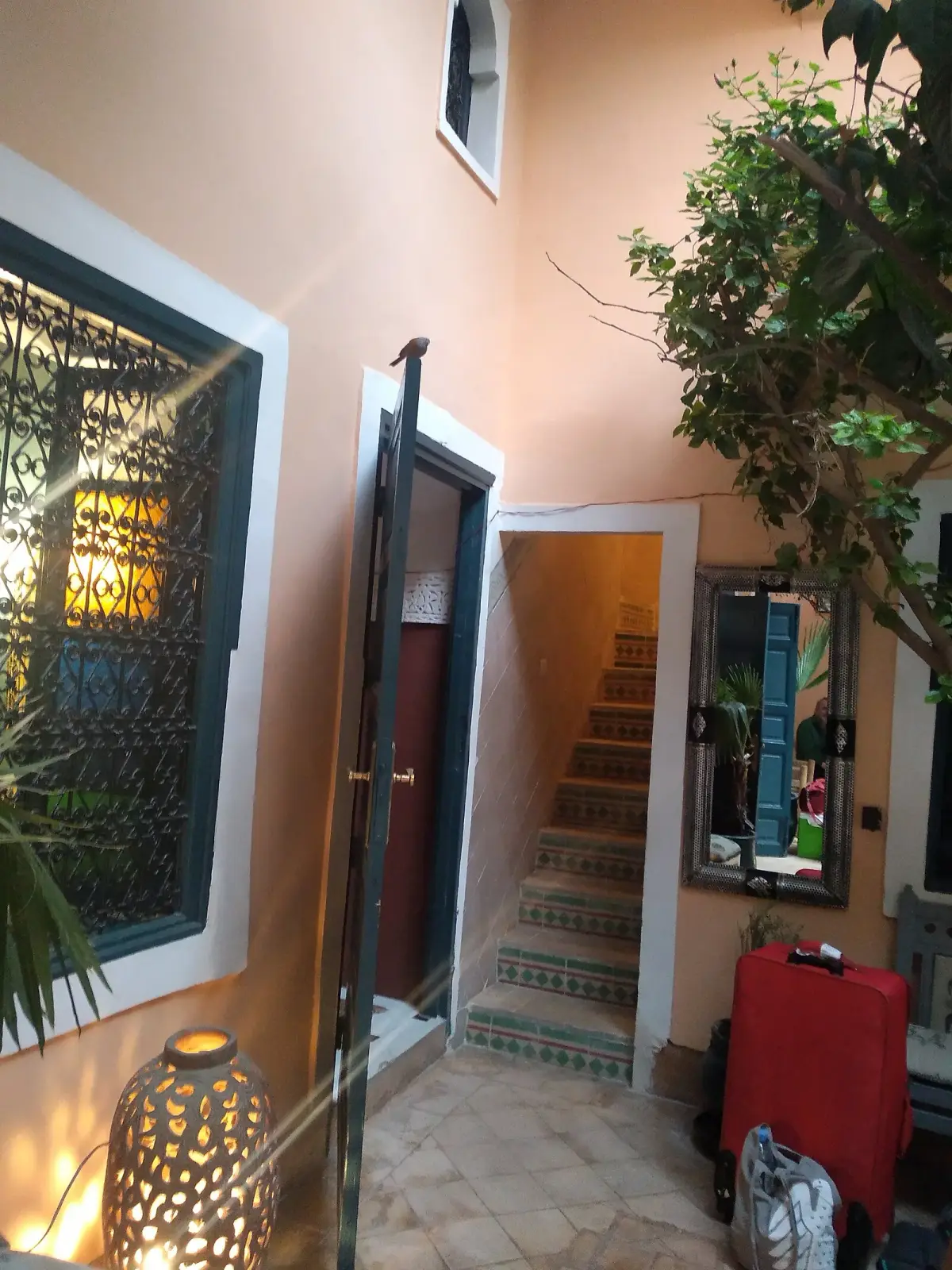
The riad isn't a property like any other. Architecture around a patio, location in classified medina, often-particular land status, hospitality potential — many elements calling for specific valuation.
1. Riad specifics — what sets it apart
- Patio architecture — typically 2 or 3 levels, rooftop terrace, central fountain, salons facing patio.
- Historic medina location (Marrakech, Fez, Tangier, Essaouira, Rabat-Salé) — limited vehicle access, heritage charge.
- Often particular land status — non-immatriculated Melkia, old indivisions, late or partial immatriculation.
- Heritage value tied to original elements — zellige, gebs, carved wood, marble.
- Hospitality potential generating significant revenues (RevPAR, GOP).
- Medina urban planning constraints — heritage protection, heights, materials, façades.
2. Adapted RICS methodology: what are you valuing?
Before choosing a method, the object of the valuation must be clarified. For a riad, three distinct objects coexist and must not be confused:
- The bricks — the bare real estate, independent of operation.
- The trading business (fonds de commerce) — the hospitality activity running on it (clientele, brand, OTA contracts, operational know-how).
- The going concern — bricks + business + FF&E + intangibles, valued as a unitary operating asset.
The method changes radically depending on which object is chosen. This section details the three applicable frameworks and the purpose driving each.
2.A — Valuing the bricks (asset only)
Typical purposes: sale of the real estate without the business; bank financing of the property acquisition only; inheritance where the property-holding entity owns the bricks while a separate company runs the operation; indivision exit on a residential riad.
(a) Vacant or owner-occupied riad:
- Comparable method (VPS 3, RICS Red Book) as primary method — transactions of similar riads on the medina (size, patio configuration, floors, terrace, condition, accessibility, location relative to medina gates and tourist axes).
- Income cross-check: an Estimated Rental Value (ERV — market rent) and a capitalisation rate observed on the medina riad segment are applied to verify the consistency of the comparable result.
(b) Bricks leased to a third-party operator (commercial lease): the Term & Reversion method is central — a two-phase DCF formalised by RICS Red Book (VPS 3) and IVS 105 standards.
- Term phase: contract rent is discounted from the valuation date to lease expiry. The capitalisation rate applied reflects the security of the cash flow — tenant in place, signed lease, possible guarantees. This is the lowest yield in the model.
- Reversion phase: the Estimated Rental Value (ERV) is discounted from lease expiry onwards, in perpetuity or to the retained horizon. The capitalisation rate is higher than the term yield — it embeds the re-letting risk premium: vacancy, negotiation, market state at expiry, possible refurbishment.
- Reading the result: the gap between passing rent and ERV reveals an over-rented situation (rent > ERV — the lease outperforms market, the reversion will weigh) or under-rented (rent < ERV — the lease under-rewards, the reversion creates value).
Methodological note: on the medinas of Marrakech, Fez, Tangier, lease transactions specifically on riads are rare — comparable rent traceability is limited. The valuer cross-references several sources: hospitality unit leases in medinas, comparable boutique-hotel leases, operator ratios. Adjustments must be documented line by line in the report.
2.B — Valuing the trading business (operating business)
Typical purposes: transfer of the business only (clientele, brand, contracts, operational know-how) without transferring the bricks; financial reporting for an operator in place; valuation for an investor entering the operating company.
Method: DCF of operating revenues, built line by line on the riad's operational cash flows.
Model inputs:
- Rooms revenue = number of rooms × occupancy rate × ADR (Average Daily Rate). Allows back-calculation of RevPAR (Revenue Per Available Room = occupancy × ADR).
- Ancillary revenue: food & beverage (F&B), spa / hammam, services, retail of crafted products.
- Operating costs: payroll, energy, laundry, consumables, marketing, OTA commissions (Booking, Airbnb, Hotels.com), routine maintenance.
- GOP (Gross Operating Profit) = Revenue – direct operating costs. Central performance indicator.
- Owner-operator charges: FF&E reserve (Furniture, Fixtures & Equipment renewal reserve, typically 3 to 5% of turnover per USALI convention), insurance, business taxes, royalties.
- EBITDA / Hotel NOI = GOP – owner charges.
Projection over 5 to 10 years with a terminal value capitalising the stabilised terminal cash flow at the operator's yield. This yield is materially higher than the bricks yield: it embeds operating risk (seasonality, OTA dependence, ADR volatility, competition). The DCF discount rate reflects the operator's cost of capital.
Cross-check: price per key multiple and EBITDA multiple observed on comparable medina trading-business transactions.
2.C — Valuing the going concern (bricks + business + FF&E) — VPGA 4
Typical purposes: full-asset transfer of an operating riad-hotel where the acquirer takes over bricks + business + staff; bank financing of a full-asset acquisition; IFRS 13 reporting for a hotel asset held by a real estate fund or corporate vehicle.
Method: RICS Red Book VPGA 4 (« Valuation of trading property and businesses ») and IVS 410 / IVS 200 (Going Concern). Unitary approach: DCF of the normalised operating cash flow as a whole, projected over the useful life, with a discount rate reflecting the combined « real estate + operating » risk.
The unitary value obtained is then analytically decomposed into:
- Bricks value — by deduction from the business value, or by separate method when sufficient comparables exist.
- Trading business value — clientele, contracts, established marketing.
- FF&E value (furniture, fixtures & equipment).
- Intangibles value — riad brand, OTA reputation and ratings, know-how.
This decomposition is essential for buyers structuring the deal (property entity / operating entity separation), for banks requiring a mortgage allocation (the mortgage attaches only to the real estate), and for the notary fixing registration duties basis by asset category.
2.D — Which framework for which purpose?
| Purpose | Methodological framework |
|---|---|
| Real estate sale only | 2.A — asset only (comparable or Term & Reversion) |
| Trading business transfer only | 2.B — operating business (DCF of operations) |
| Full-asset transfer of riad-hotel | 2.C — going concern (VPGA 4) |
| Inheritance (non-operating riad) | 2.A — usually comparable + FF&E value as complement |
| Indivision exit | 2.A if not operated, 2.C if operating riad-hotel |
| Bank financing | 2.A (bank requires bricks value), possibly complemented by 2.C |
| IFRS 13 reporting | 2.C with decomposition by asset category |
3. Medina legal verifications
- Land title (TF) if immatriculated, with recent ANCFCC certificate.
- If not immatriculated: Melkia documentation (adoulaire deeds, traditional ownership certificates, possible immatriculation judgment in progress).
- Indivisions and shares — frequent on old assets transmitted by inheritance.
- Hospitality operation authorisations (ONMT classification, guesthouse approval) where applicable.
- Compliance with medina heritage protection rules.
4. Foreign investor vigilance
- Verify land status — immatriculated or Melkia, security consequences.
- Urban planning constraints — extension prohibitions, limited modifications.
- Vehicle access — often impossible to the door, logistics to anticipate.
- Heritage renovation costs — noble materials, specific artisan know-how.
- Hospitality operation potential — ONMT classification, approval, compliance.
- Acquisition costs — registration duties, land conservation, notary, Office des Changes for repatriation.
5. Recognised uses
- Mortgage lending — bank financing (verify bank position on immatriculation and medina).
- Pre-purchase / buyer side — particularly useful given legal and heritage complexity.
- Inheritance and donation — value-setting among heirs across generations.
- Hospitality investment — quantified basis for operation decision.
- Financial reporting — for corporate holders (IFRS 13).
- Indivision exit — neutral value-setting.
Need a riad valuation?
Free quote within 24h. RICS Red Book-compliant report + medina-specific legal reading.
Request a quote →