
There is no such thing as “the Safi market” in the singular. Four segments coexist, and applying one segment's references to another is the commonest error we are called in to correct.
1. An economy on three pillars
Safi occupies an unusual position on Morocco's Atlantic coast: neither a seaside resort nor a services metropolis, it is an industrial and port town, and its property market still reflects the three pillars its economy was built on.
The first is phosphate processing. The chemical complex at Safi and its processing units are the economic lung of the province, and they structure three things at once: employment — staff, technicians, managers, subcontractors — port logistics — inbound and outbound flows, storage, haulage — and, as a direct consequence, housing demand. That demand has a characteristic a valuer must build in: it is structural and largely rental. Households tied to the industry and its supply chain occupy the residential stock without necessarily intending to settle in the town for good. An income building in Safi is therefore not assessed on capital value alone: its real letting capacity, the stability of its occupation and the profile of its tenants all belong in the analysis.
The second pillar is fishing. Safi is a historic sardine port, long one of the country's great sardine landing ports, with a dense fabric of canneries and seafood processing. That fabric has shifted over the decades through restructuring, relocation and changes of process. What it leaves behind, in and around the town, is a stock of older industrial buildings in uneven use: some still trading, some partly occupied, some stopped altogether. That is where the now central question of brownfield conversion comes from.
The third is ceramics and pottery. The potters' hill and the ceramic workshops are an emblematic craft and industrial activity, with their kilns, workrooms and display space. In property terms this creates a category of its own: mixed premises, half production workshop and half retail, which belong neither to the pure commercial market nor to the pure industrial one.
Add the medina and its older stock, the Qasr el Bahr on the seafront, a thermal power station, and the logistics fabric attached to the port, and you have a town with a legible economic geography — and a property market that reads by segment, never on average.
2. Four segments, four instructions
- Housing for industrial staff and managers. Flats, income buildings, houses in the residential districts. Rental demand tied to industrial and port employment makes this the one segment where direct comparison genuinely works — provided you have real comparables and not asking prices. Common reasons: a sale, a funding file, a succession division, a contribution in kind to a company.
- Activity units and warehouses. Logistics buildings, depots, processing workshops, premises tied to industrial and port subcontracting. Comparables thin out here and the analysis shifts to actual use and income-generating capacity.
- Craft workshops and mixed premises. Ceramic and pottery workshops, kilns, display and sales space. A building that combines production, storage and a shop window does not reduce to a single rate: the valuer has to break the floor areas down by use and rank what actually carries the value.
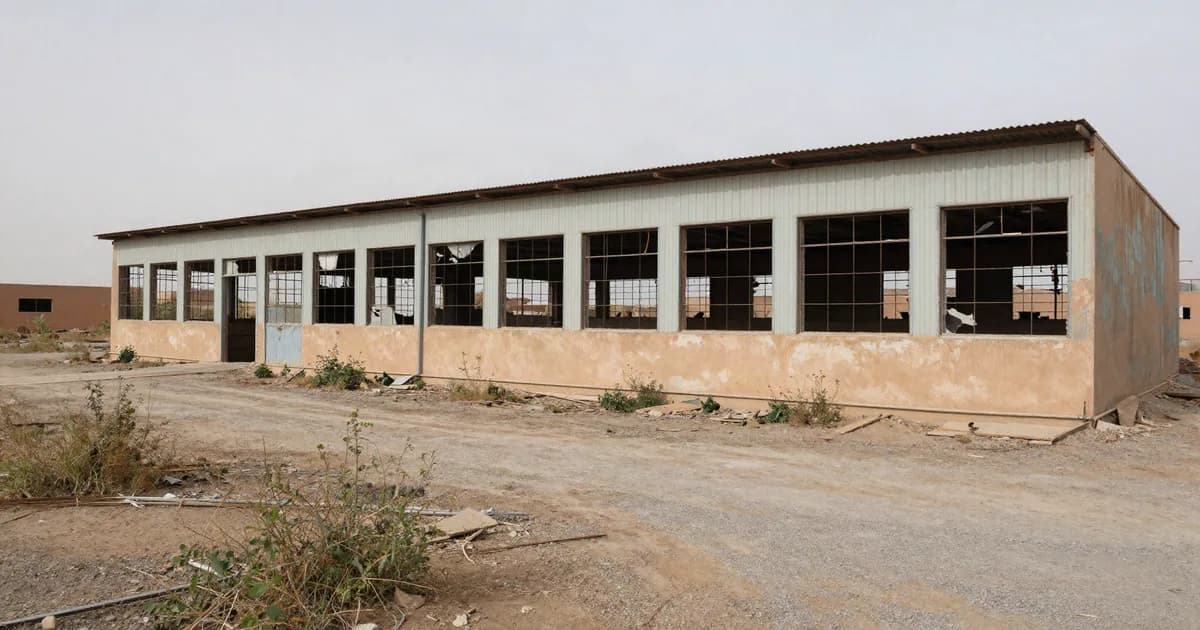
- Brownfield and disused sites. Former canneries, depots, activity sites overtaken by the spread of the town or simply shut. The most technical segment of the four, and the subject of section 4.
3. Specialised buildings, a corrosive coast, and tenure
The comparables problem. On industrial and semi-industrial assets the difficulty is not the arithmetic, it is finding material to work with. Disposals of activity sites are rare, confidential and rarely comparable to one another: two production halls of identical floor area can differ entirely in clear height, floor loading, services connections and lorry access. Where direct comparison will not stand up, two routes open, and you have to know which applies.
Depreciated replacement cost suits specialised buildings designed around a given process, with no obvious secondary market. You rebuild the cost of a modern equivalent offering the same utility, then apply depreciation: physical — age, wear, condition of the structure — functional — obsolescence of the design, unsuitability for current uses — and economic — loss of utility arising from the market environment. It produces a defensible figure where there is nothing to compare against, but it demands discipline in justification: every deduction must be reasoned.
The income approach takes over as soon as the site is let or immediately operable. You then reason on sustainable market rents, a realistic occupancy rate, irrecoverable outgoings and the return an investor would require for that asset type. Our note on valuing an industrial asset in Morocco under RICS methodology sets out how the approaches are articulated, and our typology of Moroccan industrial property explains why a warehouse, a factory and a business park do not behave alike.
One rule of scope that must never be blurred: the building is not the production tool. On an industrial site a sometimes dominant share of the economic value sits in the plant and the process — lines, machines, specific technical installations. A property valuation covers the real estate: land, structure, fixtures that are immovable by nature. Plant and equipment fall to a separate asset valuation with its own competencies. A serious report says so explicitly and fixes its scope in the engagement letter. This is a classic source of misunderstanding between vendor, purchaser and lender, and it is settled in writing, up front.
The coastal and industrial environment. Safi subjects its buildings to two simultaneous attacks: sea spray and an industrial atmosphere. Salt and humidity accelerate corrosion in steel structures — frames, cladding, exposed reinforcement — break down renders and attack joinery and services. The practical consequence for a valuation is blunt: two buildings of similar appearance can be in very different structural condition. A steel frame treated and maintained does not have the residual life of a frame left bare for twenty years in the same environment. That gap converts directly into physical depreciation, and it is established on an inspection, not from a desk.
Tenure and extent. Older activity sites present heterogeneous positions: unregistered holdings, old titles whose described extent no longer matches actual occupation, successive unregularised extensions. Boundaries must be confirmed through an adversarial boundary survey carried out by a licensed surveyor: on an industrial site a few metres on a boundary can move a fence, a dock or an access. Add the easements and reservationsattached to the port, to access roads and to services, which can heavily constrain a plot's future use without being visible on the ground. The valuer flags these, documents them and draws the consequences for value — it is not for the valuer to resolve them.
4. Brownfield: the question of the coming years
This is the subject rising in Safi, as in every old port town. Part of the industrial stock — canneries, depots, workshops, activity sites — has been overtaken by urban spread or fallen redundant through successive restructuring. These sites pose a question their appearance cannot answer: what are they actually worth?
The answer fits in a sentence: the value of a disused site depends on its permitted future use, not on its past. The starting point is therefore not the building but the zoning and planning rules applicable to the plot. What can be done there, at what density, under what constraints? A site the planning documents keep in industrial use and a site switched to mixed urban use have neither the same value nor the same buyer.
From there the natural instrument is the residual method: start from the value of the permissible scheme on the plot, deduct everything needed to get there, and the balance is what the site can be worth today. The items to document:
- Demolition costs for the existing structures, including removal and disposal of materials — an old industrial hall does not come down at the cost of an ordinary building.
- Remediation and site clearance costs, depending on the activity carried on there. This is the item most often understated, and the one that calls for specialist input: the valuer incorporates the assumption, the valuer does not manufacture it.
- Time to conversion — how long to obtain consents, run out challenge periods and market the scheme. A long timetable mechanically weighs on present value.
- Developer's profit and risk, without which no promoter commits to the operation.
The residual method is powerful and fragile in equal measure. It amplifies every assumption: a modest movement in remediation cost or in timetable can reverse the outcome. Hence a non-negotiable requirement — assumptions documented, sourced and written down, not supposed. A report that applies a residual method without stating its assumptions or testing their sensitivity is not a valuation, it is an opinion. Our detailed guide to the residual method under VPGA 10 works the mechanics through step by step.
5. How an instruction at Safi runs
Safi sits outside the six cities we operate from — Casablanca, Rabat, Marrakech, Tangier, Fez and Agadir. We attend on request, from that network, with travel time factored in and travel costs quoted separately; there is no local office. The sequence is stable whatever the asset. A written scope first — nature of the property, exact perimeter (and, on an industrial site, explicit exclusion of the production tool), purpose of the valuation, intended recipient of the report. Then document collection: title or tenure position, plans, consents, leases and rent records where relevant, planning material. Then the inspection: floor areas measured, structural condition recorded — the critical point in a saline and industrial environment — access, services and immediate surroundings examined, photographic record taken. Then analysis and drafting: method chosen and justified, assumptions explicit, value reasoned.
Fees start at 3,500 MAD excl. tax, travel costs quoted separately, with a firm quote within 24 hours and delivery in 5 to 8 days — 48 to 72 hours on the express service. Reporting can be handled remotely, which suits owners who do not live in the region: proprietors based in Casablanca or overseas, and companies headquartered elsewhere.
6. What the report is for
- Buying or selling an activity site. Putting an evidenced figure on a segment with no public references, so the negotiation is not conducted on impressions. This is the commonest instruction on activity units and warehouses.
- Reinstatement value for insurance. Decisive on industrial stock: underinsuring a production hall or a steel frame is paid for at the moment of loss, and capital value is not the right basis for the calculation. See our note on insuring an industrial and logistics building.
- An owner's decision on a brownfield site. Sell as it stands, remediate before selling, or hold pending a change in the planning documents: three scenarios that can be costed and compared on a common basis.
- Succession and division. A family property, an income building or a retail unit among heirs: a neutral valuation gives the division a starting point in an amicable negotiation.
- Contribution in kind. Bringing a building or an activity site into a company's capital: the value adopted has to be documented and defensible to third parties.
Founded in 2019, ReaConsult has completed more than 5,000 valuations (client reviews published on Google) and works from six cities in Morocco. Our RICS-certified experts produce reports that comply with Red Book standards: scope defined, method justified, assumptions stated, value reasoned. On an industrial asset or a brownfield site it is exactly that traceability of reasoning that counts — the figure is documented and verifiable line by line, rather than asserted.
A comparable exercise in another Moroccan town built around a single industry is set out in our note on valuing property in a mono-industrial market, where the same dependence between employment, rental demand and value plays out.
A building, an activity unit or a disused site at Safi? Have the segment identified and the method justified before you commit.
Request a valuation →Related articles
Note: this article sets out market situations and a valuation methodology; it carries no market price data and is neither legal advice nor an estimate. Tenure, boundaries, zoning and the obligations attaching to an activity site are matters for your notary, a licensed surveyor and the competent administration. A private valuation informs a negotiation or a decision. To have your property valued, see our contact page or the property blog.