
1. The case and the assignment
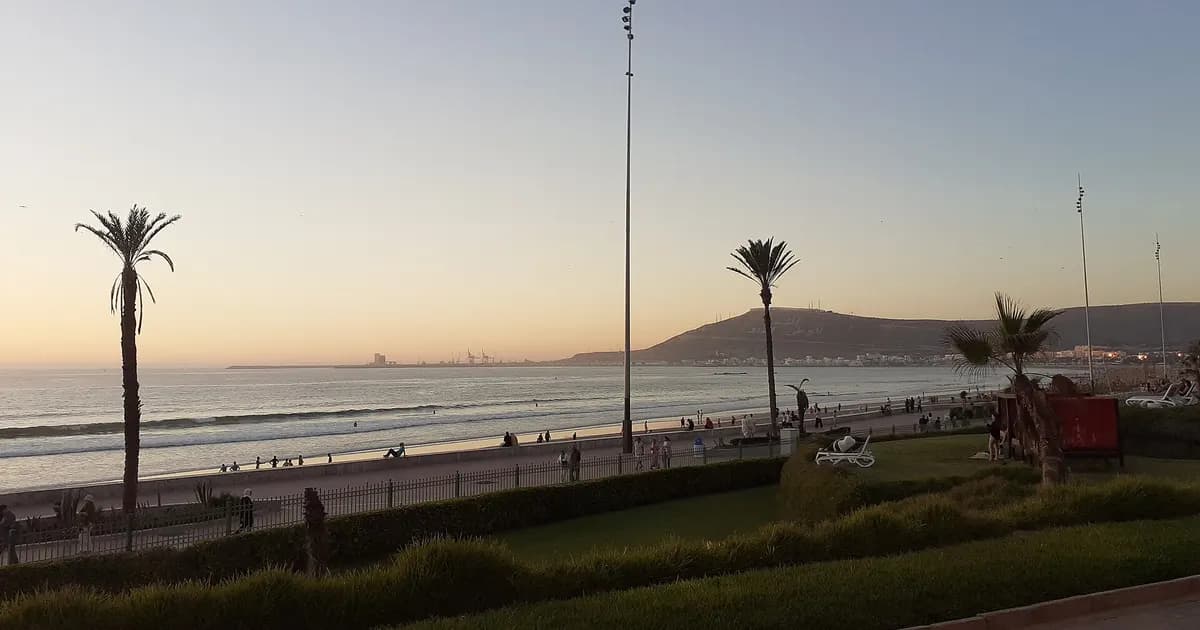
The composite case: a four-star hotel of 180 rooms in the Founty seaside district, operated directly, classified under law 80-14 on tourist establishments. The assignment: a market value in support of a contemplated sale, conducted under the Red Book Global Standards 2025 — standard VPGA 4 for assets whose value is tied to their trading, with methods consistent with VPS 5 and the IVS. An asset of this kind rules out the price-per-square-metre shortcut: what is valued is the operation, through the building that makes it possible.
2. Building RevPAR: seasonality first
Agadir runs at two speeds. Rooms revenue is therefore built season by season, never as a single annual average:
That is an annual RevPAR of about MAD 763 per available room (MAD 50.2M / 65,700 available room nights). Ancillary revenue — food and beverage, meetings, spa — is retained here at ≈ MAD 24.9M, for total revenue of around MAD 75M. The full ADR × occupancy → RevPAR → GOP mechanics are detailed in our guide to hotel valuation in Morocco (VPGA 4, RevPAR, GOP).
3. From revenue to cash flow: EBITDAR, then the FF&E reserve
- Operating costs (payroll, energy, supplies, distribution commissions, maintenance, operating taxes including the tourist stay tax provided by law 47-06): retained at 52% of revenue, consistent with a directly operated seaside four-star. EBITDAR ≈ MAD 36.0M (48% of revenue).
- FF&E renewal reserve: 4% of revenue (≈ MAD 3.0M per year), provisioned before discounting — a seaside property wears out its furniture and equipment fast. Net cash flow retained for year 1: ≈ MAD 33.0M.
4. The 10-year DCF: discounting and terminal value
Case assumptions: cash-flow growth of 2.5% per year, a discount rate of 11% (the return required for a seasonal trading asset), exit in year 10 by capitalising the year-11 flow at a 9% hotel cap rate.
Case conclusion: MV ≈ MAD 380M, within a MAD 360-400M bracket depending on the sensitivity to the discount rate and the exit cap rate — two parameters the report always states in the open, with their market justification.
5. The cross-checks
- Direct capitalisation: MAD 33.0M / 9% ≈ MAD 367M — the same order of magnitude as the DCF, the gap reflecting the growth embedded in the flows.
- Price per key: 380M / 180 rooms ≈ MAD 2.1M per room — to be confronted with comparable hotel transactions in the destination.
- Terminal value share: ≈ 43% of total value — a level to watch: the higher it climbs, the more the value depends on distant assumptions.
A DCF whose three checks diverge is not "wrong": it flags an assumption to re-examine. That triangulation — also covered in our feature on valuing a hotel in Morocco (RevPAR, GOP, VPGA 4) — is what separates a trading-property valuation from a mere calculation.
6. What this case teaches
- Seasonality is modelled, not smoothed: the 68% annual occupancy covers a 78% high season and a 58% low season — two different economic realities.
- EBITDAR without an FF&E reserve systematically overvalues a seaside hotel asset.
- Classification (law 80-14) and operating compliance belong to the value due diligence: a downgrade changes the achievable ADR, and with it the whole top of the account.
- The final report is documented and verifiable line by line: ADR sources, transaction comparables, justification of the rates — it imposes itself on no one, it can be checked.
7. FAQ
Why not value a hotel at the price of its built square metres?
Because RICS standard VPGA 4 classes hotels among trading properties: assets whose value derives from their operation. A square metre in a hotel running at 68% occupancy with a solid ADR is not worth the same as one in a struggling establishment of equal size. The reconstructed operating account — RevPAR, ancillary revenue, costs, FF&E reserve — is the only relevant basis of value.
Which documents are needed to have a hotel valued?
The operating history over several years (occupancy, ADR by season, ancillary revenue, cost structure), the classification under law 80-14, the operating authorisations, the land title and plans, and the state of the FF&E with the investment programme. The more granular the seasonal history, the more reliable the DCF.
How much does the appraisal of a hotel asset cost?
A trading-asset appraisal is quoted on the file — from MAD 3,500 excl. VAT for the simplest assignments, with a firm quote within 24h. The report, compliant with RICS standards (VPGA 4, VPS 5) and the IVS, is delivered within 5 to 8 days (48-72h express): explicit method, stated assumptions, documented and verifiable line by line.
A hotel asset to value — sale, acquisition, restructuring?
RICS-certified experts — DCF and capitalisation under VPGA 4, reconstructed RevPAR and EBITDAR, Red Book compliant reports documented and verifiable line by line, within 5 to 8 days (48-72h express). Agadir, Marrakech, Casablanca and all of Morocco.
Note: A composite, anonymised teaching case: the figures are illustrative, consistent with market orders of magnitude, and describe no actual assignment. Every real valuation rests on the asset's actual operating history and the destination's comparables. For your asset, see our hotel valuation service or browse the ReaConsult blog.