
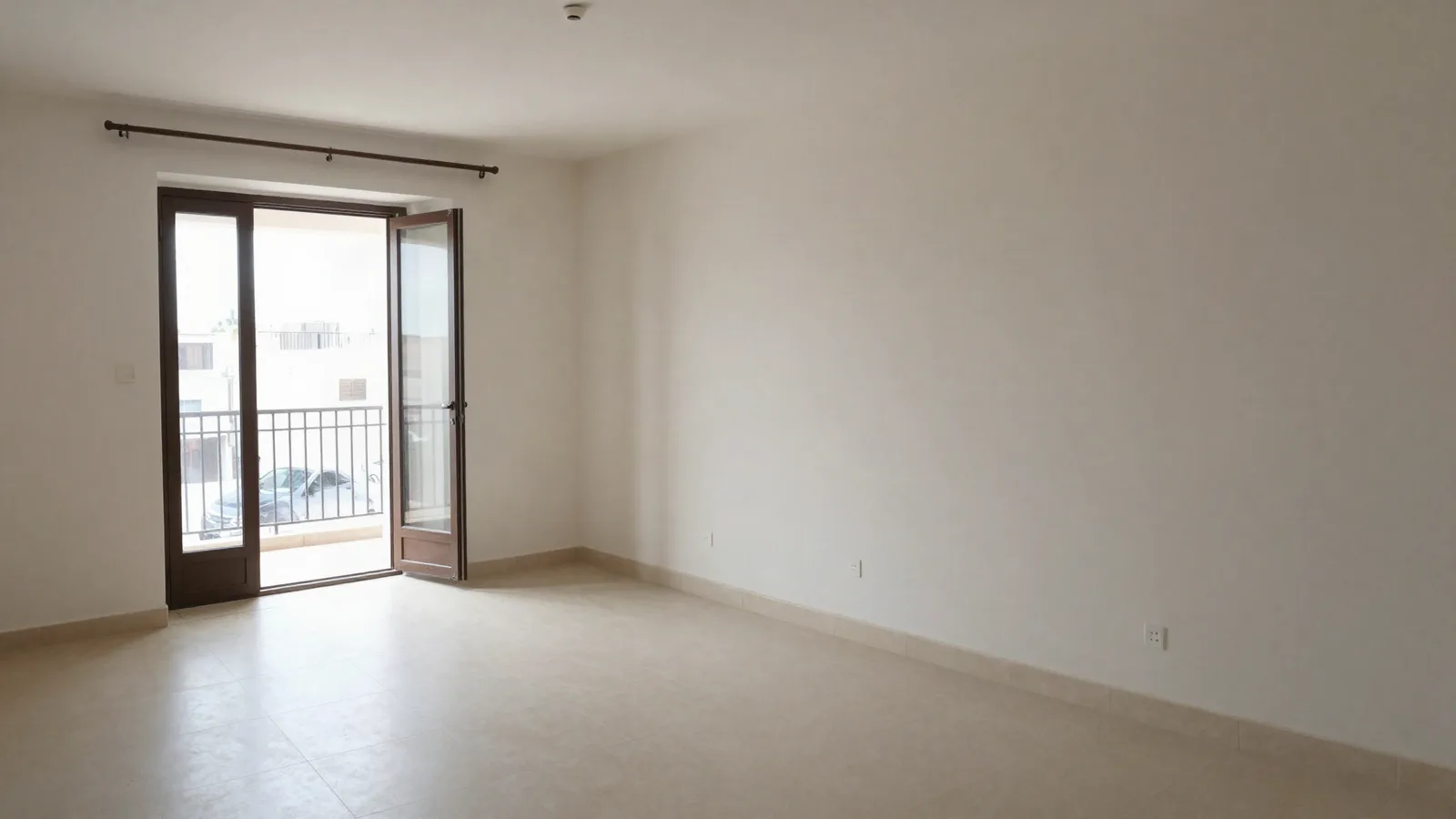
1. The size effect: why a studio does not trade at a three-bedroom's price per m²
Inside one building, the price per square metre is not constant across unit sizes. Small units usually sell at a higher price per square metre than large ones. Part of the cost of a home does not depend on its size: a kitchen, a bathroom, an entrance, a staircase share or a meter exist in a studio as in a four-room flat. Spread over fewer square metres, they push the unit price up.
The effect also runs the other way for very large units, whose price per square metre often erodes because fewer buyers can afford the total price. Between the two, the curve is not a straight line. How wide the gap is depends on the city, the district and the period: it is measured on comparable sales, not guessed. We therefore do not publish a universal coefficient, which would be wrong from one district to the next.
In practice, a price per square metre taken from a villa advertisement, or even a large apartment, cannot serve as a reference for a studio. The useful comparable is another studio, or a small unit of the same type, sold in the same area at a close date.
Neighbourhood averages call for caution too. A price-per-square-metre index published for a city mixes studios, family apartments and villas; it describes a market, not a property. It can help place a district, never price a specific lot. This is why an online estimate built on such averages usually goes wrong more on a small unit than on a standard apartment.
2. Who buys small units, and why it changes the value
The small-unit market is largely a market of rental investors: owners placing savings, heirs holding on to a property, Moroccans living abroad who want a pied-à-terre that earns its keep. Another share of buyers are first-time buyers, young professionals, or families housing a student.
This mix of demand has two consequences. First, the investor thinks in terms of yield: they weigh the asking price against the rent they expect. Second, demand depends on what makes people rent: universities, employment areas, transport, shops. A studio well placed for a tenant sells on that basis. The same studio badly placed will take longer to sell and be negotiated harder.
For the valuer, this means looking at what the prospective tenant would see: aspect, natural light, how well the plan works, an open or separate kitchen, the state of the bathroom, access to the building. These factors, more than floor area alone, explain the gaps between two neighbouring studios.
3. What the valuer compares, and in what order
The comparison method remains the base. It collects recent sales of similar properties, then adjusts each comparable for the differences observed. For a small unit the adjustment grid must go further than for a large apartment.
| Criterion | What the valuer looks at | Effect on value |
|---|---|---|
| Exact floor area | Area measured or taken from documents, on the same basis as the comparables | A few square metres weigh more than on a large unit |
| Plan | Main room, kitchen, bathroom, storage, sleeping area | A well-thought plan raises appeal for a tenant |
| Floor and aspect | Ground floor, top floor, overlooking, light | Effect varies with district and type of tenant |
| Building facilities | Lift, parking, caretaker, terrace or balcony | Assessed against equivalent comparables |
| Location | Distance to jobs, schools and universities, transport | Central to rental demand |
| Condition and finishes | Kitchen, sanitary ware, floors, joinery (apparent condition only) | Measured by refurbishment cost and speed of sale |
Every adjustment is reasoned and documented. The report lets the reader retrace the argument line by line: it binds no one, but it can be checked. For the general method, see our article on valuing an apartment by comparison.
4. The income cross-check: market rent as a safeguard
Since many small units are bought to be let, the value reached by comparison should be tested against the income the property would produce. This second reading does not replace the first: it checks that the first is plausible.
The reasoning has three steps. First, estimate the market rent of the property vacant and in good order, from comparable lettings in the same area (see our article on setting market rent). Second, derive a net income after non-recoverable costs, vacancy and management. Third, set that net income against the comparison value to see what yield it implies and whether that yield is consistent with what investors in the area require.
If the two approaches diverge sharply, that is not a failure: it is information. Either the comparables are not close enough, or the rent is misjudged, or the local market is driven by owner-occupiers rather than investors. The valuer looks for the explanation before concluding, then adopts a single, reasoned value, stating the weight given to each method.
On the difference between gross and net yield, a frequent source of unpleasant surprises, read our article on gross vs net rental yield.
5. Condominium charges: a heavier weight on a small lot
A building's charges are shared between lots according to their share. But some costs, such as caretaking, lift maintenance or cleaning, do not shrink in proportion to the size of the lot. Set against a studio's rent, they often take a larger slice than for a large apartment. They cut net income and therefore the income-based value.
The valuer therefore looks at the level of current charges, how regularly they are paid, any arrears in the building, works voted or foreseeable on the common parts, and the reserve fund if there is one. A badly run building with unpaid charges weighs on the price.
6. Common mistakes with small units
- Applying the price per m² of a large apartment to a studio, or the reverse.
- Comparing asking prices without checking them against completed sales: an advertisement states a wish, not a value.
- Leaving out charges in the yield calculation, or using gross rent only.
- Assuming immediate letting: a market rent assumes a vacant property, in good order, and a reasonable re-letting period.
- Forgetting resale: liquidity of a small lot depends on the number of investors in the area, which can change from one year to the next.
- Using an approximate floor area: on a small lot, a few square metres more or less move the result noticeably.
7. What a small-unit valuation includes at ReaConsult
Our RICS-certified valuers start from the property documents (title or ownership certificate, condominium bylaws where they exist, statement of charges), inspect the lot to describe its apparent condition, then build the value by comparison and by income. The report sets out the comparables, the adjustments and the rent assumptions, and ends with a single value. For an apartment, our fees start at MAD 3,500 excl. VAT, with a firm quote within 24 hours and a report delivered in 5 to 8 working days. See our apartment valuation page.
8. FAQ
Why is the price per m² of a studio higher than that of a large apartment?
Because part of the cost of a home (kitchen, bathroom, entrance, common parts) does not shrink with floor area, and because the total price is affordable to more buyers. How wide the gap is varies with district and period: it is measured on comparable sales.
Can a studio be valued with the average price per m² of the district?
Not reliably, or only as a first indication. The average mixes very different sizes. The studio should be compared with other small units sold in the same area, then adjusted for plan, floor, facilities and condition.
Is a studio's value calculated from its rent?
Rent is a cross-check, not the only method. The valuer derives a net income from market rent, then checks that the comparison value implies a yield consistent with what investors in the area require.
Do condominium charges really affect value?
Yes, more on a small lot, because some costs do not shrink with size. They reduce net income, and the financial health of the building (arrears, planned works, reserve fund) weighs on the price.
How much does a studio valuation cost and how long does it take?
For an apartment, fees start at MAD 3,500 excl. VAT, with a firm quote within 24 hours. The report is delivered in 5 to 8 working days, or in 48-72 hours express (with a surcharge).
A studio to buy, sell or share? Get the right value on paper.
RICS-certified valuers: small-unit comparables, a market-rent cross-check, charges taken into account. One reasoned value, documented line by line. Quote within 24 hours, report in 5 to 8 working days.
Note: this article sets out a method; it gives no price or numerical coefficient, because these vary with city, district and period. A property's value is determined by valuing that property. See also our property valuation service.