
No price per square metre, rate or yield for Al Hoceima appears on this page, and none is implied. Transaction references here are scarce and heterogeneous, and two neighbouring properties can be worth very different amounts according to slope, access, outlook and the real condition of the fabric. An average would flatten precisely the differences that matter. The subject is what has to be established first.
1. A town caught between the mountain and the sea
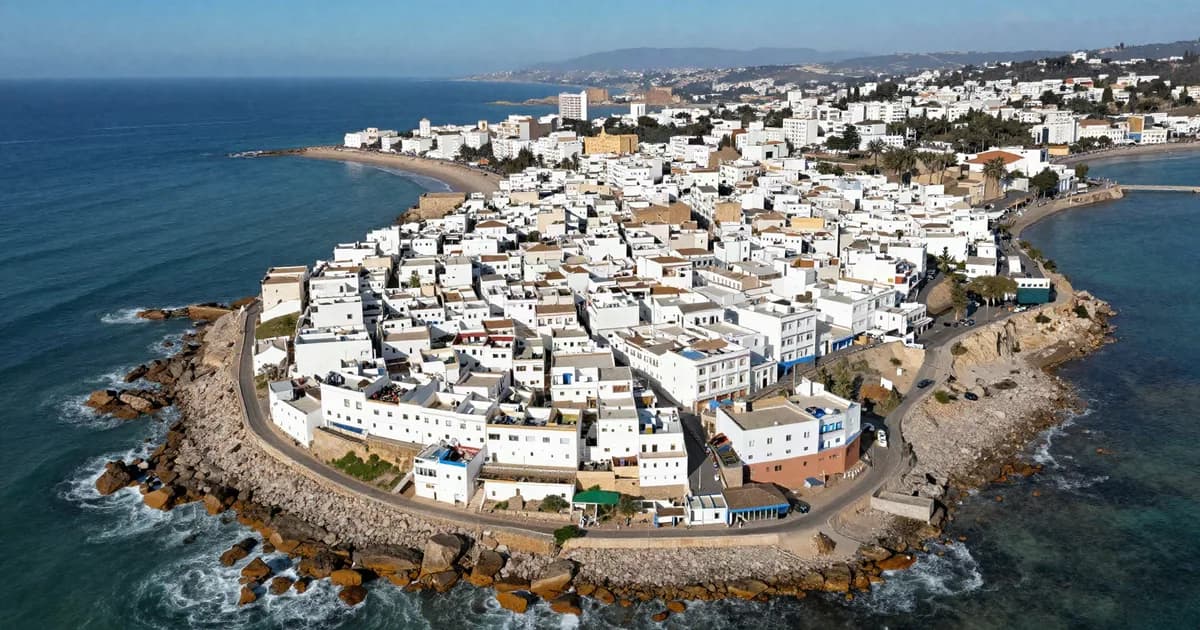
Al Hoceima is a coastal town backed by abrupt mountain relief. Its bay and the Quemado beach form the urban core; to the west lies the Al Hoceima national park, and the coast continues in a succession of coves and small harbours, Cala Iris among them. The town has a port and an airport, and its road connections were transformed by the Mediterranean coast road, which runs along the shoreline between the Tangier-Tetouan area and the Nador-Saidia axis.
The local economy rests on inshore and artisanal fishing, trade and services, a strongly seasonal tourism whose summer peak is very largely the return of emigrant families, mountain agriculture in the hinterland, and a construction sector fed by remittances. Since 2015 the province has also been the object of a public urban and tourism development programme, “Al Hoceima, Manarat Al Moutawassit”, which has accompanied several development operations.
For a valuer, that profile has a very concrete consequence: a narrow market, active for a few weeks a year, in which transaction references are scarce and heterogeneous and where two neighbouring properties can be worth very different amounts. It is exactly the sort of market where an independent valuation is worth more than an estimate formed by intuition.
2. Emigration to the Netherlands and Belgium: the key to reading the stock
The eastern Rif and the Al Hoceima area are among the principal historic sources of Moroccan emigration to the Netherlands and Belgium, and to a lesser degree Germany. That is not sociological scene-setting: it explains how much of the local building stock was produced.
- A stock financed from abroad. Houses, small income-producing blocks, seafront flats: a large share was funded by families settled in the Netherlands or Belgium, frequently through self-promotion, with the family running the build directly rather than buying from a developer.
- Ownership often held “in the name of” someone. The property was frequently registered in the name of a relative who stayed behind, for practical reasons at the time of purchase or construction — with the consequences one can guess at when it comes to be passed on.
- Long-standing undivided holdings. On the death of the registered holder the property very often remains undivided between heirs spread over two or three countries, with no common figure ever having been put on the table.
- A market timed by the returns. The mass return in summer opens a window of viewings, family discussions and transactions; for the rest of the year the market is illiquid.
A valuer who ignores that mechanism misses the substance. At Al Hoceima the question is almost never “what is this property worth” in the abstract, but what is it worth, in what actual condition, on what title, and over what realistic selling horizon.
3. Reading the stock through the earthquake of February 2004
The province of Al Hoceima was struck by a destructive earthquake in February 2004, followed by a large public programme of reconstruction and assisted reconstruction, particularly in the rural communes of the hinterland. More than twenty years on, that episode remains a lasting key to reading the local building stock.
In practice the valuer meets three families of building on the ground, and they are not equivalent:
- buildings reconstructed within the public programme, with technical supervision and, sometimes, supporting records kept by the family;
- buildings repaired without technical supervision, as means allowed, where it is not known what was treated in depth and what was simply covered over;
- older buildings, never strengthened, left as they were.
The region is moreover classified as one of appreciable seismic activity in Morocco, and construction there is governed by the Moroccan seismic design rules RPS 2000, revised in 2011. A property built or rebuilt within that framework, with design and compliance records, does not present in the same way as one whose technical history is entirely undocumented.
A limit has to be stated plainly. The valuer records and documents the apparent condition of the fabric and whether design and compliance records exist or not, and draws the consequences in value, including in the form of explicit reservations. But a structural diagnosis — load-bearing capacity, behaviour under seismic loading, sizing — belongs to a structural engineer or an engineering practice, not to a valuation instruction. A serious report says what it saw, says what it could not verify, and refers the rest to the right discipline. That is the difference between an opinion of value that can be defended and an assertion that cannot be checked.
4. What separates two neighbouring properties
On the Rif coast the spread of values between properties close together is wider than in a town on a plain. Four families of factor explain it.
- Relief and marine exposure. Sloping sites, retaining walls whose condition governs everything else, risks of slippage and run-off in heavy rain, difficult access — sometimes impassable to a vehicle — and marine exposure: salt spray and corrosion attack steel, joinery and renders. Two parcels a few metres apart can belong to two different technical realities. On the damage side, our note on damp, rising damp and water ingress sets out how such defects are recorded.
- Incremental self-build. Many properties were built without full consent or certificate of compliance, with measured areas differing from the documents and floors added as remittances arrived, each with its own standard of execution. Measuring on site is not a formality: it is often the first correction brought to a family's own idea of what it owns — see our note on floor area and price per square metre and, for owners building from abroad, our guide to supervising a build in Morocco remotely.
- Tenure position. Unregistered property is frequent in the hinterland, collective regimes exist in some rural areas, family holdings are undivided across several generations, and boundaries are imprecise, calling for a contradictory demarcation. The value of a property whose legal consistency is not established is never that of one registered and demarcated — our grid of the five tenure statuses and their effect on value and our guide to titled property against a moulkia set out the grades.
- Seasonality and a shallow market. A buyer able to afford this kind of property may not appear until the following summer. A realistic marketing period therefore has to form part of the opinion of value — without it, the figure announced is not a market value but a hope.
5. What we are actually instructed for
Requests reaching us from Al Hoceima and the Rif coast follow a few recurring patterns:
- Succession and partition between heirs spread across Morocco, the Netherlands and Belgium — a neutral figure, set by a third party, defuses a family discussion far better than one advanced by one of the co-heirs. The valuation side is covered in our guide to valuing property in a Moroccan succession.
- One heir buying out the others: whoever stays buys the shares — which still requires the buy-out price to rest on a documented basis. The mechanics are in our note on dividing an undivided property and the discount question in our study of discounts applied to undivided shares.
- Selling from a distance: setting an asking price that can be defended without being there. See our guide to selling a Moroccan property remotely.
- Insurance value on a reinstatement cost basis — an exercise in its own right on a self-built stock in hilly terrain: see our guide to reinstatement cost assessment.
- Keep or sell the family house: the commonest question of all, and the one where an outside opinion, costed and argued, is worth most.
Where the estate itself has not been formalised, the preliminary steps are described in our notes on the inheritance deed (iratha) before adouls and on registering heirs on a land title.
6. How a remote instruction runs
The format is simple: the client stays in the Netherlands or Belgium; the valuer travels to the property, records the condition, the floor areas and the surroundings, documents the inspection with photographs and video, then delivers the report remotely and talks it through by video call where that helps. The owner does not need to travel. The full sequence is set out in our guides to how a valuation is conducted in Morocco and to instructing one from abroad, with the preliminary work in our twelve-point remote checklist. Country-specific guidance for owners based in Belgium is in our guide for Moroccans in Belgium.
7. Coverage, timing and fees
Al Hoceima is outside our six cities — Casablanca, Rabat, Marrakesh, Tangier, Fez and Agadir — and there is no local office there. The town and the Rif coast are covered from that network: attendance is arranged on request, with a travel lead time, and travel costs are quoted separately from the fee. Eastwards along the same shoreline, our reading of the Nador and Nador West Med market and of the Saidia and Berkane markets covers the neighbouring coast; westwards, our note on valuing a second home on the Tetouan coast.
A firm quote is issued within 24 hours, the standard report is delivered in 5 to 8 days and the express service in 48 to 72 hours, with fees starting at 3,500 MAD excl. tax — the wider fee framework is in our note on what a property valuation costs. Our RICS-certified experts document the apparent condition, the measured areas, the tenure position observed, the comparable evidence relied on and the value, with an explicit marketing period, complying with Red Book standards. The reasoning is documented and verifiable line by line, and it binds no one: it informs a decision and an arm's-length negotiation between co-heirs or with a buyer. ReaConsult has been advising owners and investors since 2019, with more than 5,000 valuations completed, a presence in 6 cities and client reviews published on our Google profile.
A house at Al Hoceima or on the Rif coast, held undivided or about to be sold? Have the condition, the measured areas and the tenure established before a figure is discussed — attendance on request, travel costs quoted separately, the whole instruction run from the Netherlands or Belgium.
Request a valuation →Related articles
Note:this article describes market situations and a valuation methodology; it is neither legal advice nor an estimate of any particular property. It deliberately contains no price per square metre, rate or yield for Al Hoceima. Tenure status, the devolution of an estate and planning consents are matters for your notary, the adouls and the competent authorities; the structural diagnosis of a building is a matter for a structural engineer. The regimes referred to — the seismic design rules RPS 2000 as revised in 2011, and the tenure statuses — are those in force; confirm the position of your own property with the competent bodies. Every file is assessed case by case. A private valuation informs a decision and an arm's-length negotiation; it binds no one. To instruct us, see our contact page or the property blog.