
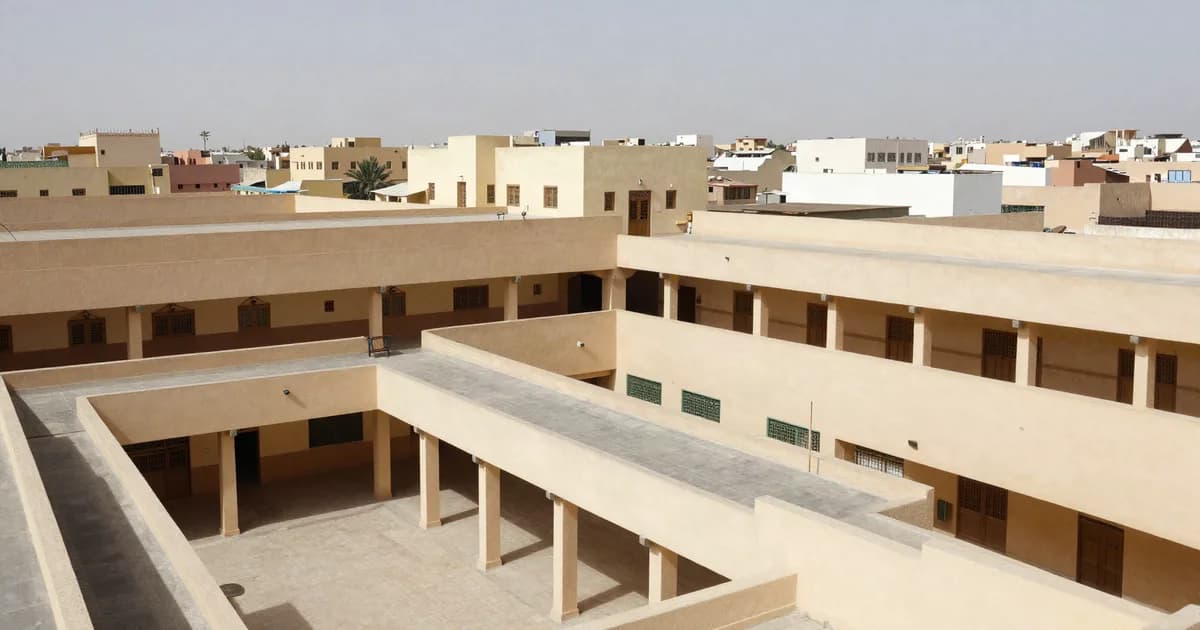
A family that has enrolled its child elsewhere at the start of term does not come back mid-year. That single sentence governs how a school's insurance programme should be calibrated.
1. Why a school is an insurance case of its own
On most assets a loss translates into a financial cost that time can absorb: you rebuild, you re-let, you catch up. A school, by contrast, is tied to a calendar nobody can shift. Enrolments are taken before the summer, fees are committed, and on the first day of term the pupils turn up. If the buildings are not fit to receive them, the operator loses more than months of trading: it loses families, and a family that has left at the start of term does not come back mid-year. The insurance consequence is direct — a school's programme has to be calibrated not on what it would cost to rebuild one day, but on what it would cost to be operational again in time.
To that must be added the nature of the public received. An education facility takes in minors, under supervision, in premises where the requirements on safety, evacuation and access control are heavier than in an ordinary building. Those requirements carry a construction cost — and therefore a reinstatement cost. The general principle of insurance value — reinstatement cost as new, land excluded, adjusted to the policy — is set out in our complete guide to reinstatement cost assessment; what follows is how it applies to a school campus.
2. What drives the reinstatement cost of a school campus
The first error is to reason about “the school”, in the singular, as though it were one building. A school is an estate, usually built in phases, and the sum insured has to reflect every component.
- The teaching blocks — classrooms, wide circulation, staircases sized for evacuation, numerous WC blocks. Generous escape routes and evacuation constraints make the construction more expensive than an office building of the same usable area.
- The specialist rooms — science laboratories with their benching, services and extraction, IT rooms and their technical installations, art rooms, technology workshops. These are technical spaces disguised as classrooms, and reinstating them costs a great deal more than a general-purpose room.
- School catering — production kitchen, stores and cold rooms, wash-up, extraction and air handling, dining halls. A catering kitchen is industrial plant: it warrants a costing of its own, distinct from the rest of the fabric.
- The gymnasium and sports facilities — indoor hall with its long spans, changing rooms and showers, outdoor courts, pitches, ball-stop fencing and lighting. The gymnasium is frequently the most expensive building per square metre on the site, and the one most often absent from the declared sums.
- Covered play areas and the playground — shelters, surfacing, play areas, external furniture and shade structures: built works, not mere landscaping.
- The boarding house, where there is one — bedrooms, shared sanitary facilities, common and study rooms, associated kitchen and laundry, with the level of equipment and safety proper to accommodating minors.
- Administration, the medical room and the library — head's and pastoral offices, staff room, treatment room, resource space and its fixed fittings.
- Staff accommodation — caretaker's or staff housing on the site: fabric in its own right, and very rarely declared.
- Boundary walls, access control, drop-off and parking — perimeter walls, gates, gatehouse, control systems, pupil drop-off areas and car parks. On a school site, the length of boundary wall alone is a significant item.
To those works the sum insured must add the professional fees — architect, engineers, technical control — demolition and debris removal, and rebuilding to the requirements in force at the date of loss. The policy then determines the basis of settlement — as new or less depreciation — and the assessment delivers both readings, with depreciation reasoned by component: the structure of a teaching block does not age like the equipment of a catering kitchen or the sports floor of a gymnasium.
3. Responsibility, safety and current standards
A school is a place open to the public, and to a particular public: minors, in numbers, over long periods of the day. The requirements that follow — fire safety, escape routes and evacuation conditions, access control, safety of playgrounds and sports equipment, accessibility — bear on the design as much as on the construction. Two consequences for insurance value.
First: the building costs more to rebuild than an ordinary building of the same area. Wider circulation, staircases sized for evacuation, safety installations, the robustness imposed by intensive use: none of that shows up in a generic cost ratio. A sum insured set on an “average” construction cost structurally understates the facility.
Second: the reconstruction will have to meet the requirements in force at the date of loss, not those of the year of construction. A facility built several decades ago and then extended in phases is not rebuilt identically: it is rebuilt to the regulations applicable at the time of the works, which can make the operation more expensive. The consent and safety requirements applicable to education facilities arise from the regulations in force; the assessment takes them into account in the costing, but their legal interpretation is a matter for the school's own advisers.
One point deserves to be made explicit, because it is a recurring source of confusion: the insurance value of the property does not cover the school's liability. The sum insured on the buildings answers for the cost of rebuilding; the school's responsibility towards its pupils, their families, its staff and third parties falls under separate cover, with its own definitions, exclusions and limits. These are two strands of one insurance programme, and securing one does not settle the other. An insurance valuation secures the material damage strand; the liability strand is worked through with the insurer and the school's own advisers.
4. Capacity: the economic dimension the sum insured does not reach
In an education facility the link between the fabric and the economics of the operation is direct: the number of pupils taken in depends on the built area and on the number of rooms available. A school is not merely a shelter for an activity — it sets its ceiling. That is what distinguishes an education asset from an office or a warehouse, where the operation can densify or move.
The question turns sensitive at the point of reconstruction. Nothing guarantees that a facility rebuilt after a loss will restore exactly the capacity it had before. The requirements applicable at the time of the works may impose more generous circulation areas, additional ancillary rooms or a different arrangement of floors; site constraints — the developable footprint, planning rules, set-backs — may prevent the same number of rooms from being recovered. A reconstruction that is compliant but less capaciouspermanently curtails the operator's revenue capacity, well beyond the period of the works.
That is a point the sum insured, on its own, does not address: it funds the rebuilding of the fabric, not the shortfall from a permanently reduced capacity. It therefore has to be discussed with the insurer in advance, when the programme is being scoped — which covers, which definitions, how they articulate with business interruption. The assessment brings the technical substance to that discussion: what exists, what it consists of, what it would cost to reinstate, and the points where rebuilding identically cannot be taken for granted.
5. Rebuilding fast: interim arrangements and the indemnity period
A damaged office building can be rebuilt at the pace of the construction programme; a school cannot. Between the loss and the reopening, the school has to keep receiving pupils. That means fallback arrangements, which carry a cost and cannot be improvised.
- Temporary or modular accommodation — installed on the site or nearby, with connections, sanitary facilities, safety and accessibility: an operation in its own right, not simply hiring cabins.
- Taking pupils in on another site — leasing premises, bringing a building not designed for teaching up to standard, transporting pupils, moving teaching materials.
- Reorganising the timetable — rotas, split sessions, extended hours: measures that limit the damage but mobilise additional staff and weigh on operating costs.
- Replacing teaching equipment — furniture, laboratory apparatus, the IT estate, the library stock: without them, temporary walls are not enough to run the school.
These items must be anticipated in the insurance programme, not discovered after the loss. And they drive a second decision that is often neglected: the indemnity period under business interruption cover. It has to be coherent not only with the time needed to rebuild — design, consents, construction, handover — but also with the time needed to rebuild the roll. A family that has enrolled its child elsewhere at the start of term does not come back mid-year; the return to equilibrium is spread over several enrolment cycles after the reopening. A period set on the construction programme alone leaves the operator alone through the longest part of the loss.
No average rate per square metre for a school
No per-square-metre rate for a Moroccan school campus is offered here, and none should be borrowed from a general construction average: a classroom, a science laboratory, a catering kitchen and a sports hall sit too far apart for a single figure to describe them. The reinstatement cost is built up building by building and component by component, by reference to costs observed on comparable works, with every input stated in the report.
6. Who insures what: property owner, operator, governing body
Private schools are rarely owned and run by the same entity. The typical structure combines a property-owning company, an operating company that runs the school, and sometimes an association or foundation as governing body. Each carries a different risk, and each has to be insured for what it actually bears.
- The owner of the property insures the fabric: teaching blocks and ancillary buildings, gymnasium, boarding house, staff accommodation, boundary walls and external works, at the full reinstatement cost — fees, debris removal and compliance included.
- The operator insures what it has financed itself: alterations and improvements made in the premises it occupies, kitchen equipment, school furniture, teaching materials, the IT estate, the library stock — and its business interruption.
- Liability is allocated by role: the owner's responsibility as owner of the building, the operator's responsibility towards pupils and families, staff responsibilities. That strand is not to be confused with the sum insured on property.
Where those three perimeters coexist, the question that matters is where the boundariesrun. Does an alteration made by the operator in a building owned by the property company fall under the “building” sum insured or under the “tenant's alterations” heading? Are the catering kitchen's installations fixtures attached to the fabric, or trading equipment? Depending on the answer, the same work will be insured twice — premium paid for nothing — or not at all — a gap discovered on the day of the loss. An assessment that schedules and allocates work by work allows each item to be attached to the right heading of the right contract.
7. The average clause applied to a school
The average clause is a standard mechanism of material damage policies: where the declared sum insured is lower than the real value of the property at the date of loss, the settlement is reduced in the same proportion — including on a partial loss. A fire confined to one teaching block, damage affecting the catering kitchen, a gymnasium roof lost in a storm: the settlement is pared back pro rata to the under-declaration, and the balance stays with the school — at precisely the moment it has to fund an emergency reopening. On a school campus, underinsurance sets in by very identifiable routes.
- An extension or a new year group never redeclared — a school grows in stages: the middle school opens, then the upper school, a wing is added, a storey is built on. Every phase built without updating the sum insured widens the gap against the real cost of rebuilding.
- The gymnasium or the canteen built later — these are typically “second generation” facilities, built once the school was established, and rarely reflected in a policy placed at the outset.
- The figure inherited from the purchase of the land and the first buildings — a historic number mixing land and construction, frozen while construction costs moved and the site densified.
- Sports facilities and boundary walls outside the perimeter — courts, pitches, lighting, ball-stop fencing, perimeter walls, gates and gatehouse: expensive works, scattered across the site, that nobody thinks to declare because they do not look like “buildings”.
- Laboratories and IT rooms refitted — a heavy investment in services, benching, extraction and fixed equipment, carried out within existing rooms, which appears nowhere in the sum insured because the floor area itself has not changed.
The opposite trap exists too. The prudent school that declares the market value of its site, land included, pays a premium every year on a land component that will never be settled: land does not burn and remains after the loss. In both directions, only a calculated sum insured protects the settlement and the premium at once. The precise operation of these mechanisms depends on the wording of each policy; the general trap is set out in our article on underinsurance and the proportional rule.
8. The RICS method: the cost approach applied to a school
The RICS Red Book recognises insurance value as a basis distinct from market value; the corresponding technical route is the cost approach. For a school campus, the instruction run by our RICS-certified experts covers:
- Inspection and survey building by building — every structure on the site surveyed separately: teaching, specialist rooms, catering, sport, boarding, administration, staff accommodation, covered play areas, boundary walls and external works. Nothing is left outside the perimeter, and the phasing of construction is reconstructed.
- Breakdown by component — for each building, structure and weathertight envelope, second fix, services packages, fixed installations. It is that breakdown that makes the sum insured legible and discussable with the insurer, rather than a global figure that cannot be supported.
- Costing as new — reinstatement cost item by item, by reference to costs observed on comparable works, taking in professional fees (architect, engineers, technical control), demolition and debris removal, and the uplift for rebuilding to the requirements in force.
- Depreciation by component — reasoned deductions component by component, to deliver the “less depreciation” reading where the policy requires it: the structure of a teaching block, the equipment of a catering kitchen and the sports floor of a gymnasium do not age at the same pace.
- Consistency with the policy definitions — the contractual definitions (building, outbuildings, alterations, contents, equipment) read across so that every work is attached to the right heading of the right contract, as between the owner of the property and the operator, with no duplication and no gap.
The deliverable is a dated and signed report, compliant with Red Book standards, setting out the description and survey of the estate, the costing broken down by building and by component, the depreciation analysis, and the figure to declare under the contractual basis. It is a private valuation: documented and verifiable line by line, at placing as much as after a loss. It does not bind the insurer, and it is not a substitute for the policy wording — what it does is replace an estimated figure with a reasoned one that both sides can follow.
9. When to refresh the sum insured
- At placing or on a change of insurer — the natural moment to substitute a calculated figure for an estimated one.
- After each phase of works — extension, additional storey, a new year group, a gymnasium, a canteen or a boarding house created, laboratories or IT rooms refitted.
- When construction costs have moved appreciably — materials, labour and requirements make reconstruction more expensive independently of the property market.
- On an acquisition or a restructuring of the owner/operator arrangement — where the figure carried over from the deeds mixes land and construction.
ReaConsult fees start at 3,500 MAD excl. tax; a school is quoted case by case according to the number of buildings, the presence of specialist rooms, of a catering operation, of a gymnasium or of a boarding house. Firm quote within 24 hours, a report compliant with Red Book standards in 5 to 8 days, 48-72 hours on the express service. ReaConsult has been operating since 2019, with more than 5,000 valuations completed, offices in 6 cities and client reviews published on our Google profile.
Is your school insured for the right sum? Have the reinstatement cost established building by building — gymnasium, canteen, boarding house, boundary walls and staff accommodation included.
Request a valuation →Related articles
Note:this article sets out a valuation methodology compliant with RICS standards (Red Book, cost approach). The average clause is a standard insurance mechanism whose application depends on the wording of each policy: refer to your contract and to your own advisers. The consent and safety requirements applicable to education facilities arise from the regulations in force and from their interpretation by your advisers. A private valuation informs the placing of cover and an arm's-length negotiation. To instruct us, see our contact page or the property blog.