
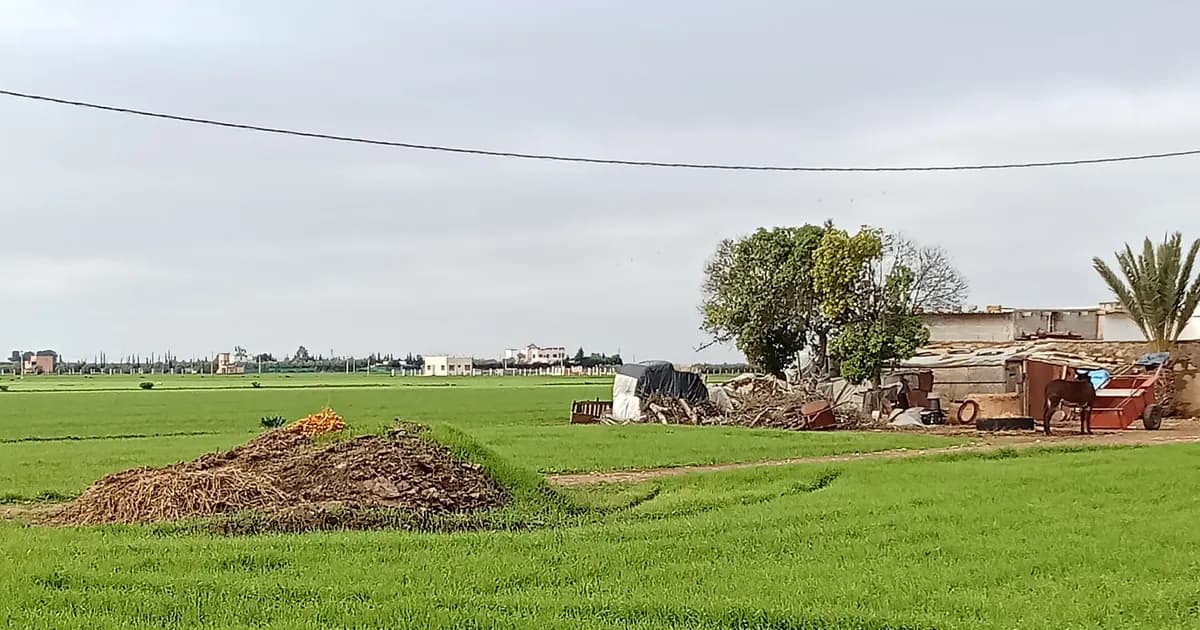
1. What the appraiser looks at first: the real access
Before any calculation, the appraiser visits the site and asks a simple question: how do you actually enter the plot today? The answer can differ a lot from what the cadastral plan shows. A path may have been used forever without anyone formalising it, or the plan may show an access that does not exist on the ground.
The report therefore describes three things, with no technical judgment on any structure: the access observed (track, path, passage between two fences), the access provided for in the documents (title, plan, deed) and any gap between the two. That gap is exactly what drives the discount or the caution.
- Does the plot touch a public road, even over a short length?
- If not, which neighbouring land must be crossed, and does it belong to one owner or several?
- Is the passage used continuously, and by whom (owner, tenant, farmer)?
- Is it passable in all seasons and for the intended uses (on foot, light vehicle, construction machinery)?
2. Right of way: registered on the title or not
A right of way for a landlocked plot is provided for by the Real Rights Code (law 39-08, article 64): an owner whose land has no outlet, or an insufficient outlet, to a public road may obtain a passage across neighbouring land, against adequate compensation, at the point that causes the least harm to the land crossed. Where the landlocking results from the division of a plot, the passage is claimed over the lots created by that division (article 65). Our guide to property easements under code 39-08 sets out the regime.
For valuation, what matters is less the principle than the proof of the right. The appraiser distinguishes three situations:
- Easement registered on the land title: the right follows the plots and binds successive owners. This is the safest case.
- Easement set out in a deed but not registered: on titled land, the deed takes effect, even between the parties, only from its entry on the land title (dahir of 12 August 1913, article 67). Until then, a buyer takes over an unfinished step, not a secured right.
- De facto passage, nothing in writing: it rests on habit and goodwill. A change of owner next door can call it into question.
The report states which category applies and what was checked (title, deed, statements collected). It does not claim to settle a right in place of the courts: it documents the situation and draws the consequence for value.
3. Width and route of the passage
A "sufficient" passage is not the same for a plot used on foot and for a plot meant to host a building site. Width and route matter for three reasons: they determine which vehicles can get in, they fix how much of the neighbour's land is burdened, and they decide whether the access could one day be relied on as the road serving a building.
The appraiser records what is visible and what the documents say. He does not carry out a survey: the precise delimitation of the passage on the ground is a job for a licensed land surveyor, whose plan then feeds the deed and its registration. On this split of roles, see the role of the land surveyor and our article on adversarial boundary surveys.
4. Buildability depends on access
This is often the heaviest point for value. A plot can be zoned as buildable by the urban plan and still be hard to build on if access is insufficient. Urban planning regulations make building authorisation depend on servicing requirements: a project that cannot be connected to a road, or whose access road is not secured, runs into difficulties when the application is made.
The appraiser does not rule in place of the authorities. He does what he can do: read the zoning, record the state of the access, and write down the assumption on which the value rests. For zoning, see our guide to land valuation: zoning and buildable potential.
5. How the lack of access weighs on value
We give no discount percentage: there is no scale for landlocked plots. The gap is measured on comparable sales of plots with the same zoning, similar size and in the same area, with and without direct access. The report reasons with two written assumptions:
- Value with secured access: that of a comparable plot with direct access or a registered easement.
- Value in its current state: the previous value, reduced by what a reasonable buyer deducts for the cost, delay and uncertainty of securing the passage.
The value retained is single and reasoned. It depends on how solid the passage is, its width, the buildability it allows and the size of the buyer pool: a landlocked plot interests fewer buyers, often the neighbour who is crossed or a buyer willing to negotiate the passage himself. That scarcity of buyers is part of the discount, and the report explains it.
6. What the owner can do before selling
Being landlocked is not always a dead end. Before putting the plot on the market, several steps can add value without promising anything:
- Check the title: is an easement already registered? Charges appear on the land title, available from the land registry.
- Formalise the passage by a deed, with the neighbour's agreement on location and any compensation, then have it registered on the title.
- Have the passage plotted by a licensed land surveyor so the deed describes a precise route and width.
- Consider buying a strip or swapping parcels with the neighbour where direct access is possible.
- Have the plot valued under both assumptions (before and after securing access) to see whether the effort is worth its cost.
If the plot results from a poorly designed subdivision or a partition, the enclosure sometimes has a precise origin, which shows in the title history. Where relevant, a notary and a lawyer validate the legal arrangement.
7. Two frequent mistakes
Believing the law settles everything. A statutory right of way exists, but its route, width and compensation still have to be fixed. Until that is done, a buyer sees a possible dispute and deducts it from the price.
Confusing tolerated access with guaranteed access. A friendly neighbour today is not necessarily one after a sale or an inheritance. The appraiser does not count on goodwill: he writes down what is registered, what is in writing and what rests on habit only.
The report given to the owner states, for each of these points, what is established, what is assumed and what difference it makes to value. It is documented and verifiable line by line, and binds no one: anyone can challenge it item by item.
8. Checklist before buying or selling
- Record of the real access (photos, description) compared with the plan.
- Up-to-date land title: registered easements and charges.
- Easement deed, if any, with route and width.
- Identity of the owner or owners of the land crossed.
- Approved zoning and the consequences of access for the right to build.
- Written value assumptions: with secured access, in current state.
- Plan of the passage by a land surveyor if the route has to be fixed.
9. FAQ
My plot is landlocked: am I entitled to a passage across my neighbour's land?
The Real Rights Code (law 39-08, article 64) allows the owner of a landlocked plot, with no outlet or an insufficient outlet to a public road, to obtain a passage across neighbouring land, against adequate compensation and at the point that causes the least harm to the land crossed. Have your own situation confirmed by a notary or lawyer.
Does an easement not registered on the title have value?
On registered (titled) land, an easement deed takes effect, even between the parties, only from the date it is entered on the land title (land registration dahir of 12 August 1913, article 67). Until it is entered, the appraiser treats the passage as a risk and writes it into the value assumptions.
How much value does a landlocked plot lose?
There is no fixed percentage. The gap is measured on comparable sales of plots with and without access, then adjusted for how solid the passage is, its width and the buildability it allows.
Can a buildable but landlocked plot get a building permit?
It depends on the servicing requirements of urban planning rules and the applicable development plan. Unsecured access makes the application uncertain. The appraiser writes down the assumption used without replacing the authorities.
Who plots and measures the passage on the ground?
A licensed land surveyor. ReaConsult values property; it does not carry out surveys. The surveyor's plan feeds the easement deed and its registration.
How much does valuing a landlocked plot cost?
From 6,000 MAD excl. VAT for a plot, firm quote within 24 hours, report in 5 to 8 working days (48-72 h express with a surcharge).
A plot without direct access to buy or sell? Have the assumption written before the price is set.
RICS-certified experts. A report documented and verifiable line by line: observed access, easement, value assumptions. Firm quote within 24 hours, report in 5 to 8 working days.
Related articles
Note: The right of way and its registration fall under the Real Rights Code and the rules in force; each case has its own features. This article is methodological and does not replace the advice of a notary or lawyer. To have your plot valued, see our real estate appraisal page.