
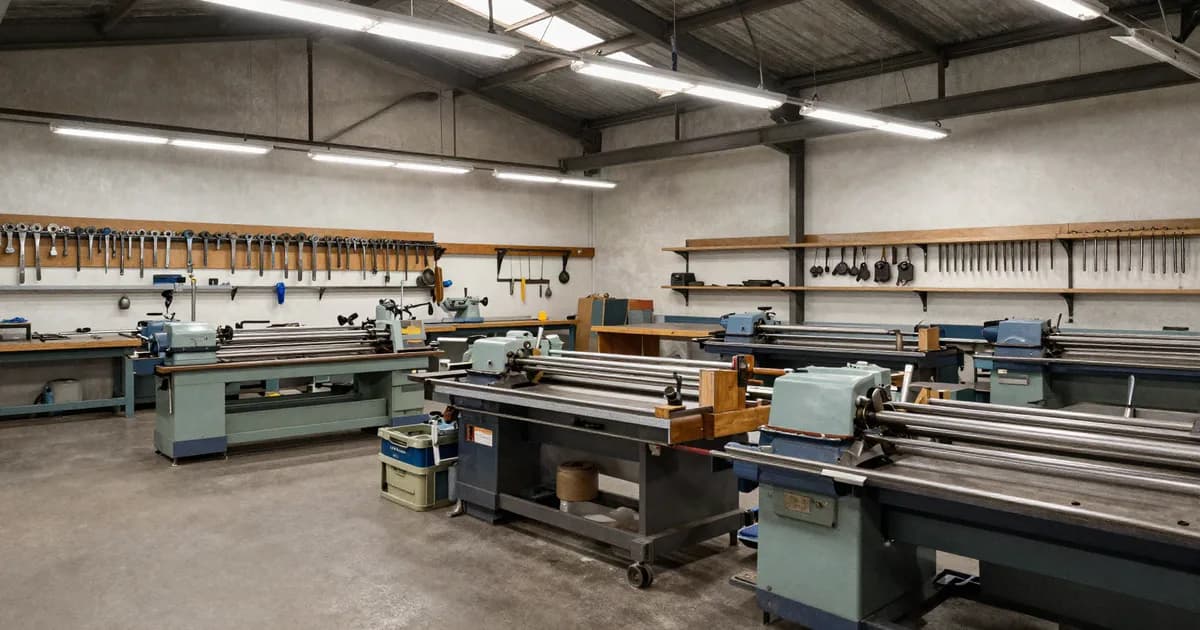
Why the workshop is the industrial asset that actually trades
An integrated factory is built around one company's process and rarely changes hands intact. A workshop is different: it is bought, sold and let. Growing SMEs, industrial artisans, sub-contractors and trade distributors generate continuous demand on active estates, which means the valuer has something the specialist-asset valuer usually lacks — observable letting evidence. Value can be founded on the market rather than on construction cost.
Our general guide to valuing an industrial asset in Morocco places the workshop at the generic end of the spectrum, opposite the purpose-built plant. But every real workshop departs from that ideal to some degree, and the whole substance of an instruction lies in measuring the departure. A shed with a five-metre eaves height and a domestic electricity supply is not the same asset as a crane-served hall with a thickened slab, even if the two share a postcode and a floor area.
For readers unfamiliar with the Moroccan market: an industrial estate (zone industrielle) is a zoned area, usually developed by a public or semi-public promoter, where plots are sold or leased with industrial planning permission attached and a set of estate regulations governing site coverage, setbacks and permitted activities. Location within, or outside, one of those estates is the first fact a valuer establishes — it determines both what may lawfully be done on the site and who would buy it. Our mapping of Morocco's industrial zones sets out how the main catchments differ.
The attributes that create the value
Versatility comes first
A workshop is worth, above all, the number of activities it can accommodate without works. An unobstructed column grid, a decent clear height, direct lorry access, a balanced ratio of office to production space, a yard deep enough to manoeuvre in. The more versatile the unit, the wider the pool of occupiers, the shorter the probable void, and the more robust the rental value underpinning the valuation.
The corollary matters just as much. Every specialisation — inspection pits, over-thickened floor slabs, process partitioning, extraction hoods fixed to a particular layout — narrows the market and must be tested with a single question: does this serve the market, or only the occupier currently in the building? The technical characteristics that recur in this analysis are catalogued in our note on the technical specification of Moroccan industrial buildings.
Under-hook height and crane gantries
For heavy machining and fabrication, the height that matters is not the height to the underside of the roof truss but the under-hook height — the clear lift available beneath the crane hook, which governs the size of the components that can physically be handled in the building. A structure designed to carry overhead travelling cranes, with runway beams, strengthened columns and deeper foundations, is what separates a genuine workshop from a plain shed.
The valuer verifies the real capacity of the structure, separates it from the cranes themselves (which fall within a plant and machinery valuation, not a property valuation), and then confronts that capacity with local demand. Reinforcement that no occupier in the catchment needs is expenditure that has been incurred, not value that has been created. That distinction is unglamorous and it is where most owner expectations break.
Utilities: power, air, extraction
Installed electrical capacity, a dedicated transformer substation, compressed air distribution, extraction and treatment of welding or paint fumes: these determine what the building can actually be used for. The valuer documents what is properly part of the property — the substation enclosure, buried ducts, fixed distribution — and what is plant, then assesses the gap between what exists and what the market now expects. A unit whose supply must be reinforced before production can start carries a discount that a prospective buyer will price precisely, because the works have both a cost and a lead time.
Own, finance or acquire a workshop in Morocco and need the rental and capital evidence set out properly?
💬 Chat with a RICS-certified expert on WhatsAppThe RICS methodology in practice
Capitalised rental value: the primary approach for a versatile building
The valuer reconstructs a market rent from lettings of comparable workshops in the same catchment, adjusting for floor area, height, condition, the proportion of office accommodation and the quality of access, then capitalises that income allowing for voids and the actual state of occupancy. Online asking rents are read as an indicator of market tension, never as firm comparable evidence — the gap between quoting and signing can be material on a slack estate. Where the workshop is owner-occupied, the reconstructed rental value remains the backbone of the reasoning, because the value of the building does not depend on the identity of the person standing in it.
The capitalisation rate applied to that income is itself an evidenced input rather than a convention; our review of industrial capitalisation rates in Morocco explains how the range is derived and why it varies by catchment and covenant strength.
Depreciated replacement cost (VPGA 5): cross-check, then primary method
For heavily equipped workshops — heavy roof structures, thick slabs, exceptional heights — the generic letting market stops explaining the asset, and depreciated replacement cost takes over. DRC is a cost-based approach set out in VPGA 5 of the RICS Red Book Global Standards: the cost of replacing the asset with a modern equivalent, less deductions for physical deterioration and functional and economic obsolescence. Each deduction must trace back to something recorded on inspection, not to a flat percentage, and the whole exercise is checked against the occupier question: who, in this catchment, would pay for these reinforcements?
Direct comparison where a sales market exists
On estates where workshop sales are observable, direct comparison completes the analysis. The valuer adjusts for floor area, age, the residual development capacity of the plot and the tenure position — a let workshop and a vacant one address entirely different buyers. Residual capacity is easily missed: an under-developed plot on an active estate carries a development value that income alone will never reveal, a point developed in our guide to land valuation and buildable potential in Morocco.
What the valuer needs from you
- Title and planning. The land title (in Morocco, registered land is recorded at the ANCFCC, the national land registry, and the title certificate is the primary evidence of ownership and encumbrances), the estate regulations and zoning, site coverage, residual buildable capacity, easements.
- The building. Areas by use — production, storage, offices — clear height and under-hook height, column grid, slab loading capacity, crane runways where present.
- Utilities. Installed electrical capacity, transformer substation, compressed air, extraction, fire safety provisions.
- Occupancy. Owner-occupation or an existing lease — rent passing, unexpired term, indexation — and any works carried out by the tenant.
- Market. Letting and sale evidence for comparable workshops in the estate, observed vacancy, the direction of travel of the catchment.
Where the unit is let, the lease terms do more than set the rent. Moroccan commercial leases are governed by a specific statute with its own renewal and indemnity mechanics, summarised in our note on commercial lease law 49-16; and where the passing rent sits above or below market, the valuation has to be structured on a term and reversion basis, as explained in our guide to valuing over-rented and under-rented property in Morocco.
Common traps
- Valuing reinforcement the market has not asked for. An overhead crane in a catchment with no heavy engineering demand generates no premium.
- Mixing bricks and plant. Cranes, machine tools and spray booths belong in a separate plant and machinery valuation. Adding the two together produces a number that is of no use to a lender, an auditor or a buyer.
- Extrapolating from asking rents. Quoted rents are not signed rents, and the gap widens on estates with weak demand.
- Ignoring residual development capacity. An under-built plot on an active estate holds value that the income approach alone will not surface.
- Overlooking environmental condition. Oils, solvents and paint operations leave traces. Workshop contamination exists, and it lands on the buyer's liability rather than the seller's conscience.
What the report is for
Bank finance secured on the building, a sale of the workshop with or without the business, the exit of a shareholder, statutory or IFRS accounts, an arbitrage between letting and selling: the report sets out a reasoned value, suitable for amicable negotiation and adversarial discussion. It is a private valuation. If a matter proceeds to litigation, the court appoints its own expert — that appointment is the judge's, never the parties'.
Our reports are prepared by RICS-certified valuers and comply with the RICS Red Book Global Standards, in English, with the bases of value, assumptions and valuation date stated on the face of the report. Fees for industrial instructions are quoted individually and start from MAD 3,500 excluding tax for standard assets, with a quotation within 24 hours. ReaConsult: founded 2019, more than 5,000 valuations completed across 6 Moroccan cities, over 1,000 per year, with client reviews published on Google. Planning, operating permits and environmental compliance are matters for the competent authorities and for your own legal advisers; a valuation report records what is observable and prices its consequences.
Sale, refinancing or portfolio arbitrage on an industrial workshop?
Describe the unit — estate, areas, heights, utilities, occupancy — and we reply in English within 24 hours with a firm quotation.