
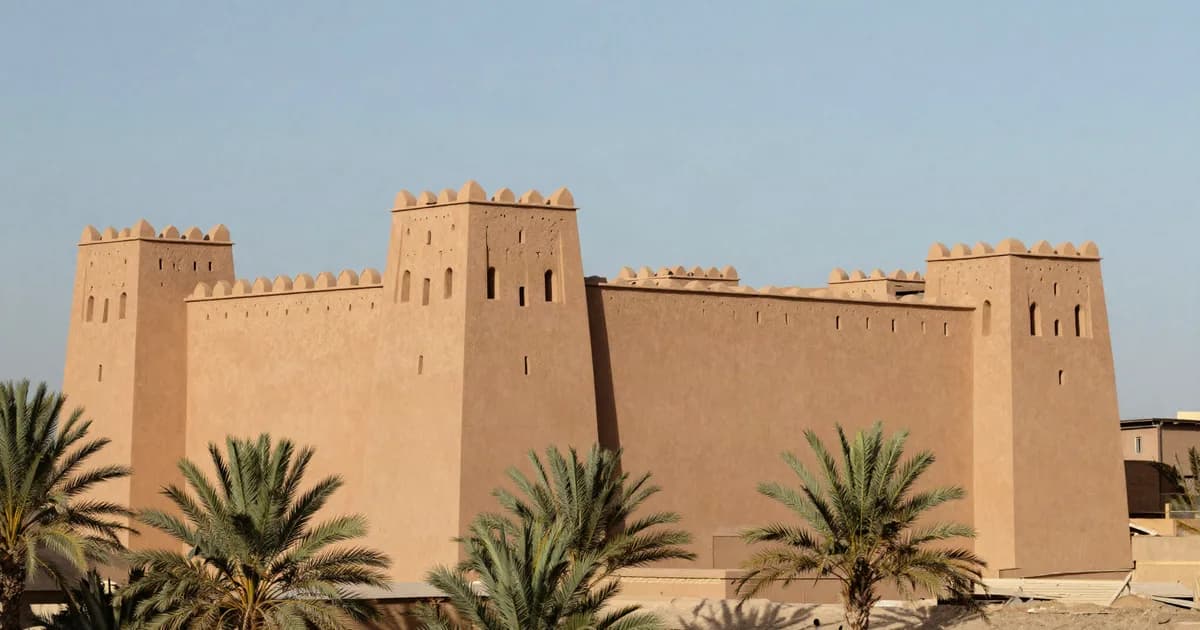
There is no market price for kasbahs, and none is asserted anywhere on this page. What follows is a method for building a figure where no ready-made figure exists.
1. The context: a coveted heritage, a narrow market
From the Draa and Dades valleys to the imperial medinas, Morocco holds an exceptional stock of traditional buildings. Part of it changes hands: families selling an ancestral house, investors hunting for a place of character for a boutique hospitality or cultural tourism project, public bodies and foundations undertaking restoration. The market that results is narrow, opaque and profoundly heterogeneous — unique buildings, few transactions, and considerable spreads between a restored asset that can be operated and a ruin of the same footprint.
A valuation therefore cannot lean on any published level of value for this asset class. It is assembled piece by piece from the site, the condition of the fabric and the field of possible uses. That is a slower exercise than a comparison, and it is the only one that produces a figure a purchaser or a seller can retrace.
2. What makes a heritage asset different
- Earth-built fabric. Rammed earth, adobe, palm timber: capable materials, but demanding ones that decay quickly without maintenance. Condition is qualified zone by zone — restorable, to be rebuilt, decorative elements recoverable.
- The cost of restoration. Specialist labour, traditional techniques, prescriptions on materials where they apply: restoring heritage fabric can absorb a major share — sometimes the whole — of the finished value of the scheme. It is priced from surveys and professional estimates, not by eye, and this page quotes no rate for it.
- Heritage constraints. Listing or scheduling under the legislation on the conservation of heritage, or a protected perimeter: prior consent for works, prescriptions, limits on alteration. Real constraints — but the same status sustains the character on which the commercial appeal of a hospitality or cultural scheme rests.
- Land tenure. Such properties are frequently unregistered, held in wide family co-ownership, with imprecise boundaries. The tenure analysis is an absolute precondition, on the same reasoning we set out on titled property against a moulkia and in our survey of the land tenure statuses and their effect on value.
- Relative isolation. Access, services (water, power, drainage), distance from tourist flows: each of these conditions the realism of a use and the cost of delivering it.
3. The methodology: three blocks and one test
- Scoping. Purpose of the instruction — sale, acquisition, family division, a tourism scheme, a funding file — basis of value, and the assumptions made about condition and about the scheme.
- The land and the site. Footprint, situation, landscape and tourism setting, accessibility, services: the value of the position, independent of what stands on it.
- The fabric and its restoration. A documented state of conservation, and the cost of putting it right as a professional order of magnitude. On a heritage asset the cost logic converges with the one used for insuring historic fabric at reinstatement value: rebuilding like for like bears no relation to standard new-build.
- Use potential — the highest and best use test. Boutique hotel, guest house, events, cultural use: each candidate use is tested against three criteria — legally possible (zoning, heritage constraints, tourism consents), physically deliverable (access, services, configuration), and economically sensible in that particular area. Only a use that passes all three supports a value.
- Synthesis. Where a credible scheme exists: a residual approach — the value of the completed scheme, less the costs of restoration and of running the works, less the promoter's margin — or projected income on stated assumptions, cross-checked against the rare references of heritage assets actually in operation, on the logic set out in our riad-hotel valuation under VPGA 4.
Why no restoration rate appears on this page
A cost per square metre for traditional construction, a heritage discount expressed as a percentage, or a programme length for a restoration are exactly the numbers that travel furthest from the file they came from and do the most damage once they arrive somewhere else. None is published here, and none exists as a general figure. On this asset class the cost of works is established case by case, from the technical surveys available and from estimates obtained from specialists in traditional construction, and it is carried into the report as an assumption with its sensitivity shown — never as a certainty. Reports comply with Red Book standards, delivered in 5 to 8 days (48-72 hours express), from 3,500 MAD excl. tax, with a firm quote within 24 hours.
4. The inputs to assemble
- Tenure and title. Land title, moulkia or the state of any registration in progress, the composition of the family co-ownership where there is one, and the exact heritage status — listed, scheduled, within a protected perimeter — evidenced from documents.
- Technical. Structural surveys of the earth-built fabric, measured drawings, the condition of decorative work, and estimates for restoration from professionals who work in traditional construction.
- Planning and consents. Zoning, the scope for a change of use, and the conditions attaching to the tourism consents required by the intended scheme.
- Market. Whatever references to heritage transactions exist in the region, and the trading performance of comparable establishments, used to test whether the scheme is economically realistic rather than to set a price.
5. The traps that recur
- Paying for the dream at the price of the finished scheme. The photogenic charm of a kasbah says nothing about value. Between the property as it stands and the restored, operable scheme lie years of work and a considerable risk, and the acquisition price has to reflect both.
- Underestimating earth-built restoration. Applying standard construction costs to a heritage contract leads to major overruns. Only professionals who work in traditional construction can price it seriously.
- Ignoring the heritage constraints. Discovering the prescriptions after acquisition rewrites both the budget and the programme. The status of the property is verified beforehand, from documents.
- Adopting a hospitality use without testing it. Without access, without services, without realistic consents and without a local tourism market, there is no hospitality value. Highest and best use is what disciplines the enthusiasm.
- Treating tenure as a footnote. Wide co-ownership and unregistered land complicate a sale. That risk is dealt with at the outset, not at the bottom of the last page.
6. What the report is for
A heritage valuation serves the situations in which the asymmetry of information is at its greatest: the acquisition of a unique property with no price reference; a family sale, where the point is to set a defensible price without giving away an ancestral asset; a division between heirs; a funding or grant file for a restoration scheme; the contribution to a company of a property intended for a tourism project. Prepared by RICS-certified experts, the report sets the value in its present state, the cost of restoration and the value of the scheme side by side, on assumptions that can be traced — a position that is documented and verifiable line by linein an arm's-length negotiation, on a segment where asking prices are often a matter of sentiment.
The process follows the stages described in our guide to how a property valuation is conducted in Morocco, and the fee framework is set out in our note on what a valuation costs. Usual delivery is 5 to 8 days, 48-72 hours on the express service, from 3,500 MAD excl. tax, with a firm quote within 24 hours. ReaConsult has been advising owners and investors since 2019, with more than 5,000 valuations completed, offices in 6 cities and client reviews published on our Google profile.
7. The questions owners ask
Can a kasbah be valued with no comparable at all? Yes — and that is the ordinary case. The value is built by decomposition: land and site, fabric and cost of restoration, use potential tested by highest and best use. Each block rests on verifiable material — surveys, professional estimates, regional trading references — and the report states its assumptions instead of simulating a comparison that cannot honestly be made.
Does heritage status raise value or depress it? Both effects run at once. The constraints make works dearer and limit alteration; the status protects the character and the setting, which are strong commercial arguments for boutique hospitality and cultural tourism. The balance depends on the scheme, and the report analyses it case by case rather than applying a standard adjustment.
Can a kasbah held in family co-ownership be valued?Yes, and it is a frequent instruction: the valuation gives a neutral basis for a division, a buy-out of shares or a joint sale. The tenure analysis — title, moulkia, the composition of the co-ownership — forms an integral part of the work, alongside the family's own legal advisers. The same reasoning underlies our note on a counter-valuation between siblings over a house in the Fez medina.
Buying, selling or restoring a heritage property in Morocco? Have the site, the fabric and the scheme documented before a price is agreed.
Request a valuation →Related articles
Note:this article sets out a valuation methodology complying with Red Book standards, for information. No restoration cost per square metre, heritage discount, level of value for any region and no programme length is quoted, because no such general figure exists for this asset class. Heritage status, constraints and consents fall under the regulations in force — confirm the position of your own property with the competent authorities and with your own advisers. A private valuation informs a decision and an arm's-length negotiation. To instruct us, see our contact page or the property blog.