
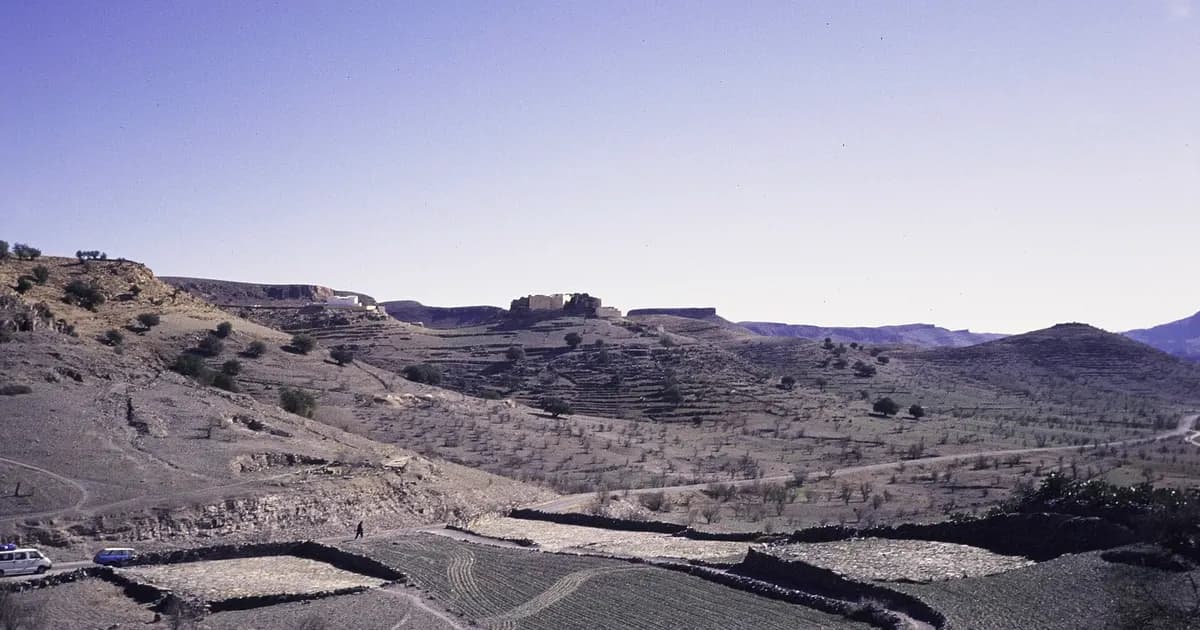
Four engines, four logics. A scenery warehouse, a valley guesthouse, a restored kasbah and a town-centre flat share neither buyers, nor risks, nor method — and applying one's references to another is simply wrong.
1. Four economic engines that do not overlap
Ouarzazate resembles no other Moroccan town from a valuation standpoint, because its economy rests on four pillars that barely intersect. The first is film: the town is home to studios of international standing — notably the Atlas Studios and the CLA Studios — and has served as a location for foreign productions for decades. A genuine service economy has grown around that activity: logistics, crew accommodation, extras, set construction, equipment hire. It generates demand for warehouses, workshops and temporary accommodation found nowhere else in the south of the country.
The second pillar is heritage tourism. The Taourirt kasbah sits at the heart of the town; the ksar of Aït Ben Haddou, inscribed on the UNESCO World Heritage List, lies nearby. Around them, the Drâa, Dadès and Roses valleys, the oases and the road of the kasbahs support a stock of guesthouses, inns and small character hotels, often run by Moroccan or European operators settled there for years.
The third is the Noor Ouarzazate solar complex, one of the country's major solar developments, sited north-east of the town. Through its construction and then its operation it supported demand for accommodation, offices, depots and technical services, and left lasting traces in the local property fabric. The fourth lies in the function of the town itself: its airport and its role as an administrative and service centre for a vast rural hinterland, which sustains demand for housing, retail units and offices independently of tourist cycles.
For a valuer this combination has one direct consequence: the market segments are narrow, specialised and weakly comparable to one another. It is a mistake to carry references across from one to another, and an honest report says where the evidence is thin instead of smoothing it away.
2. What comes across the desk
- Kasbahs, ksour and traditional earth-built houses — capital value, reinstatement cost for insurance, succession division; with the condition and freshness of the restoration as the central question.
- Guesthouses, inns and small character hotels — valued by separating the property from the business, crossing comparison with the income approach.
- Warehouses, scenery workshops and sheds tied to the film and logistics economy — low-comparability assets, valued by depreciated replacement cost, or on income where they are let.
- Flats, houses and retail units in the centre and the extension districts — capital value, funding files, undivided family interests.
- Peri-urban and valley land — where tenure, boundaries, water easements and zoning carry the risk.
3. Raw earth: the defining valuation issue
This is what most sharply distinguishes Ouarzazate from coastal or metropolitan markets. Kasbahs, ksour and traditional houses are built in raw earth — rammed earth, adobe — a construction system that does not forgive neglect. Protection of the wall heads, the condition of the renders, the drainage of rainwater away from wall bases: these are permanent maintenance items, not occasional works. A year without maintenance shows, and two buildings of similar appearance can conceal very different structural states.
Value therefore depends directly on three things a valuation must document precisely: the quality and freshness of the restoration; the craftsmanship deployed — a repair in unsuitable materials can accelerate deterioration instead of arresting it — and the availability of artisans able to work on this kind of fabric, which governs the cost and the feasibility of future maintenance.
The least understood consequence concerns reinstatement value. The cost of rebuilding properly restored earth construction bears no relation to that of a concrete building: materials, specialist labour, programme duration and workmanship requirements all differ radically. Standard policies handle this badly, and the gap is usually discovered at the moment of loss. A reinstatement cost assessment, prepared before any event, is more than a comfort here — our complete guide to reinstatement cost assessment explains how the sum insured is built, and our note on insuring a riad or heritage property covers the same problem on traditional urban fabric.
4. Guesthouses, film-industry assets and land: three separate readings
Guesthouses and inns require a clean separation between the value of the property and the value of the business. Tourist accommodation in Morocco is subject to authorisation and to a regulated classification: a licence does not automatically pass to a purchaser, and trading without authorisation is a risk, never a value. Two regional factors compound the reading: the pronounced seasonalityof Saharan tourism, which makes any single year's figures misleading, and exposure to international conditions, the clientele being largely foreign. A serious report states both reservations rather than smoothing them out. The methodological frame is the one we set out for a riad or guesthouse shifting from residential to trading property, and, for more structured operations, in our guide to hotel valuation under VPGA 4.
Film and logistics assets — warehouses, scenery workshops, sheds — form a segment of low comparability: transactions are rare and the buildings rarely substitutable. They are most often valued by depreciated replacement cost, or on incomewhere a lease is in place. The valuer has to look hard at the building's real versatility: a volume designed for one very specific use converts badly, and that rigidity weighs on value.
Land, finally, concentrates the familiar southern Moroccan cautions in amplified form. Peri-urban and valley plots present varied tenure: unregistered holdings, and collective regimes in certain rural areas — the distinctions are set out in our guide to Morocco's land tenure statuses. Boundaries are frequently imprecise and call for an adversarial boundary survey before any serious transaction. In the oases, water and irrigation easements are not details: they govern agricultural use and sometimes access itself. Near heritage sites, add zoning and landscape protection constraints. And one reminder that bears repeating: moving a plot to developable use is an administrative decision, not a valuer's assumption — a report that prices an unsecured “development potential” is selling a hope, not a value.
Four segments, four methods
- Kasbah or earth-built house → condition and restoration documented first; capital value by comparison where evidence allows, and a separate reinstatement cost assessment for insurance.
- Guesthouse in trade → property and business separated; income approach, with the licence position and seasonality stated as reservations.
- Scenery warehouse or workshop → depreciated replacement cost, or income where let; versatility of the volume assessed explicitly.
- Valley or peri-urban land → tenure, boundaries and water easements secured before any figure; current designation only, never a hoped-for one.
5. How an instruction runs, and from where
Ouarzazate sits outside the six cities we operate from — Casablanca, Rabat, Marrakech, Tangier, Fez and Agadir — but the town is connected to Marrakech, which is one of them, and that makes missions into the province and the Drâa valley straightforward to organise. We attend on request, from that network, with travel time factored in and travel costs quoted separately; we hold no local office. The valuer carries out the inspection — condition of the fabric, floor areas, immediate surroundings, access — documents it with photographs and video, and the report is delivered remotely to whoever instructed it, wherever they live. Fees start at 3,500 MAD excl. tax, with a firm quote within 24 hours and delivery in 5 to 8 days — 48 to 72 hours on the express service.
The instructions we receive follow a few recognisable scenarios: the purchase or resale of a guesthouse by a European operator; supporting a funding file; a succession among dispersed heirs — common in a province where part of many families lives elsewhere in Morocco or abroad; the reinstatement value of an earth-built property; a contribution in kind of a trading asset to a company; and the decision facing a non-resident owner who must choose between holding, letting and selling without being able to visit. For that last case, our guide on instructing a property valuation in Morocco from abroad sets out what to prepare.
6. What the report gives you
Founded in 2019, ReaConsult has completed more than 5,000 valuations (client reviews published on Google) and works from six cities in Morocco. Our RICS-certified expertsdocument the condition of the property, the floor areas, the comparables actually available and the value adopted, together with the explicit reservations that a market as specialised as Ouarzazate's demands. Reports comply with Red Book standards.
What makes such a report useful in an amicable negotiation — between co-heirs, with a purchaser, or in a decision taken from abroad — is not authority conferred by anyone. It is that the reasoning is documented and verifiable line by line: scope defined, method justified, assumptions stated, evidence listed, and the thin patches named as thin. A private valuation informs a negotiation or a decision; it does not settle a question that belongs to another process.
A kasbah, a guesthouse or a plot at Ouarzazate or in the Drâa valley? Have the segment identified and the value documented before you commit.
Request a valuation →Related articles
Note: this article sets out market situations and a valuation methodology; it carries no market price data and is neither legal advice nor an estimate. Tenure, property boundaries, trading authorisations and zoning are matters for your notary, a licensed surveyor and the competent administration. A private valuation informs a negotiation or a decision. To have your property valued, see our contact page or the property blog.