
Before you buy: the survey nobody automatically arranges
British buyers expect a surveyor. French buyers expect a battery of statutory diagnostics. In a Moroccan transaction, neither happens by default. The notary or adoul handles the legal security of the deal — title, encumbrances, capacity, registration — and does not inspect the building. Nobody will tell you the roof is failing unless you engage someone to look at it.
So commission it yourself, before signing, or make the preliminary agreement conditional on a satisfactory technical assessment. Our guide to the pre-purchase inspection as a legal safety net explains how that condition is normally framed. What a competent assessment of an older Moroccan property looks at:
- Structure and movement. Cracking patterns tell a story — some are cosmetic, some are the building talking. Our note on diagnosing cracks in Moroccan buildings covers how severity is read.
- Damp. Rising damp and infiltration are the dominant pathology in old Moroccan houses, and the most expensive to treat properly — see damp and water infiltration.
- Roofs and terraces. Flat terraces, traditional drainage and decades of patch repairs. The single most common source of the water that causes everything else.
- Services. Electrics and plumbing in a house built before either was standardised. Frequently a full replacement rather than a repair.
- Party walls and neighbours. In a medina, your walls are shared. Your neighbour's leak becomes your damp — and your works need their cooperation. See party walls in Morocco.
- Legal standing of what exists. Extensions, added floors and mezzanines that were never authorised are common, and they are a value and resale problem, not merely a paperwork one.
None of this is exotic. It is simply work that, in Morocco, the buyer must think to commission — and that a foreign buyer viewing the property twice, in good weather, will otherwise never see. If a defect surfaces after completion, the remedies exist but are slower and less certain than prevention: see hidden defects after purchase.
Considering an old property and want to know what it is worth after the works, before you commit?
💬 Chat with a RICS-certified expert on WhatsAppTraditional craftsmanship: the part that cannot be rushed
Old buildings need old techniques
A medina house built of rammed earth, lime mortar and cedar behaves differently from a concrete-frame apartment. Lime allows walls to breathe and to release moisture; sealing the same wall with dense modern cement render traps the water inside and pushes the damage upwards and inwards. A great deal of expensive remedial work in Moroccan medinas is the correction of a previous, well-intentioned, entirely modern repair. When you brief a contractor for an old house, the first question is not price — it is what they intend to build it back with.
The maalem economy
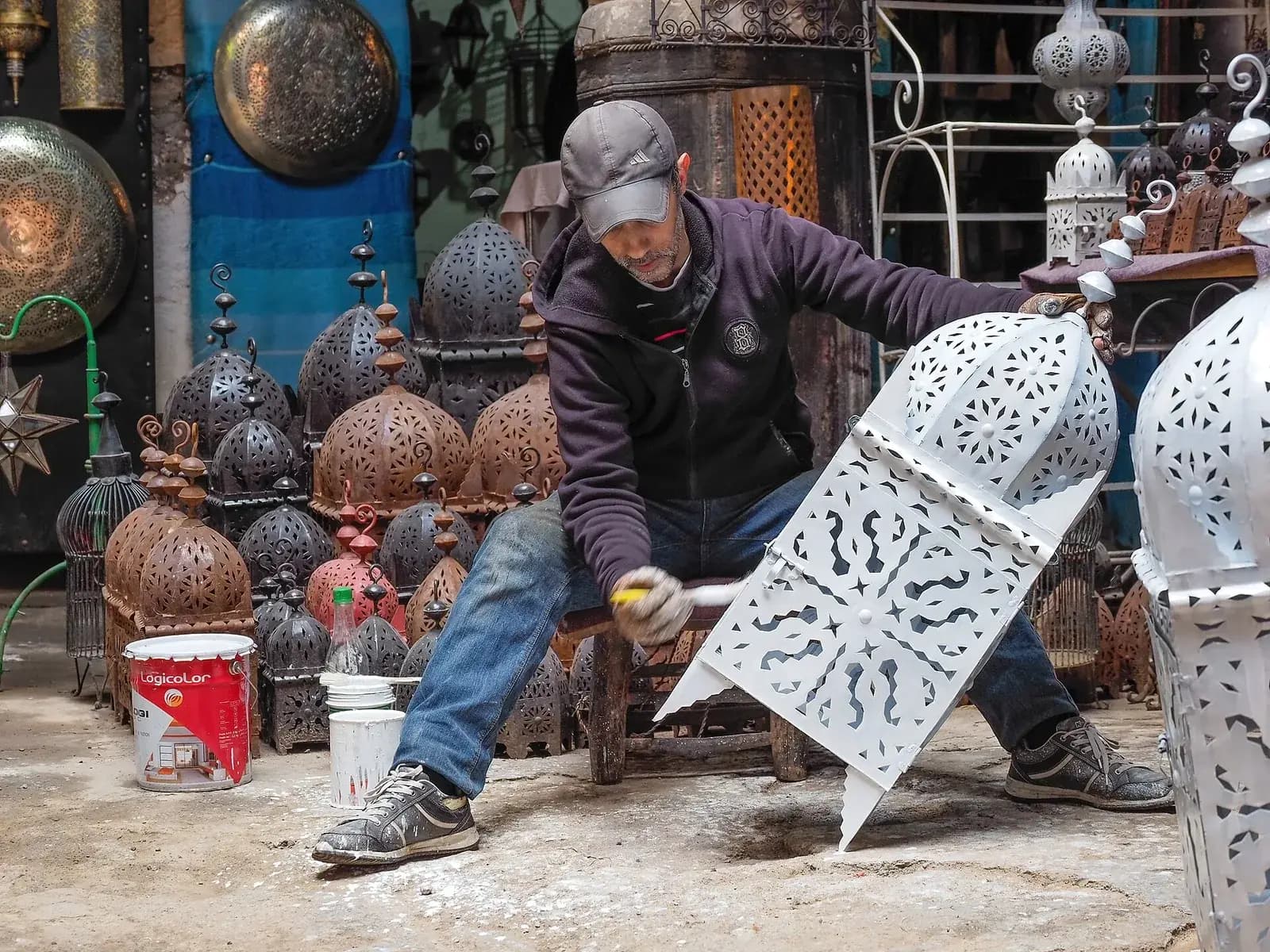
Tadelakt, zellige, carved plaster, painted and carved cedar, wrought iron: these are living crafts practised by maalems, master artisans whose good reputations travel by word of mouth and whose diaries are full. Two consequences for your budget. First, quality varies enormously and is visible only in finished work — always ask to see completed sites, not photographs. Second, the schedule is set by the availability of the right hands, not by your holiday calendar. Ambitious decorative work on a riad is a seasons-long undertaking, and treating it as a summer project is the fastest way to get mediocre finishes at premium prices.
Access changes everything
In a medina, no vehicle reaches the door. Materials arrive by handcart or by donkey; rubble leaves the same way. That single fact reshapes the cost structure of a project relative to an identical house on a suburban plot, and it should be discussed explicitly when you compare quotations. It also explains why apparently similar riads a few hundred metres apart can carry very different renovation economics — a point developed in our guide to buying a riad in Marrakech.
Contracting: write it down, stage the payments
Most renovation disputes involving foreign owners come down to the same three absences: no written scope, no priced breakdown, no link between payment and verified progress. The corrective is unremarkable and works:
- A written scope of works, room by room, item by item, in a language you actually read, with what is excluded stated as explicitly as what is included.
- A priced breakdown rather than a single global figure — you cannot control variations against a number that has no components.
- A payment schedule tied to stages that someone independent has confirmed are complete. Never pay ahead of verified progress.
- Invoices for everything. Beyond the obvious, documented works build your cost base for the eventual gain computation and support the file if you later need to transfer sale proceeds abroad.
- Insurance and warranties. Ask what cover the contractor holds and what statutory construction warranties apply to the works — see the decennial warranty. Whether a given warranty covers your particular works is a question for a lawyer, before signing.
- Permissions. Structural changes, added floors and façade alterations are regulated, and in historic quarters additional heritage constraints apply. Confirm what is required with your architect and the local authority before demolition, not after.
Supervising from 2,000 kilometres away
The structural weakness of the absent owner is that the person doing the work is also the person reporting on it. Break that loop: engage an architect or a project manager directly, on your own contract, whose duty is to you and whose fee does not depend on the builder. Their job is to hold the scope, verify stages before payments are released, and send you dated photographic reporting on a fixed rhythm.
Two further habits earn their keep. Visit at the unglamorous moments — after demolition and before the finishes go on, when problems are still visible and cheap to fix. And be careful with powers of attorney: give a narrow, specific mandate for a defined act, never an open-ended authority over the property. Our guides to remote construction supervision and to powers of attorney go into the detail.
Will the money come back? Value the outcome, not the dream
Renovation spending is not automatically converted into value. Markets pay for location, usable surface, light, condition and clean legal standing; they do not reimburse an owner's personal taste, and there is a ceiling in every street beyond which no amount of craftsmanship registers in the price. The disciplined sequence is to establish the likely finished value first, then size the works against it — rather than discovering the ceiling at resale.
That is precisely what an independent valuation does. A ReaConsult report gives you a market value grounded in genuine comparable evidence, signed, in English, and usable as free evidence in negotiations and adversarial proceedings; if a matter goes to court, the court appoints its own expert. It is equally useful before you buy — to test the asking price of a property sold on its potential — and before you commit to a scope of works. Fees start from MAD 3,500 net of tax (~£280 / ~€330). ReaConsult: founded 2019, RICS-certified experts, 5,000+ appraisals across 6 cities, client reviews published on Google. Reinstatement cost for insurance purposes is a separate exercise we also carry out; questions of building regulations, permits and contracts should be put to your architect and lawyer.
Know the finished value before you sign for the ruin
Send us the property and your renovation intentions. English reply within 24 hours with a firm quote.