
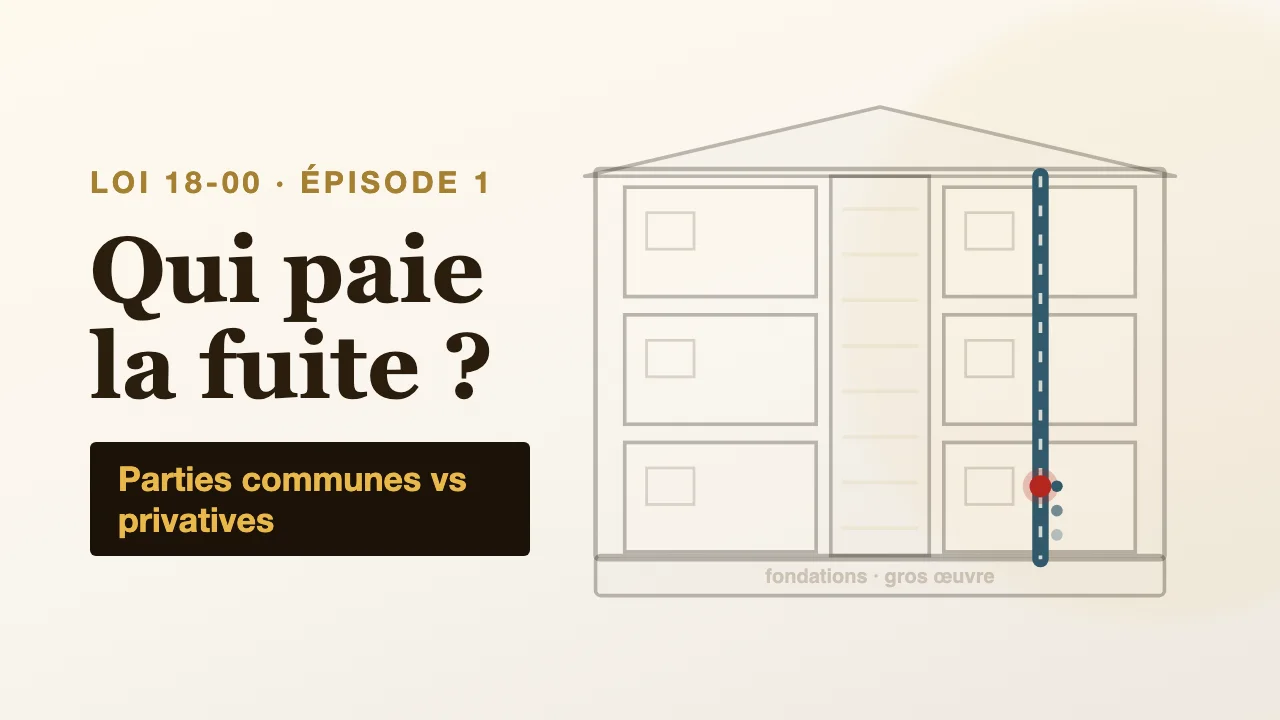
The video is narrated in French with English subtitles. The written breakdown below is self-contained. French version: parties communes ou privatives.
1. The distinction that governs everything
Law 18-00 splits the building in two, and one question settles who pays: on which side does the damaged element fall.
Article 2 defines a private area as one belonging to each co-owner « for the purpose of enjoying it individually and personally »: it is their exclusive property. Article 3 defines a common area as one intended for the use and enjoyment of all co-owners or of some of them.
That last clause is decisive and almost always overlooked: an area can be common without being common to the entire building. This is the legal basis for special charges borne only by the units concerned.
2. The article 4 list — and the sentence that settles the leak
Article 4 lists what is deemed common:
- the land, structural works, foundations and load-bearing walls;
- the façade, roofs and cellars intended for common use;
- staircases, passages, corridors, entrances, basements and lifts intended for common use;
- walls and partitions separating two private areas;
- shared equipment, including the related parts that cross the private areas;
- ducts, chimney heads and air vents for common use, and the refuse storage areas.
The fifth item settles the leak: a shared pipe does not change nature because it crosses a private unit. It remains common, and its repair falls under common charges.
Article 4 bis, added by Law 106-12, adds the mirror rule: a non-load-bearing wall separating two units is common « between those units only ». The cost is then split between the units concerned, not across the whole syndicate.
3. Who pays: articles 36 and 6
Article 36 sets the principle: every co-owner contributes to the preservation, maintenance and management of the common areas. It adds a second layer, a frequent source of disputes: contributions to collective services and shared equipment are apportioned according to the usefulness of those services for each unit. A ground-floor unit and a top-floor unit do not derive the same benefit from the lift, and the bylaws may reflect that.
The general allocation key comes from article 6: each share is set according to the extent of the private area relative to all private areas in the building, as at the creation of the condominium — unless the title deeds or the general assembly decide otherwise. In a building with 260 sq m of private areas, a 120 sq m unit bears 46.2 % of common charges; a 60 sq m unit bears 23.1 %.
4. Before you pay: which majority approved the expense?
- Relative majority (article 20) — maintaining the building and ensuring the safety and quiet enjoyment of occupants, installing shared aerials and satellite dishes, accessibility works for people with disabilities, appointing the caretaker.
- Three quarters of the votes (article 21) — drawing up or amending the bylaws, approving the budget and setting charges, major maintenance works, collective insurance, appointing and removing the manager (syndic) and deputy.
- Unanimity (article 22) — erecting a new building or adding floors, assigning the right to add floors, works altering the common areas, converting a common area into a private one, excavation rights, full demolition.
Timing matters as much as the majority: article 59 duodecies requires challenges to general-assembly decisions to be brought within two months of notification, failing which they are time-barred. The manager must notify the minutes within eight days (article 16 nonies) — that document starts the clock. See also our article on general-assembly rules under Law 106-12.
Source. Law No. 18-00 on the status of condominium ownership of built properties, as amended and supplemented by Law No. 106-12 (Dahir No. 1-16-49 of 27 April 2016, Official Bulletin of 3 November 2016) — consolidated text published by the Legislation Directorate, Ministry of Justice. General information only; this page is not legal advice.
A dispute over charges or common areas?
When the argument turns on how an expense is apportioned, what a unit is worth, or the true extent of the private areas, an independent technical opinion puts the negotiation back on measurable ground. Our RICS-certified experts handle these matters through our condominium advisory service, from MAD 3,500 excl. tax, with a firm quote within 24 hours.